Stephanie Malia Krauss Shares Insights Into How We Thrive
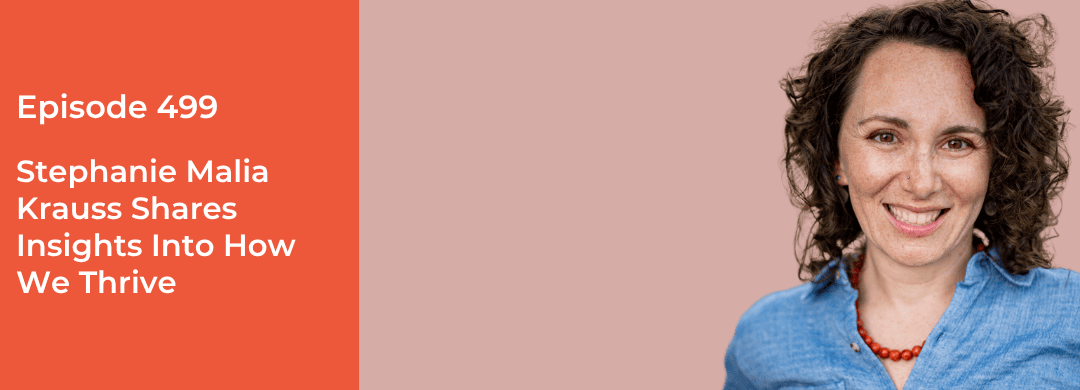
Today we’re talking about what it really means to thrive in a world that often feels overwhelming—for our kids and for us. My guest is Stephanie Malia Krauss, author, speaker, and strategist whose new book How We Thrive: Caring for Kids and Ourselves in a Changing World explores the urgent need to protect the human essentials—things like sleep, play, connection, and wonder—that modern life so often erodes. Stephanie and I explore the idea of “rehumaning” how we live, learn, and parent. We talk about the interconnectedness of body, mind, heart, and spirit, and the importance of collective care in raising kids in today’s world. Stephanie shares practical, grounded ways to navigate overwhelm and make small shifts in daily life that can help families move from merely surviving to truly thriving.
About Stephanie Malia Krauss
 Stephanie Malia Krauss is an author, speaker, and strategist helping leaders rehuman how we live, learn, and work. Her newest book, How We Thrive: Caring for Kids and Ourselves in a Changing World, examines the urgent need to protect the human essentials—like sleep, play, connection, and wonder—that modern life diminishes or denies.
Stephanie’s commitment to this work began as a teacher and coach, where she witnessed how different environments can deplete or restore people. She later founded a school for young people furthest from opportunity, and now leads national and state efforts in education and youth development. Working with leaders from classrooms to Congress, Stephanie advises states, districts, and national organizations through her consulting shop, First Quarter Strategies. Stephanie is also the author of Whole Child, Whole Life: 10 Ways to Help Kids Lives, Learn, and Thrive and Making It: What Today’s Kids Need for Tomorrow’s World.
Things you’ll learn from this episode
- Why collective care and community are essential antidotes to modern overwhelm and burnout
- How the practice of rehumaning helps us reconnect with our core human needs
- Why honoring the interconnectedness of body, mind, heart, and spirit is key to real resilience
- How small, intentional shifts in daily rhythms can meaningfully improve family well-being
- Why thriving means living in full animation—rooted in love, belonging, and advocacy—not just enduring
Resources mentioned
- How We Thrive: Caring for Kids and Ourselves in a Changing World by Stephanie Malia Krauss
- Rehumaning Childhood (Stephanie’s Substack)
- Geoffrey Cohen on Belonging: The Science of Creating Connection and Bridging Divides (Stanford Digital Education)
- Whole Child, Whole Life: 10 Ways to Help Kids Live, Learn, and Thrive by Stephanie Malia Krauss
- Making It: What Today’s Kids Need for Tomorrow’s World by Stephanie Malia Krauss
- How We Can Prepare Differently Wired Children for an Uncharted Future, with Stephanie Malia Krauss (Tilt Parenting Podcast)
- How to Help Our Kids Thrive in Tough Times, with Stephanie Malia Krauss (Tilt Parenting Podcast)
- Making It: What Today’s Kids Need for Tomorrow’s World by Stephanie Krauss
- Dr. Eric Soto-Shed (Harvard researcher)
Want to go deeper?

The Differently Wired Club is not your typical membership community.
There’s something here for everyone, whether you’re a sit back and absorb learner, a hands-on, connect and engage learner, and everything in between. Join the Differently Wired Club and get unstuck, ditch the overwhelm, and find confidence, connection, and JOY in parenting your differently wired child.
Learn more about the Differently Wired Club
Episode Transcript
Debbie:
Hey Stephanie, welcome back to the podcast.
Stephanie Malia Krauss:
Thanks Debbie, I could not be more excited to be here with you.
Debbie:
Always happy when your name pops up on my calendar. I’m like, I get to talk to Stephanie today. So this is going to be a good conversation. And I want to kind of set the stage for us, if you will. So the last time you were on the show, it was to talk about your book, Whole Child, Whole Life, 10 Ways to Help Kids Live, Learn, and Thrive. And so you have a brand new book out called How We Thrive. And I was thinking about how typically authors write a book for adults and then it’s like translated for younger readers like the seven habits of success or the don’t sweat the small stuff for teens.
And I was thinking about your book. I’m like, you kind of did the opposite because you wrote the book for parents to help their kids. And now you’ve widened it out and you’re bringing us into the loop as adults. So I’d love to know the origin story for this book. Like, why did you decide this is going to be the next thing that you focused on?
Stephanie Malia Krauss:
That’s a really good question. I think to understand it, we have to go back one more book, which is when you and I first met, which was called Making It. And it was about what young people needed to be ready for the future. And it dropped in 2021 when all of our households were homeschools and we were shoved in in the earlier days of the pandemic. And so I went on this virtual book tour, including coming on your podcast and was talking all about the future and what kids needed to be ready and heard from parents and teachers and coaches and counselors that they were worried that their kids weren’t well. And the real concern was how can we talk about what they need to be ready for the future if we’re really concerned they might burn out before they get there. And so I wrote Whole Child Whole Life.
The world had opened back up. I went out on a real tour, both virtually and in person on stages and in classrooms and school buildings and with parenting groups. And I surveyed every single group that I spoke to and I asked the same three questions. How are your kids? How are their families? And how are you doing? And what was striking because it reflected my own interior, but also alarming, was that every single community I spoke to, no matter where it was geographically, no matter sort of the demographics of the place, everyone said kids and us, the grownups, were all overwhelmed, overloaded, stressed, and exhausted. And so my books have really reflected where we are with our kids and in our own lives, this kind of look to the future and then a pullback of wait, what do the kids need to be well right now? And then us saying, God, we’re not okay either. Like, why are we living like this? We’re worried about our kids living the way they are. And also we’re fraying. And so How We Thrive is interesting because while I started with this look to the future, How We Thrive is this look back to the past to say like across human history and other challenging times in history, what have we as humans been able to tap into whether we’re young or older that really have a profoundly outsized impact on how we’re feeling and how we’re doing and how we’re living. And so this is a book about collective care. It says much about us, the grownups as it is about young people.
Debbie:
I loved Making It. That was when I first was introduced to your work. And I think it’s absolutely still relevant today, even though when it came out, it felt very breakthrough for me in terms of what it was presenting. And as you’re talking about what you were hearing from families when you were touring for your last book, Whole Child Whole Life, and that was a couple years ago, things have changed substantially in terms of our collective nervous systems, I think in the past year or so. So I’m just wondering, how are you thinking about this book coming out now in this particular climate?
Stephanie Malia Krauss:
We’re talking right after I recorded the audio version for How We Thrive. And obviously the podcast listeners, when you’re hearing it, it’s a little bit farther down the road, but I just had this experience myself of kind of being closed off in a sound booth and hearing again the research. So How We Thrive chronicles the evidence and research from over 100 scientists and experts in the field across all kinds of disciplines from how we sleep and move to how we create and play and the importance of things like contribution and faith. It’s really a tour de force. And I was really impacted myself by that research at how much more resonant it is depending on how depleted I feel. The more depleted I feel, the more I need to know how I can human, how can I possibly human in what feels like a pretty dehumanizing time.
And so if we go back to those surveys, I continue when I talk to groups to ask, how are the kids, how are their families, how are you? And it generates, if you’ve ever seen like a word cloud where the number of responses is the size of the answer on the screen. And so what I’ve been seeing is while across the past five years, people have been overwhelmed, overloaded, stressed and tired, now the size of the word overwhelmed and the size of the word burnout for both kids and grownups is just larger.
It’s encompassing a bigger space. And one of the things that I really dig into in How We Thrive that I believe is the contributing factor to this is what I call the dangerous weather of modern life. That there are some forces that are surrounding us that intensify in the same way that the weather can. And the storms are for many of us getting stronger. And our ability to withstand that is really dependent on the supports that we have internally and externally, but things like overwork or addictive tech or increasingly artificial tech. And even just the existential dread, as that goes up, if we are not deliberately intentionally re-humaning our life, getting ourselves back and centered to what it means to be healthy and human and whole, we are going to feel those winds and that weather so much more. And it’s really going to impact not just us, but kids.
Debbie:
I wanted to actually share the blurb that I wrote for the book. I was lucky enough to read an advance copy. It’s one of the benefits of my job. And what I wrote is that How We Thrive is exactly the book we need right now, a gentle grounding guide for parents and others caring for kids who are trying to stay steady in an unsteady world. With our trademark calm and clarity, Stephanie Malia Krauss offers a roadmap for tending to ourselves so we can meaningfully show up for our kids. It’s a deeply human, holistic reminder that we matter too.
That was kind of the overwhelming feeling. It’s like we do matter and I think we don’t spend enough time remembering that because we’re so distracted by all of the things and the demands of our lives. Can we circle to this concept of human? You use the word human a lot throughout the writing of the book. And you just mentioned re-humaning. Can you talk a little bit more about how you arrived at that term and what exactly it means?
Stephanie Malia Krauss:
Absolutely. So as I started the research for How We Thrive, the real question was how do we thrive? What does that require? What can we actually do with what we already have, no matter who we are, where we live, what we’re going through, and how depleted we are already feeling? What do we possess that we can tap into that’s going to help us be healthy, help us be well, help us not just endure life, but enjoy it? I think that was the phrase that really stuck with me as we were going through as a family the last couple of years and I was researching and writing the book at the same time.
My boys, I have a tween and a teen, and they’re going through life right now and they’re experiencing these forces in their own way. And for me, parenting them through that and being a person during that. So this idea of how do we both endure and enjoy life really reflects the tension of this moment, this really honest acceptance that things are hard. They’re tricky, they’re challenging, they’re difficult. But the reality is that we’re a quarter of a century into hard. This is a century that started with 9-11 and moved into smart technologies and the Great Recession.
And then we’ve all lived through the past five, six years, the pandemic times and forward. So we need to understand that the weather will be here or it will worsen, which means that there is this element of enduring. We have to get through it, but that’s not a good life. And that’s what I want for myself and my kids. So that was the question, what does it take to have a good life? And what was so powerful about it is that as I dug into the research, what I found was across species, animals included, we all have different things that keep us alive. Some animals have speed or strength or stealth, and we have some critical essentials, what I call human essentials in the book, that in a wonderfully organized way can break into body, mind, heart, and spirit, that across millennia, 300,000 years of humans looking like and acting like we do, we’ve tapped into to be healthy, to be connected, to feel like ourselves, and to get through incredible challenge.
Being a parent of differently wired kids, you yourself the same, we know what it’s like to go through challenge. In many ways, this is our moment. We’ve been going through challenging times. Our kids have been going through challenging times always. So what the science says is that we can tap into things that we are actually already born knowing how to do. These are what I think of as evolutionary endowments. And it’s like aligning or adjusting yourself and suddenly feeling like you can stand up straight all of a sudden. As soon as we do them, it’s this kind of cosmic adjustment. It’s like, this is how I’m supposed to live. That felt really good. And so on the body side, you have things like how you feel when you get enough sleep or you’re moving your body the way that you’re meant to or eating fresh food for a period of time instead of the fake stuff.
On the mind side, it’s things like play or flow that are increasingly hard to come by. And so where I arrived in the book, which was in a strange way deeply hopeful, is that it seems that a lot of our difficulties and depletion come from the fact that we’re living inside of a modern context that simply makes it harder to tap into these things. It’s harder to get the movement that we need. It’s harder to get the sleep that we need. It’s harder to find ways to flow because the research says if you’re in flow and somebody interrupts you, it’s going to take at least 20 or 30 minutes to get back and focus again. And I’m interrupted all the time. So this idea of re-humaning is a deeply hopeful idea, which is what does it look like in the same way that we practice mindfulness, that in a world that is intent on making it harder to tap into the essentials that we are born with, our own superpowers that our kids have, to protect it, to protect those essentials at all cost, to prioritize them.
What does it look like to be countercultural with our own kids and say your sleep is more important than this sports practice tonight or that assignment and I’m going to stand by you if your grade dips or you have to regulate what’s not making you feel safe or going in a space that nurtures creativity. It’s deeply liberating because this is what we’re born made and meant to do. Our kids are wired for this in the same ways that we are. We all just get there in a different way, but they too are meant to play and sleep and eat good food and create and experience love and belonging. And then it’s our job to figure out how do we protect that for them given who they are, given where they’re going to school, given what their circumstances are.
Debbie:
I love how you put this in the context of human history broader, that we’re just this little speck in the grand scheme of things and that context really helps. So as you said earlier, you organize the essentials in your book around body, mind, heart, and spirit. Are they all equal? Or is there an order in which you suggest people approach reconnecting with those essentials?
Stephanie Malia Krauss:
It’s a good question. I think they’re all equal in the sense that these are all natural inborn capacities that we have, that when we’re doing them physically, so physiologically and psychologically, we feel better, we do better, we perform better, we’re more able to withstand challenge and change. And when we’re not getting them or when we’re not doing them, we’re harmed. Obviously things like on the body side, getting sleep and eating fresh healthy food, which by the way in the book, if listeners are struggling financially, I have charts on what are some fresh inexpensive options, what are some options that we can afford. Interestingly, the research shows that frozen fruits and veggies, because they’re picked at the prime of ripeness, can be cheaper and healthier for us, which I thought was really interesting.
So from a basic how do we keep our body functioning and alive, I would say obviously the body essentials are key. We need sleep, we need food, we need to feel safe and regulated, we need to be moving our bodies. When you look at some of the other essentials, let’s think about heart. In the heart essentials, there’s being able to connect with other people. I think about this as social health. There’s belonging and love. From studies, we now know that experiencing loneliness causes intense physical pain. It’s the body’s alarm system saying something is not right here. Back to this look back through human history, if we go all the way back to our Stone Age ancestors and hunter gatherers, they are tribal and their ability to survive out in the wild was their ability to band together. It’s why we call them bands. To band up. If you wandered away from that group of people who you were traveling with or you were living with, your body sent out all of the flares to say go back, go back. You got to stay with people to stay alive.
Sometimes we underscore the importance of the essentials that aren’t truly hard physical like did you get the sleep that you need. But the relationship with them is so profound. If you’re feeling lonely, you’re not going to be sleeping as well as you should, or maybe you’re sleeping too much. You are more likely to feel depressed and then you’re not going to move your body. At the end of the book, I talk about our human ecosystem, the way that all of our systems are connected. In the same way that if we think about our actual physical body, we know that if our heart is racing, our lungs have to increase or decrease the amount of breathing to compensate. With these human essentials, if we are not getting the love that we need, there’s something else happening on the body side. There’s something else happening on the mind side.
Another great example of this, especially for people who have kids who are still in school, is around sleep. If young people aren’t getting the sleep that they need, the consequences to their ability to learn, to feel safe and regulate, to play, to be able to really tap into anything, to emotionally feel settled is through the charts. We know this. We have the research in our own lived lives. So what’s more important than figuring out what’s more important or not is to actually do an assessment or an audit on yourself. I’ve got some great tools at rehumaning.com and in the book of just what are the daily questions that you’re asking yourself. If we think about the body again, am I getting the food that I need for my body based on where I am and what I’m going through? Am I getting the sleep that I need? Do I feel regulated and safe where I am and with what I’m going through? Am I moving my body the way that I need? You and I are at a stage of life where I didn’t realize I write about it in the book, but I didn’t know I was supposed to be strength training. And so here I am doing the research and I’m like, no, I thought I was fit. But now I know at this age and stage and situation, I need to be lifting weights. Then you move into these other ones that are deeply convicting of like am I playing? No, I’m not playing. And then I look at the research and adults need to be playful. It may not be play in the way that we think, but I’m now asking myself am I being playful in my work, in my marriage, in the time that I spend with my kids? Am I taking moments to experience wonder?
So my recommendation would be for us to learn what those essentials are and to make a part of re-humaning that regular practice of checking in with yourself and saying wait, am I getting that in the way that I need? And if not, how do I protect it? How do I prioritize it? And then when it comes to parenting, how do I provide it? How do I create the conditions in my home where this can happen? So many of your listeners are unbelievable advocates for their kids. We wish we didn’t have to be, but we have gotten these life degrees in advocacy. This also gives us a really great framework to say my kid needs to feel regulated in that classroom and there’s no way he can learn until he feels physically and psychologically safe. That is worth fighting for. My kid is supposed to be able to find flow and he can’t do that when it’s so loud and stimulating, but that is his evolutionary endowment that is worth fighting for. Or he or she or they do not feel like they belong in this classroom or this program. It’s okay if I take them out.
That is worth fighting for. It liberates us and it gives us permission to tap into our own natural wisdom when we ask ourselves are we supposed to be living like this or is it supposed to be this hard. The weather, what we talked about before, these external forces in our life that are the addictive tech and the overwork and the feeling overtapped, we can’t change those. But we have so much internal agency over what we can change. I spoke to one researcher about sleep and she and I were talking about there’s so much injustice in the world. There’s so much horrible stuff. But how much better would people feel and maybe act if they were well rested? Just if they were getting the sleep that they need, would it be incrementally or maybe incredibly different? They’re free. They’re not a prescriptive program. This is humaning. This is making the way to human.
Debbie:
So I know and I’ve read the book and I can hear it in your voice. This is a very optimistic, hopeful book. There’s so much possibility here and it’s very exciting. I know that’s part of what you’re doing when you put this out into the world. I’m always hearing my listeners’ voices in my head and trying to think of how they might listen to this conversation. Could you talk about how you share these ideas about restoring ourselves and really nurturing ourselves in ways that don’t make parents feel as if there’s so much work to do, like they’re behind already and they’re already feeling depleted. How do you navigate that tension?
Stephanie Malia Krauss:
First, let me level-set. When I was writing the book, I had to reach out to my publisher more than one time and say, I am writing a book about how to counter the overwhelm of modern life, but I am too overwhelmed in my modern life and I need more time. There is not enough time. Before we started recording, we were talking about in doing the audio book, I woke up and had one kid with strep and one kid with the gunk, bubonic plague, whatever was going around, and there were other things happening in my life and then in the bigger world. We are living in a time where we are stretched to the max all the time. It would be a terrible thing if I was saying here’s how we thrive and refresh and refuel when we’re feeling depleted and it’s going to take more time and effort for you. What we do need to do is give ourselves the gift of learning what our human bodies and brains and hearts and spirits are capable of and need. So there is a little bit of investment in ourselves and our kids in getting educated on what these essentials are, what they look like, and figuring out what is going to work within your particular circumstances.
There are also ways in which technology can be great tools for us. In the book on food, for example, I talk about using the AI platform that I use, Claude, and going into my kitchen and taking pictures of everything that I had and saying I want to make my kids fresh meal. One of my kids is a very restrictive eater. I’m always worried that he’s not getting the nutrients that he needs and we have busy schedules. And so I asked based on what I have what can I pull together quickly in this timeframe with a picky eater and just got some ideas. On the other side, exploring the benefits of things like love and belonging doesn’t take time. It just takes permission. It just takes checking in. It takes that liberating piece. In the spirit essentials, it’s celebration and contribution, feeling like you’re of service and you have a role in your house or your family. Belief, which is belief in something bigger, like whatever your faith might be, and belief in something better, hope. These don’t cost us anything. They don’t take time. But what we have to understand is that they’re increasingly restricted, ignored, or even denied in the places where we’re spending time, in our workplaces, in our schools. It really is the protect and prioritize and provide part that you’ve got to figure out.
The reality is you already know how to do it. You already know how to love. You already know how to play. Even hamsters know how to play. Mice and rats laugh. We all know how to play. You already know how to be creative. You don’t have to be a creator, but you can be creative. At the end of the book, I talk about these main lessons. One of them was slowing down and making space. Another was making space. You don’t have to learn anything new. You just have to find the small moments of spaciousness where you can protect and prioritize. Then you have to know what things are worth prioritizing. Rest can feel very dangerous if you’re afraid that something is not going to get done or you’re not going to get paid or you can’t pay the bills. And yet to know what happens when it’s not present gives you that energy to protect it at all costs. These essentials are life giving, but the absence of them are genuinely life-threatening. We have to understand that the stakes have never been higher because it’s increasingly hard to human. That’s why re-humaning has to be a practice and that it doesn’t demand perfection. It just demands the practice of it.
Debbie:
That steady investing in or showing up for ourselves and reminding ourselves that we matter. What I love about everything you just shared and about what listeners would find so much more of in your book is the reminder that the smallest little tweaks, even a notice, can change your experience on any given day. It can change an interaction with your child. It can change how your nervous systems communicate with each other. This is big stuff that we’re talking about through these small shifts.
Stephanie Malia Krauss:
Throughout the book, I talk about these simple small shifts or mini moves to weave this more into our life. There’s a researcher that I talk about in the book, Jeffrey Cohen, who has this concept of situation crafting, that we can make very small tweaks to the environment, very doable things, that just really have that profound impact. It makes me think one of my kids has been doing physical therapy lately. The physical therapist who knows all the muscles in the body and the bones will say if you just make this really small adjustment and pushes in such a small mini way and then will ask how does that feel. And my kid will say my God. What is this magic? This is the alchemy of a little bit of science, a little bit of art, but so much instinct. So much of this is just our instinct and the permission to say this is what’s worth protecting more than ever.
Debbie:
As a way to wrap up, the book again is called How We Thrive Caring for Kids and Ourselves in a Changing World. It is so full of generous and gentle wisdom. If someone listening is feeling really depleted right now, which I’m sure is many of you out there, for whatever reason you’re really feeling like you don’t have much capacity, what is something, an invitation that you have for them or something that you would want them to know about this season of life that they’re in right now and how they can find a way to thrive?
Stephanie Malia Krauss:
First off, I’m with you. On any given day, I’m also going to wake up and feel the weather and the storms of this life and absorb them when I think about my kids. So this is about intention and deliberate practice. Rehumaning is a practice and a gift that you’re giving yourself and your kids, but it’s active. It’s something that we’re just going to commit to. What I would say to you, if you’re feeling depleted, we’ve only lived like this for 1 percent of human history. For millennia, our ancestors whose cells and how they lived life got passed down to us. The oldest cells in our body know how to live a different way. You don’t have to live like this in every moment. This isn’t about a radical conversion of your life. You don’t have to uproot and change where you’re living or working or where your kids are going to school or how they’re getting their education or any of those pieces. It is about giving yourself permission to be human in a world that makes it hard and giving yourself permission to not just be alive and going through the motions, but to be awake in the world.
Thriving is not something to achieve or accomplish. It is simply living your life in full animation, but it shouldn’t just be livable, it should be lovable. If you’re listening and you feel depleted, you deserve and your kids deserve to have these essentials protected and that they’re worth it and that the research backs you up. When you want to slow down and make space and take time and protect your body and your mind and your heart and your spirit, the science is on your side. It’s going to also make you a better worker, make you a better parent, make you feel good, make you live longer. This is about tapping into what you already have. You don’t have to buy anything. You don’t have to research anything. Just let yourself be liberated into who you’re really made and meant to be.
Debbie:
So good. Stephanie, thank you so much. Thanks for everything you shared. Congratulations on the book. You mentioned rehumaning.com as a website, and I’ll have a link to that in the show notes as well as to all of your books and our past conversations. Is there anywhere else on social or elsewhere you want people to connect?
Stephanie Malia Krauss:
Absolutely. I’ll be starting a new subset called Rehumaning Our Lives that really takes the science that’s coming out all the time and the stories that I’m hearing on the road and just makes it practical. If you want to choose to start rehumaning your life and you’re saying this can’t be how I’m made to live, how are we meant to live, join the conversation by going to rehumaning.com, getting the tools that you can use, being a part of the movement of that, and then come find me on Substack so we can be in conversation together.
Debbie:
I will definitely connect with you on Substack. I’m dipping my toe in the water over there and I spend a lot of time on Substack these days, so that’s exciting. Thank you so much. Such a great conversation.
Stephanie Malia Krauss:
Thanks, Debbie.
Do you have an idea for an upcoming episode? Please share your idea in my Suggestion Box.