A Conversation with Dr. Mary Claire Haver About Perimenopause
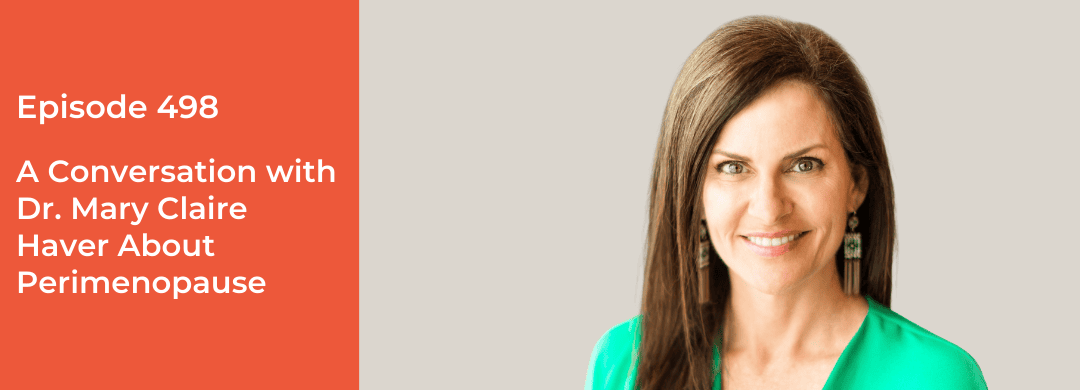
Today we’re diving into a topic that so many women experience but far too few of us are adequately prepared for—perimenopause. My guest is Dr. Mary Claire Haver, a board-certified OB-GYN, Certified Menopause Practitioner, and New York Times bestselling author of The New Menopause and her most recent book, The New Perimenopause. Through her clinical work, her online programs like The Galveston Diet, and her platform The ’Pause Life, Dr. Haver has become a leading voice in making menopause education accessible, practical, and grounded in science.
In our conversation, we explore the biological and emotional complexities of perimenopause, why early intervention—including hormone therapy—can be so important, and the gaps in medical training that have left many women feeling dismissed or unprepared. Dr. Haver shares practical strategies for managing symptoms, explains what she calls “The Menopause Toolkit,” and offers empowering guidance to help women advocate for their health and navigate this transformative phase with more knowledge, confidence, and support.
About Dr. Mary Claire Haver
 Dr. Mary Claire Haver, MD, FACOG, CMP, is a board-certified Obstetrics and Gynecology specialist, a Certified Menopause Practitioner from The Menopause Society (formerly the North American Menopause Society (NAMS)), an Adjunct Associate Professor at University of Texas Medical Branch (UTMB), a Certified Culinary Medicine Specialist, and a passionate entrepreneur and best-selling author with a focus on women’s health. Dr. Haver graduated from Louisiana State University Medical Center and completed her Obstetrics and Gynecology residency at UTMB.
As her patient population grew older, Dr. Haver started receiving numerous complaints and concerns about weight gain during menopause. This inspired her to do a deep dive into the science of menopause, aging, and inflammation beyond what she was taught in school and residency, which led to the creation of The Galveston Diet online program and, in 2023, a national bestselling book. Dr. Haver integrates a patient’s medical history, symptomatology, nutrition, exercise, supplements, and possibly hormone therapy, or what she likes to call “The Menopause Toolkit.”
Dr. Haver has a large social media following of over 7 million, where she posts advice for menopausal women and learns a great deal from her followers and community. She aims to make menopause care easy and accessible for everyone. She founded The ‘Pause Life, a comprehensive approach to menopause education and support, and is the author of the New York Times bestseller, The New Menopause and her most recent title The New Perimenopause.
Things you’ll learn from this episode
- What differences there are between the biological process of perimenopause and menopause
- The impact of hormone shifts in estrogen, progesterone, and testosterone on women’s mental health and brain fog during perimenopause
- Ways to effectively communicate with healthcare providers who may not be up to speed on menopause research and/or may be dismissive of symptoms
- The benefits and timing of menopause hormone therapy during perimenopause
Resources mentioned
- The Pause Life (Mary Claire’s website and online community)
- The New Perimenopause: An Evidence-Based Guide to Surviving the Zone of Chaos and Feeling Like Yourself Again by Dr. Mary Claire Haver
- The New Menopause: Navigating Your Path Through Hormonal Change with Purpose, Power, and Facts by Dr. Mary Claire Haver
Want to go deeper?

The Differently Wired Club is not your typical membership community.
There’s something here for everyone, whether you’re a sit back and absorb learner, a hands-on, connect and engage learner, and everything in between. Join the Differently Wired Club and get unstuck, ditch the overwhelm, and find confidence, connection, and JOY in parenting your differently wired child.
Learn more about the Differently Wired Club
Episode Transcript
Debbie:
Hey, Dr. Mary Claire, welcome to the podcast.
Dr. Mary Claire Haver:
Hi, thanks for having me.
Debbie:
So excited. I’ve been wanting to get you on my show for so long because I want to share the incredible work that you’re doing for women. And I work with mostly moms who are struggling and suffering, uh, parenting their neurodivergent kids, but also in this time of life. And so I know your story. I’ve been following your work for a really long time since even before the new menopause, since the Galveston diet, so I kind of know your origin story for the work that you’re doing in the world, but would you take a few minutes for listeners who aren’t familiar with you to kind of talk about how you came to be doing this work?
Dr. Mary Claire Haver:
My background, I’m a medical doctor in the United States. I did my residency in obstetrics and gynecology and I worked at a large academic institution for about 20 years. And I really didn’t realize how important this really is to long-term health and how much women were really suffering until I was aging along with my patients. I got out and practiced. I’m having babies. My patients are having babies and we’re all kind of growing up together. And I was lucky that I lived in a small town with a big university. And so everybody was my patient, right? Like the PhDs, the nurses, my friends. And so I’m seeing these patterns develop and these women that I work out with, go to church with, walk, run half-marathons with and everyone was really struggling with this new weight gain in their midsection.
So that’s kind of like, it’s a little bit vain, that’s kind of like what got my attention was I started gaining weight, my friends were gaining weight, my patients were all gaining weight, and I was like, wait a minute, I know them. I know their lifestyles. I know this can’t be right. They’re not sitting up eating bonbons every night. And all the conventional wisdom had taught me and medical school had taught me is this is a morality problem. “They’re just not working hard enough.”
So I started doing, being a scientist. My husband’s like, figure this out, you’re a scientist. I don’t, when what we tell our kids, if you can’t continue the same process, if you’re not getting the outcome you want, right? Like it’s just never gonna work. So, that just led to a massive amount of research and realizing, wait a minute, menopause has something to do with this, the hormone loss, it’s driving inflammation, it’s driving so many things. And as I started talking about that on social media, my account exploded. And there was so much interest in menopause in general, right? And so then Galveston Diet was first and talking about weight gain and visceral fat and all of that, but it just really blew into the whole menopause picture in general. And then that became The New Menopause book and kind of history from there. And then I opened a menopause clinic. I built a company around menopause. And it’s like, it’s my whole personality now.
Debbie:
You really are in the forefront. I feel like everyone’s talking about this now. And I feel like you are the kind of leading the charge, which is, I think, why I gravitated to your work so much. And just to say for listeners, this isn’t the typical podcast conversation. It’s not necessarily about parenting. One of the reasons when I reached out to the publicists at Random House, I said, but this is a quality of life issue. And this is something I really wanted listeners of my show to have access to. And then I’m just going to The New Menopause.
So someone held this up to me on a Zoom call a couple of years ago when I was describing my own personal suffering. And she’s like, you have to read this book. And that became the book I gifted to all of my friends that year for the holidays. I wish I’d had access to this much earlier, so I’m on the other side, right? Which is why I’m so excited about your new book. Your new book is going to help so many people. Thank you for holding it up. It’s called The New Perimenopause, an evidence-based guide to surviving the zone of chaos and feeling like yourself again. It’s so good. And let’s kind of lay the framework here. So for listeners who are newer to this, can you just kind of clearly define perimenopause, it’s different from menopause.
Dr. Mary Claire Haver:
Yeah. So, you don’t want to think of perimenopause as the waiting room for menopause. It is a very unique biological transition, very similar to kind of the chaos of puberty. So, it’s jokingly called cougar puberty. But as chaotic, we don’t just wake up and start ovulating as teenagers or whenever you genetically just started having periods, nine, 10, 11, 12, 13, whatever. It is a year or two of massive hormonal shifts in the body before you become regular and everything kind of settles down into that ebb and flow of 28 day cycles for the average woman. Perimenopause takes much longer. It is a seven to 10 year transition from normal, regular hormone ebb and flows to, because, and the reason why this all happens is that human females are born with all of our eggs. And then we run out. Menopause is no more eggs. That’s it. You have exhausted your entire supply. And medically, we call that ovarian failure, which sounds terrible, but it is a natural biological process for human females.
So when we reach a critical egg threshold level, the signals that come from the brain that make an ovulation happen, the ovaries sit there and just wait to be told what to do. They do not operate on their own. They need the signals coming from the brain. The brain sends the signal down and whenever you cross that threshold, the ovaries start becoming resistant to those signals. So the brain is the first thing to notice, wait, I sent my signals, where’s my estrogen? Like it’s not coming back up like it used to every month. The brain gets very upset. Our neurotransmitters, serotonin, norepinephrine, dopamine are all related to our sex hormones of estrogen, progesterone, testosterone. And when we start going through this chaotic phase, so instead of just this gentle decline, which is what I thought I understood perimenopause to be, it is literally a zone of chaos. We have massive rises in estradiol, higher than we’ve ever seen outside of pregnancy, and then crashing down and then delayed ovulations, and progesterone never kind of gets to where it used to be. So in a premenopausal woman, before menopause entered the chat, when she had enough eggs to keep that system rolling, you could predict on day 10 she does this, on day 12 she does that, on day 15 she does something else, and it’s very biologically predictable, and the brain’s super happy for most women in that phase. Now we get to the point where you go into chaos. The brain is the first thing that feels it. It’s not your periods, it’s not your breasts, it is sleep disruptions, mental health changes, and brain fog. So when we look at the scans of glucose uptake through the menopause transition and you see the frontal lobe getting hit so hard, our processing, that’s the brain fog, and then in the memory center where we consolidate our memories. So we’re seeing all of these brain symptoms first, years before the periods actually become irregular.
Debbie:
So first of all, this is such good information because when I was going through this, it just wasn’t available. And I also, maybe TMI for listeners, but I was on an IUD. So I didn’t have a period for many, many years. So I had no idea. It was COVID. I had a 15-year-old neurodivergent kid struggling, all of these things. And I was just like, this is just what this time of life is like. But chaos, as you said, this zone of chaos is exactly what it felt like. Why do you think it catches so many women off guard?
Dr. Mary Claire Haver:
They weren’t prepared, they didn’t understand, they didn’t know. And so all of a sudden you feel like you’re a little bit crazy. And you go to your doctor and they think you’re a little bit crazy because they weren’t taught that this happens. Everyone knows your periods stop, you have hot flashes. That is menopause. And that for years was, we only treated menopause to stop hot flashes for no other reason. And so we’re not, imagine, the analogy I use, and I’m gonna date myself here. Did you see Blue Lagoon when you were a kid? I’m older than you.
Debbie:
Well, I wasn’t allowed to, but I did watch it at Vicki’s house.
Dr. Mary Claire Haver:
She starts her period right in the lagoon. She has no idea what’s happening. She thinks she’s dying. There’s blood everywhere. She’s crying, whatever. We prepare our girls for this. My kids had all the stuff bought, everything ready. It was just no big deal. They weren’t scared. We’re not doing this for perimenopause. Women are being blindsided by symptoms and not understanding. And then they’re going to the medical profession and they’re not getting help, the majority of them either, because we’re not doing a great job training our medical professionals as to the biological consequences of perimenopause. And so that’s what I’m working on is that advocacy part. So this book is meant to provide education and anticipatory guidance for this transition. This is the little sister to The New Menopause.
Debbie:
I love that, the little sister. One of the things I love is that you include these take to the doctor messages throughout, are so helpful. And I will just share that I had to really push here in the Netherlands where I live when I started taking, which I thought was called HRT, but now it’s more preferable to call it hormones.
Dr. Mary Claire Haver:
What’s in a name? Everybody, all these regulatory agencies are trying to split hairs, it’s hormones.
Debbie:
But I really had to push for that and kind of explain and kind of prove my point. Can you talk about what you’ve noticed in the landscape over the past maybe five years in terms of doctors willingness to listen to the research?
Dr. Mary Claire Haver:
I feel like it’s not the doctor’s fault. If you’re not trained and then you go out into the world and your CME is not keeping up with menopause stuff, it doesn’t make you a bad doctor. You’re just undereducated in this very, very important topic. So you probably right now have only about a 10 percent chance of being able to walk in in the US into your OBGYN, your family medicine, your internal medicine doctor, and be able to have a really robust conversation about menopause hormone therapy because they were not trained. If you get lucky, great.
So I would call ahead or if you have a good relationship with them go in with your tools your resources the studies. We give you links guides as much information as we can so you can advocate for yourself. But don’t be surprised if they’re still reluctant. We’re forced into these 10, 15 minute visits. There’s not enough time. These poor doctors are being forced to see 30 patients a day. When do you have time? Then you have to go home and be a parent and you do all the things everybody else is doing and there’s just not a lot of time for the average clinician to seek out this extra training.
What excites me is that the menopause society is exploding, lots and lots of new clinicians joining, wanting to learn, wanting to make this a robust part of their practice. There’s also some pretty good telemedicine options in the US. I’m not sure in the Netherlands if it’s the same, but telemedicine is really opening up. They’re building menopause companies. Not all are great, but to serve this niche underserved population specifically. In my clinic, I just do menopause. I send my patients back to the gynecologist for their pap smears and their breast exams and their biopsies. We are just managing menopause, perimenopause, and then helping them build a runway for the next 30 years of being healthy.
Debbie:
I would love to talk about menopause, perimenopause, and ADHD. And you talk about this in your book, but this is something I got a lot of questions from my community about. Full disclosure, I am someone who discovered my own neurodivergence, my own ADHD as an older woman. My whole family is neuro-spicy. My kids, ADHD. There’s a lot going on in my family. But you talk about perimenopause symptoms can mimic ADHD. And so I’d love to just dive into that a little bit more. And if you have ways of helping listeners kind of determine are these cognitive symptoms.
Dr. Mary Claire Haver:
We don’t have a great litmus test. Both my girls are on the spectrum as well. I have personal experience with my kids and they’re doing great. On social media, I’m seeing so many people saying, I didn’t get diagnosed until perimenopause. And is it the chicken or the egg thing? You may have been well controlled with what you built in your life, but now you’ve removed that protection. Estrogen was really protecting you and now your symptoms are not manageable with the systems you had in place. And so you’re getting your diagnosis as an older adult where you were just able to manage before.
A good example is my oldest was able to manage her symptoms with no medication until medical school. So that amount of stress on her system overrode her ability to manage her symptoms just through lifestyle intervention. We’re not sure if we’re unmasking or it’s new diagnosis, but the information is getting out there. You have to expect if your neurotransmitters are changing, if the amount of myelination on those nerves is changing across the menopause transition, it makes sense that this is going to lead to more ADHD type symptoms, whether or not you get the official diagnosis or not. And some patients think that hormone therapy or quieting that zone of chaos with hormone therapy is really helpful to their symptoms.
Debbie:
That’s what one parent in my community said. I’m kind of maxed out on hormones, which has helped. And she’s also made significant changes with her exercise and her nutrition and no alcohol, which have also helped. So all of those things combined are making a difference. Let’s also talk for a moment about these shifts in hormones that affect anxiety. You talked about mental health, irritability, brain fog, and the anxiety and almost this existential depression, which I’d never experienced before. I experienced for the first time in my life when I was in this phase while trying to co-regulate with a human who was not very regulated at the time. Just wondering if you have any on how these hormone shifts impact the kind of nervous system load.
Dr. Mary Claire Haver:
We see a 40 percent increase in diagnoses of anxiety and depression across the menopause transition. The SSRI prescriptions double. Things like Prozac and Zoloft, we see a doubling of the prescriptions across the menopause transition. So what’s happening? It can be anxiety and or depression or both. Also something called anhedonia, which is you’re not depressed, but you’re not joyful. You’ve lost a lot of the joy and things aren’t just making you happy rather than you being sad all the time. We’ve seen this for years, we’ve documented this for years. After the Women’s Health Initiative, when people were terrified to prescribe hormone therapy, the rate of prescriptions for anti-anxiety, anti-depression meds skyrocketed. It just makes sense.
Debbie:
I feel like there’s been a lot of coverage in the news in the past few years about how the research about hormone replacement therapy that initially had people like my mom just stop. And now we’re realizing it wasn’t interpreted correctly. Can you just speak to that if there are listeners who still haven’t heard that message?
Dr. Mary Claire Haver:
For the vast majority of patients, the benefits are gonna outweigh the risks. The menopause society is clear on that, especially young, early in your menopause. You have cardiovascular protection if you start in the first 10 years or before the age of 60. It’s always gonna protect your bones. If you are high risk for Alzheimer’s, for example, if you have the APOE4 gene starting early does appear to have some protection. The data is still evolving on dementia prevention in the general population, but it’s not harmful. It’s a pretty exciting time to see where research is heading. Things are a little tough in the US right now because funding is drying up, but a lot of private funding is pouring into women’s health research, especially this area.
Debbie:
By the time I read your book and decided I really need to get on the hormone therapy bus, I was realizing I’m kind of at that window where the benefits may not be as great because you talk about starting within a certain period of time. Are there benefits to starting it earlier?
Dr. Mary Claire Haver:
Yes, absolutely. Definitely for mental health. Great studies coming out of Australia where they started patients not on SSRIs, but on menopause hormone therapy. They did head to head comparisons and the women on hormones were doing better in perimenopause for depression and anxiety symptoms. The other window of opportunity is bone loss. The greatest rate of bone loss moving toward osteoporosis is in perimenopause. So if we want to slow that train down and hang on to your bone mass, especially if you have a family history or you know you are already osteopenic, I would heavily consider starting hormone therapy then.
Debbie:
Thank you. So grateful that younger women are getting this information when they can take action on it. Okay, so you have a chapter called Talking Points and Lab Tests, everything you need for your next appointment. I love this so much. It’s so practical because I think there is such a hierarchy. So many of us as women, when we’re in these doctor’s offices and we don’t know what we don’t know, we can really defer to the expertise of the person we’re talking with. Can you say a little bit more about how you structured that chapter and how you hope it empowers women?
Dr. Mary Claire Haver:
I tried to give scripts on what to say. Coming from someone who was that physician who didn’t understand perimenopause well, when I was setting up sample scripts of things to say and resources to bring, I was looking at it like, what would have worked for me when I was in that space of not understanding? What could a patient have said or given me that would have made me pause and consider? Educating yourself as much as possible, realizing that your great OB or your great family medicine doc who has done wonderful care for you may not have the knowledge base to help you here. Call ahead. Ask before you spend the copay and get a babysitter and go down there for something they’re not going to help you with. Ask your friends if they’ve had a great experience with a provider and consider some of the online options.
Debbie:
Okay, thank you for that. Super helpful. I have a couple other questions that came in from my community. One of the questions was, I’ve heard about premenstrual dysphoric disorder being much more prevalent in people who are autistic or who have ADHD. Have you found any research or anecdotal findings on perimenopause and menopause experiences as it relates to neurodivergence in general?
Dr. Mary Claire Haver:
I have an ADHD expert coming on the podcast and I’m going to have to ask her. I don’t know of any right now, but that doesn’t mean it doesn’t exist. We know that PMDD gets much worse in perimenopause because of that feedback. What used to be predictable now becomes chaotic. And for some women, it tips them over into the most severe symptoms they’ve ever had with their PMDD.
Debbie:
We’ll keep an eye out for that episode and share a link once it drops. Here’s another question. How do exercise and supplements such as rhodiola, L-theanine, and magnesium decrease or eliminate symptoms?
Dr. Mary Claire Haver:
When we talk about supplements, we don’t have one that cures menopause. Symptoms overlap and have different causes. Some women will take soy-based products, which is a phytoestrogen, and find relief for hot flashes. Turmeric definitely helps with joint pain. There are good studies in menopausal women for that. Sleep disruption is a big one. There are decent studies on magnesium depending on why you’re not sleeping. If it’s sleep apnea, nothing’s helping. But if it’s hormone-related sleep disruption, magnesium can be helpful. Rhodiola can be helpful. Lemon balm has shown some studies. L-theanine for anxiety has been shown to be helpful. We approach it symptom by symptom. But you don’t want to end up with a bucket of supplements treating all these little things when you maybe just need some estrogen.
Debbie:
Makes so much sense. That was my next question. You talk about sleep and nutrition and exercise. This is a multi-pronged approach. Are there any that give the most bang for the buck?
Dr. Mary Claire Haver:
You have to sleep. If you’re not sleeping, nothing works. I have to protect my sleep with my life. I have a mattress cover that adjusts temperature. I wear trackers. I probably go overboard. But I’ve had to prioritize sleep in a way I’ve never had to in my whole life. Chronic insomnia is recognized as a risk factor for cardiovascular disease and Alzheimer’s. This is important. I go to bed at the same time. I wake up at the same time. My room is cool. My room is dark. I use my bed for intimacy and for sleep. We don’t watch TV in bed. I don’t read in bed anymore. Turning off blue light. I put my phone on brick at night so I can’t do social media but my kids can still call me. Being really intentional about that.
Debbie:
So good. Let’s wrap up. At the end of your book, you talk about what I wish I’d known at 35. I love that. You obviously can’t walk us through that whole chapter, but could you share the biggest thing you wish you had known at 35 that would have changed your life back then?
Dr. Mary Claire Haver:
I would have known I would lose two of my brothers and my dad. I didn’t know anything about menopause and I should have educated myself. How important it was to really savor those moments with the kids. I had a really rough mental perimenopause and I was not the best parent. I was yelling and falling back on things that my parents had done because I didn’t know any better. Investing in therapy earlier. It doesn’t have to be this hard. There are resources. I didn’t understand I deserved them. I cannot take my health for granted. I’ve lost two brothers to cancers related to poor choices. I don’t have the genes to be able to smoke and drink and do all the things without worrying about long-term health.
Debbie:
The work you do is life saving. It’s life affirming and critical. I want to name the book again. It’s The New Perimenopause, an evidence-based guide to surviving the zone of chaos and feeling like yourself again. Any last thought you’d like to share?
Dr. Mary Claire Haver:
Perimenopause is inevitable for all of us if we’re lucky to live long enough, but suffering is not.
Debbie:
Perfect. Thank you so much for your time. Congratulations on the book. Good luck with spreading the word. We’ll do our part to help.
Dr. Mary Claire Haver:
You’re welcome. Thank you.
Do you have an idea for an upcoming episode? Please share your idea in my Suggestion Box.