Parenting for Independence: Strategies for the Transition to Adulthood
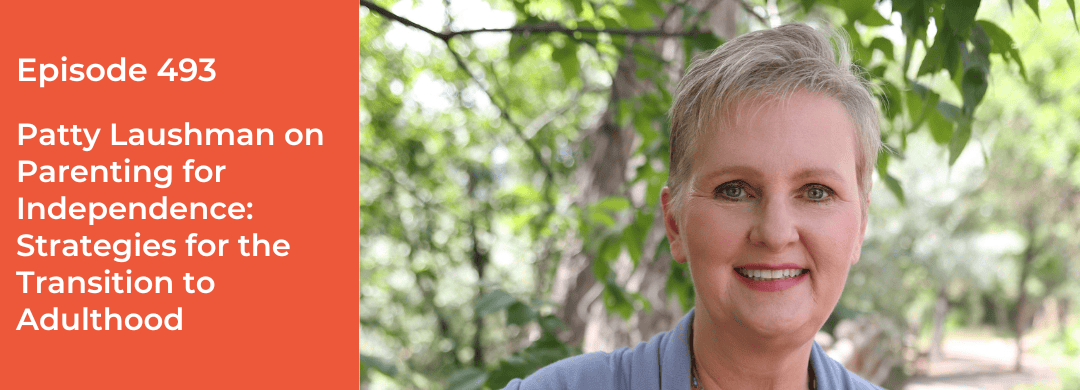
Patty Laushman, a speaker, autism life coach, and the author of the book Parenting for Independence: Overcoming Failure to Launch in Autistic Emerging Adults, joins me to talk about one of the misunderstood stages of parenting: supporting our neurodivergent kids as they move into emerging adulthood. In our conversation, Patty and I unpack the concept of “failure to launch,” why that label is actually unhelpful and inaccurate, and how redefining independence can change everything. We talk about self-determination, motivation, and what support actually looks like during this phase of life. Patty also shares her SBN parenting framework—Support, Boundaries, and Nudges—and offers grounded, compassionate guidance for navigating this transition while strengthening trust and connection along the way.
About Patty Laushman
 Patty Laushman is an author, speaker, educator, and coach who specializes in supporting neurodivergent individuals and the families who love them. With both personal and professional experience, she deeply understands the challenges of being neurodivergent in a world designed for those who are more neurotypical—and the transformative power of the right kind of support.
She is the founder and head coach at Thrive Autism Coaching, where she and her team help neurodivergent teens and adults, as well as their parents, build the skills and confidence needed to thrive. Patty developed the SBN™ parenting framework, a step-by-step system that teaches parents how to use support, boundaries, and nudges to help their autistic emerging adults reclaim motivation, build momentum, and move toward more meaningful lives on their own terms.
Through her Parenting for Independence group coaching program, Patty has guided hundreds of families through this unexpected stage of parenting—helping them rebuild trust, strengthen relationships, and finally start seeing progress. Her compassionate, neurodiversity-affirming approach has been described by clients as “the only thing that has ever worked for us.”She lives with her husband, son, and Golden Retriever in the Denver/Boulder metro area. In her spare time, you’ll find her hiking, camping, headbanging to heavy metal, or devouring medical or crime dramas.
Things you’ll learn from this episode
- How understanding a child’s lived experience lays the groundwork for more effective, compassionate parenting
- Why the term “failure to launch,” while loaded, can help families find the right support and resources
- How redefining independence to include positive interdependence supports healthier outcomes for emerging adults
- Why self-determination is central to helping neurodivergent young adults move out of stuckness and burnout
- How the SBN framework—Support, Boundaries, and Nudges—guides parents in creating momentum without control
- Why resetting expectations and timelines can ease parental shame and anxiety while supporting real growth
Resources mentioned
- Parenting for Independence: Overcoming Failure to Launch in Autistic Emerging Adults by Patty Laushman
- How to Get Your Autistic Emerging Adult in the Driver’s Seat of Their Life (freebie from Patty)
- Parenting for Independence (Patty’s program)
- The Real Work of Parenting Neurodivergent Young Adults (Part 1) — a crossover episode with Penny Williams (Full-Tilt Parenting podcast)
- The Real Work of Parenting ND Young Adults (Part 2) (Beautifully Complex podcast)
- A Conservation with Dr. Gina Riley on Self-Determination Theory & Motivation (Full-Tilt Parenting)
- A Conversation with Linda Murphy About Declarative Language episode (Full-Tilt Parenting)
Want to go deeper?

The Differently Wired Club is not your typical membership community.
There’s something here for everyone, whether you’re a sit back and absorb learner, a hands-on, connect and engage learner, and everything in between. Join the Differently Wired Club and get unstuck, ditch the overwhelm, and find confidence, connection, and JOY in parenting your differently wired child.
Learn more about the Differently Wired Club
Episode Transcript
Debbie:
Hey, Patty, welcome to the podcast.
Patty Laushman:
Thank you so much for having me, Debbie. I really appreciate it.
Debbie:
Yeah, well, I appreciate having the chance to talk about launching, is it is something I get a lot of questions about, especially having now being the parent of a 21-year-old. I actually did a double episode on this last fall. Yeah, it was good. And there’s so much more to talk about. But I really appreciate that you’ve created a resource that’s really to help parents navigate this time, which can be really tricky and complicated. as a way to start our conversation, would you take a few minutes and just give us a little bit more info about who you are in the world and why you came to be doing this work and supporting parents with their Neurodivergent Kids launch?
Patty Laushman:
Sure, sure. So I am the mother of a multi exceptional neurodivergent son and we really struggled the first eight and a half years of his life. just, didn’t have the full picture until we got all these incremental diagnoses and then finally at eight and a half, he was correctly identified as autistic. And that was really the missing piece for us. It really helped us understand what he was experiencing, what his perspective was. And until we took that into account, all these things we were trying to do to help him were not working. when we got that correct identification, it was such a positive thing for our family because suddenly what we were doing to try to help him was working because it was informed, it was autism informed. so I had to pull him out of public school to start homeschooling because public school was just an unmitigated disaster. And I had been researching for years prior to that how to teach someone who is dyslexic, dysgraphic, dyscalculic. And so once I pulled him to homeschool, things got really real. And now I am the one on the hook for educating this really unique brain. So I spent years doing that. I had to kind of slow down my consulting practice to focus on helping him. But I started figuring these things out and he started thriving and it was amazing. And then I had more time to focus on my career. At a certain point, I decided that I didn’t want to do sales development consulting anymore and I was looking for something else early in the pandemic and considered going back to school to become a mental health therapist, specializing in autism. But when I looked at the reality of what that was gonna cost and how long it would take.
I was interviewing other mental health therapists who specialized in autism and one of them said to me, she was like, why do you want to start over at your age? Like, why don’t you just, you know, go to Boston, talk to AANE, do their life map coach training and become an autism life coach. And I was like, I don’t know what any of those words mean. I need you to break that down for me. like, I was like, I have no idea what you’re talking about. And so she explained that if I had had this training today, she had clients she could refer to me and I thought, well, that’s compelling. So I started looking into it and realized that coaching autistic adults could potentially be a better fit for my personality. And so I,I looked into it, I pursued it, I hung a shingle about four years ago, started coaching autistic adults. And then because most of the time I coach someone, it was their parent funding the coaching, I was talking to lots of parents of adults and I really miscalculated. These parents had had these children longer than my son had been alive and I assumed they had figured out all the things that I had figured out during those really difficult years. But I realized that they were isolated.
They were confused. They were feeling a lot of shame as parents, and they didn’t know what to do or where to go. so I eventually, one of the parents asked if I could coach her directly. And I was like, never considered doing this. But she was like, I want you to coach my 29-year-old daughter, but she won’t consider it. So I want you to tell me what you would do in our situation. And so I did. It just kind of snowballed from there and I started coaching lots of parents and then I was able to take all of these things I had learned and put them into a framework that I was able to teach parents so they could go off and kind of make their own decisions in the moment on what to do and how to respond. And it’s been really successful.
Debbie:
That’s great. Such an important resource and I imagine there aren’t many people out there doing the work that you’re doing.
Patty Laushman:
I am not aware of anyone else doing this work, honestly.
Debbie:
Yeah. So let’s talk just to kind of create some containers, if you will, for this conversation. first of all, your book is called Parenting for Independence, Overcoming Failure to Launch an Autistic Emerging Adult. So you mentioned in this example that you just shared, the autistic adult was 29 and you were working with a parent. So when you think about emerging adulthood, what are we talking about?
Patty Laushman:
Yeah, that’s a great question, Debbie. I would say anywhere from 16, 17 to probably 35. That’s the age range of the parents I tend to work with, but I’m working right now with a family who has a 42-year-old. She went off and became a college professor and was very successful for a number of years. And then I don’t know what the details were of her situation, but she lost her job. And now she’s moved back in with these parents who are like, this is not working, this is not gonna work. So yeah, I would say probably 16, 17 to about 35 typically.
Debbie:
And then, you know, you and I talked before we, well, first of all, I just want to say, sorry, let me say this over because I am already like complicating my question. I was lucky enough to see your book in advance and I actually blurbed it. And I get asked to blurb a lot of books, but I really felt this was such an important addition to what exists to support parents who are really trying to navigate a path where there really isn’t one, right? And one of the things I thought would be important for this conversation in particular is to talk about just some of the language. Just so we can kind of set listeners expectations. Again, the subtitle is failure to launch, which can feel really loaded, right? That term. And then I also want to break down independence. So let’s talk about this idea of failure to launch. And you said you had to think long and hard about whether or not to include that in the subtitle of your book. talk to us about what you mean by that and what you were thinking about as you were deciding this really needs to be in there. Yeah.
Patty Laushman:
Yeah, it’s such a great question. I put so much time into thinking about this title. And I even had early readers question, do you really want to include that in the title? And I said, I’m uncomfortable with the term. I know other people are uncomfortable with the term. I said, but give me another option. I want to make sure that I’m attracting the right readers that they will understand what they’re going to get out of this book. They and I could not come up with an alternative term. So that’s how we settled on that.
It’s a term that is something that someone might Google, something they might type into Google when they’re looking for information. My son is stuck in their bedroom. My child dropped out of college and moved back home. Those are not things that people type into Google necessarily AI search, but they’re not typing that into Google. And so I wanted, I needed to use a title that would attract the right readers and give them information on what they can expect to get out of the book. So as I’m uncomfortable even just talking about it, but that’s, that was the reasoning behind it. And then independence I know is also really a complex and loaded term in our community for so many reasons. And I work with a wide range of clients. And one of the most difficult scenarios I work with is parents who have a child who is refusing any sort of help. And they have internalized the idea, I’m 18, I’m an adult, I should do everything on my own. And that black and white thinking that we often see in this population. what I tell the parents and what I recommend they tell their adult child is no one was meant to do life alone. Nobody on this planet was meant to do life alone.
Even a CEO who we culturally look at as one of the most successful examples of adulthood, that CEO does very little by themselves. They have a whole team at work and there’s probably a team at home assisting that CEO. And the other kind of fraught concept around independence is that our kids may or may not achieve the level of independence or a type of independence that looks like what we as parents have achieved. And sometimes I need to talk with parents about this, that if you are pushing your child towards something that looks like the independence that you have yourself, you may be setting yourself and your child up for failure because it may not be what they can achieve. You know, maybe a situation where, and I see this quite frequently, where they can either work full time professionally or they can take care of their day-to-day living, but they can’t do both. Or maybe it may be a temporary situation. Like I’m thinking of one young man who’s in college. He is at the most competitive college in Colorado right now.
But he and he can do that, but he cannot take care of his apartment. So he has once a week support His mom comes and makes sure he has nutritious food that he has clean clothes, you know Just like a you know physical check-in once a week and he asked for this which is very important parents cannot be he recognized that he was struggling and actually gave his mom permission for this once a week check-in. So it’s an agreement they have in advance. And with this little bit of support, he’s able to be successful at what he wants to do.
Debbie:
Yeah. Yeah, so that’s really helpful. And I think that even the term independence is interpreted often in one way, right? We think of independence means you’re living independently. You don’t need help from anybody else. You’re taking care of your rent and your medication and your insurance and your like you’re fully. And, you know, as you said, that’s not how most people live, right? And we all are.
Patty Laushman:
Yes. Yeah, positive interdependence is what I tell my parent clients. You are striving for positive interdependence, whatever that looks like for your child. I use myself as an example. I’m really good at a lot of things. And I’ve been very independent for a long time, but I have no mechanical ability whatsoever.
And if I had not married my husband, who was very mechanical, I would be spending thousands of dollars a year on IT support, even though I’m very technical, I would still be spending thousands of dollars on IT support and mechanic support and changing the oil and recognizing the truck needs maintenance. without my husband, I would be lost in that area of my life. You know, unfortunately, I think there’s some shame around needing that kind of support in certain areas of life. And that’s really unfortunate. That’s really unfortunate because sometimes it just takes a little bit like this mom once a week checks in at her son’s apartment. They have this prearranged agreement. I will look for this, this and this. I will help with this, this and this. And it enables him to achieve his goals for his life.
Debbie:
Yeah, I definitely want to come back to that because as you were describing that story, I’m like, how do we get our kids to want the help? But let’s put a pin in that. We’ll come back to it. But I do have one more question before we kind of move on, and that is this idea of self-determination. And so when we talk about independence a lot on the show, we often will kind of pivoted to that independence isn’t necessarily the goal, living a self-determined life is. Is that part of the equation for you?
Patty Laushman:
Right. Yes. Absolutely. Absolutely. I don’t get into detail in the book about self-determination theory, but I do talk about it more in my Parenting for Independence group coaching program. It’s really the foundation of everything I teach is self-determination theory. Yeah.
Debbie:
OK, great. Yeah. And listeners, I’ll just mention that I did an episode on self-determination theory, and I’ll have a link in the show notes, because it is really fascinating to think about. And it’s a really helpful framework with which to kind of consider our young adults’ life and how we can best support them. So you used the word stuck before, and that is something I hear a lot, that language of being stuck. And that’s how a lot of parents would describe their emerging adults. can you give some examples of what stuckness might look like, and what’s really going on when someone appears to be stuck?
Patty Laushman:
Yeah, absolutely. So I have clients, you know, one of the very common stories before parents come to me is their child did okay in school until, you know, they got to college. And then because of that huge leap in developmental expectations, and there’s usually a huge leap that precedes the stuckness.
They go to college and now suddenly they’re expected to take care of things that there were structures, support structures around previously and now the expectations have increased exponentially and they are trying, trying, trying and they end up burning out and then they drop out and then they move back home and then they go into their bedroom and they won’t come out for a year. That’s a pretty common story that I hear. Sometimes they get stuck after high school. They, you know, are not confident that college is going to work for them. And they, you know, they’re not working. They’re not making progress on their future, I would say, generally speaking, they’re not participating in future focused activities, which is a phrase one of my clients gave me. She’s like, I really like thinking about it in terms of future focused activities.
And then sometimes they graduate from college and now they’re not able to make that leap into the world of work. That’s another really common profile that I end up working with. And it’s just so frustrating for the parents. It’s so frustrating for the young adult. They’re like, you know, I did all the things and now I’m in my bedroom playing video games. And then no one knows what to do. Like they just stay there. They’re stuck. The parent is trying to help in the ways that they know how to help and it doesn’t help. It just ends up with a lot of frustration and in some cases harms the relationship between the parent and that child. They’re both feeling a lot of shame and there’s just, there’s not a lot out there to help them illuminate a path forward. And that’s where my work comes in.
Debbie:
Yeah. Why, in your experience, what are some of the kind of underlying reasons for the stuckness? You know, when reading your book, I’m just thinking about about burnout, which is also something we talk a lot about, and the toll that that can take. you know, I’m assuming that that is one reason maybe you could explore that a little bit, but also share some other things that might be going on behind the scenes.
Patty Laushman:
Yeah, absolutely. So I would say there are probably three concepts that parents need to understand. In launching, there’s do they have the skills? Do they have the capacity? And do they have the readiness to take action? And so in the case where they have burnt out in college and moved back home, that’s probably a combination of skills and capacity. Right? And you can’t be ready to take action towards your future unless you have both the skills and the capacity. You can have the capacity, but if you’re lacking skills, you’re probably going to try, try, try and burn out. And vice versa, if you have the skills, but not the capacity because you’re in burnout, there’s no future focused action because you don’t have the readiness.
Debbie:
So yeah, I imagine that with the parents you’re working with, that might come as a surprise, right? Especially if they kind of thought, OK, we made it to this. My child has gone to university. Or they’re making progress. Or they’ve taken a job. Or they’ve shown these signs of independence. I mean, you mentioned the example of the parents of an older adult who had a career and things and is now kind of back at square one. What is happening for the parents when this comes up? I imagine there’s a whole range of emotions that go along with this.
Patty Laushman:
Yeah, I think there’s a lot of shame. There’s a lot of anxiety. And then after they’ve been working at trying to help their emerging adult get unstuck, there’s this absolute terror around what happens when I’m not here anymore to support them. That is the scariest thought. I mean, I had this thought as well, even when my son was younger, when he was, you know, eight and a half and nine, and we understood what was going on and why he was struggling. He is an only child with no cousins. And I just thought, oh my gosh, like I’m getting a pit in my stomach just thinking about that time in my life. And you know, the good news for us is that now, you know, nine years later, he is wildly, wildly exceeding the expectations for what I thought was possible. Like if someone had told me today, nine, let’s say nine years ago, someone had told me where we would be today, I would have been like, there’s no way, like I could not see a path from where we were to where we are today. And so I understand that when parents come to me and they’re just, you know, really feeling quite hopeless and anxious and frustrated, I get it, I get it.
Debbie:
I mentioned that you offer the SBN parenting framework in your book, Parenting for Independence. So would you just take a few minutes and kind of walk us through it?
Patty Laushman:
Sure, absolutely. So SBN stands for support, boundaries, and nudges. And if you think about this visually, think about their goals for their life in the center of a Venn diagram. And then support would be an overlapping circle at the top. So you support them in their goals. That’s where it starts. Well, first you have to understand, actually, there’s two steps before you implement the framework. So the first step is deeply understanding their experience of life, because without that information, when you try to implement this framework, you’re just gonna keep running into dead ends. You have to really understand how they’re experiencing life. You have to understand where their skills are. You may make assumptions about their skills, but when you start, using declarative language, which I also teach as part of my program. Declarative language plus that understanding creates the foundation for you to implement the framework.
So once you understand what they’re experiencing, where their skills are, what their challenges are, what’s holding them back from taking that future focused action, then you can start supporting them in their goals. And when you do that, you end up deepening your relationship with them. Because the relationship, without the relationship, you’re just not going to be successful with the next steps, which is where they start taking action and growing those skills. So you support them in their goals. It grows your relationship. It increases your influence with them. And what you’re doing essentially is getting their permission to provide that support that they need.
Debbie:
So let me interject there. So first of all, I love this. And the question that came up for me, and that I imagine that listeners are going to have questions about, is deeply understanding their experience of life and what they want. A lot of our kids don’t know what they want. They may feel hopeless about the future. They may be stuck in such a way that they don’t see a path for themselves. So can you talk about how do we even begin to engage if we have a child who might be an unwilling participant in our understanding their experience?
Patty Laushman:
Yeah, absolutely, absolutely. So when I take parents through this process, they’re working toward understanding the relationship. And there are absolutely situations where that emerging adult does not have goals. So then I have a whole other section in my program where I teach parents why, what might be going on for them to not have those goals. So then that would be kind of your detour step, right? Instead of going to boundaries and nudges, your next step is identifying why they don’t have goals. And there’s a few different reasons that I typically see they are so burnt out or struggling with mental health challenges. It’s like, if you’re drowning in the ocean and I’m on a boat and I, you know, start yelling at you, where do you wanna be in five years? They’re gonna be like, just throw me the life preserver. I don’t, you know, like who cares, right, you know? So if that is the situation that you discover through this questioning and understanding what’s going on, then your next step is clear.
You’re getting them the help, either they’re in recovery from burnout or dealing with the mental health challenges. They may be unaware that what they want to do can be future focused. So my kind of classic example is the young man who was interested in history but didn’t understand that he could go and study that in college and then turn that into some sort of career, right?
So it may be information that is missing. So then your next step is providing that information. Another really common situation is they have experienced so much soul crushing failure, they have zero confidence that they can achieve any goals. So in that case, we look for ways in that support realm to start building their confidence. And I have a bunch of different ways that parents can do that. So those are the most typical scenarios. I still have families where even once they go through all those steps, the young adult is still not willing to engage. And so then we start moving into the boundaries and nudges phase of the framework.
Debbie:
Got it. Okay. Okay, so why don’t you lead us through those then too? I’m curious to learn more.
Patty Laushman:
Sure, yeah, absolutely. So boundaries, if you’ve ever done any sort of mental health therapy, boundaries are things that you do or don’t do that preserve your own energy and mental wellbeing, which is absolutely essential to parenting. If you’re not in a good place, it’s like the classic oxygen mask, you are gasping for air, you are not in a place that you can help your child. So boundaries are really, really essential. And boundaries are tricky with our kids because it depends on what is going on. If you want to implement a boundary, you may be putting them in a situation where that need is not going to be met. If you decide, you know, I just can’t do this for you anymore. I just can’t do this for you anymore. It’s just depleting me as a parent so much. I just can’t do this anymore. And it’s, and there’s a skill issue. They’re not able to step into that space because of a skill issue. As a parent, you’re going to have to find an alternative. You’re either going to have to suck it up for a while longer, or you’re going to have to find someone else who can take over that area of life.
It could be if you’re fortunate enough to have a spouse who can step in, my husband and I are great at tagging in and out when we are lacking our own capacity. It might mean hiring a professional to step in, but boundaries are super, super tricky, but they’re absolutely essential. So when you implement a boundary, so you either communicate what you’re going to start doing or stop doing, your child is going to resist because this is a change. You’re changing the rules, right? And they have been benefiting from an area in which you did not previously have a boundary. They’ve been benefiting in some way. And when you implement that boundary, they are going to resist. And that can look like any number of scenarios, they may shut down, they may melt down, they may just not play ball. And so it’s really, really hard to implement those boundaries. So a lot of times I’m coaching parents through that really difficult process, but then the parent is in a much better place afterwards. have one mom right now I’m thinking of specifically, we’re putting a boundary in place around meals, dinners specifically, and she wants her daughter to start cooking two meals a month.
And there’s some other things that we need to set boundaries around. So we’re working through that and it’s very, very, very difficult. Because the 22 year old is not, is responding in a way that we would expect when you’re changing the rules on someone who has that significant need for sameness. And then the other area where I do a lot of work with parents, which I think is unique to my parenting framework is the nudges. So nudges are not just randomly pushing them into doing things that they don’t wanna do. Nudges need to be very carefully crafted, very small strategic steps that get them outside of their comfort zone because that’s where skills are built.
Skills are not built when you’re sitting in your comfort zone. But if you push them, if you nudge them in a way that pushes them so far outside their comfort zone, all you end up doing is creating a sense of panic and then they will do everything they can to return to that comfort zone and there’s no learning. There’s no learning that happens as a result of that and then they will just dig their heels in the next time you try to gently nudge them, it just creates this vicious cycle. And so what I work with parents on is, here I’ll just use a very typical specific scenario, for the most stuck who are saying they don’t have goals, where we might start, once we’ve gone through all the steps, you need to have that understanding of what is going on. I cannot emphasize that enough because, if you start implementing nudges without that understanding, experience from the adult child’s perspective can be experienced as abusive and that will harm your relationship or just misinformed and it reduces their respect, right? And so it’s super critical to build that relationship up first.
So you have that social capital to spend when you start to nudge them. But a really typical scenario is you know, someone who’s come home from college, they’ve been stuck in their bedroom for 10 months to a year, it’s usually when I hear from parents, and they’re just, they’re not playing ball. They’re just, not doing anything future-focused, they have no goals, they just shut every conversation down. So what we will do then is say, okay, so here’s what I need. If you’re living at home, you need to be doing something that is future focused. And you need to start, we might start with five hours a week if they’re doing absolutely nothing, okay? So we might say, okay, five hours a week, you need to start doing something that is future focused. It can be in these categories. So it might be you start volunteering or I’ll go volunteer with you. If they are so anxious about leaving the house, I will suggest find something that you can do together once a week, you know, it can be volunteering, can be exploring career options. I have a whole slew of resources for parents that they can use to, you know, give us options. It might be, you know, doing something that is hobby related, go out and find an art class or something like that, but it needs to be something that is future-focused and then we decide typically in advance what percentage of those hours need to be done outside the home. I have some families where doing anything outside the home is just not a possibility.
They need to start with future-focused activities that happen at home and sometimes it’s with the parent support. But what I tell parents is you cannot help without prior permission. It’s not helpful if they don’t want your help and I see a lot of parents get stuck there. They just kind of inflict their help because the parent is feeling so desperate. The parent needs to see progress and they start forcing their help and that does not get you where you want them to go. They need to be in the driver’s seat of all of this. So did that answer your question?
Debbie:
So one of the things, just to go back to the conversation specifically around the boundaries, and I was thinking about this concept of learned helplessness. I guess, how do you advise parents who are really struggling to figure out where the line is, right? Between, you know, and I don’t like the word enabling, but it comes up all the time between like enabling or like finding, yeah, what the, just navigating that tension, right? Like, I don’t want to push my kid into fight or flight. I want to honor and respect where they are. And I want to kind of have that nudge. any kind of, I don’t know, insights on how to navigate that tension.
Patty Laushman:
Yes, okay. So the biggest mistake I see parents making in that area is they’re trying to do too much at once. And that is a recipe for failure. We are dealing with a human typically in my client case where they have this significant need for sameness. And so every little change you make, every little boundary you set, every little nudge you make is you changing the rules. And that is just not ever going to be welcome. And so the first thing is getting very clear on what you want to do. Like what is the hill you’re willing to die on as a parent? And just stay focused there. Just stay focused on one thing because when you’re trying to make changes in multiple areas, you’re just, going to get that resistance and then they shut down and you just get more frustrated. So just be really clear about what, what you’re working on right now. And I get, I get that urge to fix everything. Like parents tell me they’re like, you know, there’s just so much we need to do. There’s so much we need to work on and you’re just never going to make progress that way, especially with, you know, an emerging adult who has that need for sameness has a significant need for autonomy.
So a lot of my clients have children with the PDA profile. And fortunately, my framework works because it’s all based on self-determination theory and getting them in that driver’s seat of their life which activates intrinsic motivation and you’re only helping with prior permission to keep them in that driver’s seat. So I would just say, get very clear about what one thing you’re working on at a time and just be very cognizant that no matter what you do, you have to keep them in the driver’s seat without you reaching over and grabbing the steering wheel because every time you do that, you’re creating a setback. So I know it’s frustrating to sit there and watch them in the driver’s seat not moving forward. you’re sitting in that passenger seat with the map saying, OK, so you said you want to go here. There is an exit in half a mile, or you can go two miles and get off there. And they’re just like, I know it’s frustrating, but I do have ways to help them move forward without pushing them into that panic zone.
Debbie:
And I just imagine there’s also a lot of work for parents around resetting their expectations on timeline, which is something we talk a lot about as well at Tilt. And I think even if we know intellectually that it takes as long as it takes and there is no one timeline for any human, I think most parents, there’s a yes, but like, yeah, I agree with that. But at a certain point, dot, dot, dot. So how do you counsel parents who really are attached to a timeline.
Patty Laushman:
So I, you know, sometimes there are legitimate timelines. So I have a client right now. She, I don’t know how old she is, but she said, I am planning to retire in five years and my 23 year old daughter is still living here and decided to take one college class per semester. can’t get her to consider taking more than one class. We’ve, and we’ve done all the work we’ve, you know, understood, we’ve supported, we’ve worked on the, you know, we’ve done all the things. And her daughter is still saying, I’m going to take one community college class per semester. And mom is doing the math. And she’s like, well, when I retire in five years, I’m not going to be able to fund that. And she’s not going to be financially independent. And so what we’re working on right now is it’s going to become a boundary issue, because this is a legitimate timeline. So we talk about, is there a way to reset expectations? And it takes as long as it takes. If we can do that, great.
If we cannot do that, like in this case, what we are working on right now is communicating with the daughter. Totally support you in this path. Love this college program for you. Here is my reality. As your mom, I need to retire in five years. And here’s what I can do. And that’s what we’re working on. We’re making the list. Here are the things that we can do. I can do this, this, and this, and this. After five years, here’s what’s gonna change. And one of those things is you’re gonna have to start paying me rent if you’re still living here. You are going to have to do this because I just, can’t do these things anymore. And that’s gonna be a really difficult conversation. But now we’re respecting her daughter’s autonomy. We’re giving her the information she needs to make the best decision for herself today. And it’s just, it’s gonna be a process.
Debbie:
Yeah. A process. It’s all a process. Yeah. So I’m going to just name your book again, and I’m going to hold it up for the YouTube folks. It’s called Parenting for Independence, Overcoming Failure to Launch in Autistic Emerging Adults. And I think if you’re listening or watching, if you’re listening to this or watching this, can tell that Patty knows her stuff and has a really, I think, gentle and respectful way for us to support our kids on whatever timeline they’re on while also making sure that our needs get met too. Because as you said, we matter in this equation too.
Patty Laushman:
Right. Absolutely. I can’t emphasize that enough. Parents get so depleted trying to help their adult children. a lot of times, they’re shocked when I say, well, you need to do this because your needs matter too. And they’re they’re mind blown. Like, never considered that. And really, when you start implementing those boundaries, you’re triggering growth in the areas in which they were previously benefiting from you not having that boundary. So I didn’t mention in the parenting framework. So if you look at boundaries and nudges as circles that overlap with each other, but also their goals, where that intersects, that’s where their growth is created.
Debbie:
Well, let listeners know where they can connect with you and learn more about your work.
Patty Laushman:
Yeah, absolutely. So my website is the best place to go to find out more about me and my services, my group coaching program. My book is listed there as well. So my website is thriveautismcoaching.com. And if you look under the services section, you can find my Parenting for Independence program. There’s always a wait list. You can join the wait list. People on the wait list get all the good information before it goes out to the general public and any free training that’s coming up you get early access to everything. So I recommend joining the wait list if you’re interested.
Debbie:
That’s great. Awesome. So listeners, as always, I will have links in the show notes pages to those resources. I will link to the conversation we had on declarative language. I love that you use that as a tool that has been a game changer for me and our family. And yeah, I just want to say congratulations on the book. It is such a helpful resource for those of us with kids in these complicated ages. And it’s just nice to have some tools and to know that we’re not alone in kind of forging this path.
Patty Laushman:
Yeah, absolutely. Thank you.
Do you have an idea for an upcoming episode? Please share your idea in my Suggestion Box.