Laura Key on ADHD Aha Moments, Parenting, and Burnout
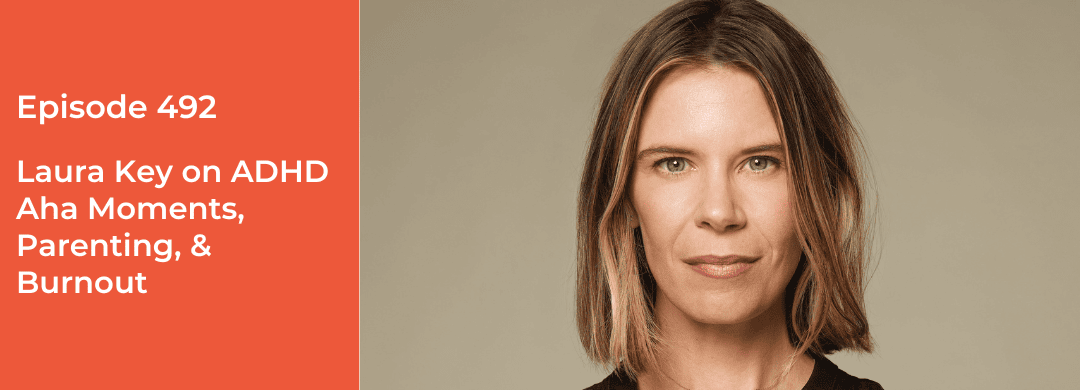
Today’s conversation is a candid, honest look at what it’s really like to parent while navigating ADHD yourself. My guest is Laura Key, Vice President of Content Strategy at Understood.org and the host of the award-winning ADHD Aha! podcast. Laura was diagnosed with ADHD at 30, and she brings both professional insight and lived experience to this conversation as a mom raising two neurodivergent kids. Laura and I talk about the emotional labor so many mothers carry, the unique challenges parents with ADHD face, and why self-compassion is not optional—it’s essential. We dig into shame, burnout (both the quiet, everyday kind and the big, overwhelming kind), communication with partners, and the pressure that can come with framing ADHD as a “superpower.” This episode is an honest exploration of the joys and struggles of parenting with ADHD, and a reminder that you’re not alone in any of it.
About Laura Key
 Laura Key is Vice President of Content Strategy at Understood.org, a non-profit organization dedicated to empowering the 70 million people with ADHD, dyslexia, and other learning and thinking differences in the United States. She’s also the host of the award-winning ADHD Aha! podcast.
Things you’ll learn from this episode
- How adult ADHD is often misread as anxiety at first, and why addressing one can illuminate the other
- Why late identification can bring both grief and relief after years of self-blame for brain-based differences
- How shame and invisible executive function demands can quietly dominate family life, especially for moms
- Why being great in a crisis but overwhelmed by daily details is a common—and misunderstood—ADHD pattern
- How burnout can show up as both “micro” and “macro” exhaustion, including frenetic busyness that masks collapse
- Why recovery often starts with basic regulation and more realistic self-expectations, not grand productivity plans
Resources mentioned
- ADHD Aha (podcast)
- Imposter Syndrome After a Lifetime of Hacking Her ADHD (Debbie with Laura on ADHD Aha)
Want to go deeper?

The Differently Wired Club is not your typical membership community.
There’s something here for everyone, whether you’re a sit back and absorb learner, a hands-on, connect and engage learner, and everything in between. Join the Differently Wired Club and get unstuck, ditch the overwhelm, and find confidence, connection, and JOY in parenting your differently wired child.
Learn more about the Differently Wired Club
Episode Transcript
Debbie:
Hey Laura, welcome to the podcast.
Laura Key:
Hi, Debbie. Thanks for having me. It’s great to see you again.
Debbie:
It’s great to see you too. And yeah, I’ll just say this upfront that I was on your wonderful show, ADHD AHA, maybe a few weeks ago as we’re recording this and we had such a good conversation. Very, yeah, it was very vulnerable on my side. like, oh my gosh, I really, really went there. And you know, you are so easy to talk to. And I was like, I need to have Laura on my show. So just to kind of set the stage.
Laura Key:
Sorry, I do that to people, yeah.
Debbie:
We’re going to be talking, just kind of having a more casual conversation for listeners. This isn’t kind of like a here are the five things that you need to know about X, and Z, but rather just having a really honest conversation, talking about lived experience of parenting, moming, while ADHD-ing, and all the joy and challenge that comes along with that wild ride. So as a way to kind of set us up, can you give us a little context for who you are in the world and kind of how you’re coming to this conversation.
Laura Key:
Yeah, well, I mean, as you mentioned, I’m a podcast host. I host the ADHD Aha podcast, which is part of Understood.org’s podcast network. I work at Understood.org. So I consider myself to be, you know, I’m a full-time employee, right? So I have a job. I think that’s important context, especially when we’re talking about burnout and parenting. I’m a mom. I am a wife. I’m a mom of two kids, a seven-year-old boy and a 10-year-old girl who both learn and think differently. And yeah, I’m just kind of feeling it out as I go through life, Debbie. That’s really what I’m doing here. I have ADHD myself. I was diagnosed when I was 30 with ADHD after previously being diagnosed with an anxiety disorder. So the ADHD anxiety combo, which I’m sure you’ve talked to lots of folks about that. So it’s a lot. And as I get older, wiser, we hope. I think it’s getting a little bit easier, but who knows? We’ll see. Every day is a challenge or a joy or just like you were saying in the intro.
Debbie:
Yes, I talk about us being like the full range of the human experience that we get to have every single day, which is great and challenging. Yeah, yeah. For sure. So and you you said you got your identification of ADHD at 30. Would you just tell us a little bit more about that? So many of my listeners are experiencing this kind of especially because of, you know, navigating process with their child and then kind of realizing, oh, okay, maybe I need to look in the mirror.
Laura Key:
Right. I get that so many times with my guests as well. They’re discovering their ADHD through their child’s evaluation or diagnosis. That wasn’t the case with me. I didn’t have kids at 30. They came shortly after. For me, it was that a year or two prior to my ADHD diagnosis, as I mentioned, I had been diagnosed with anxiety disorder. And once I kind of got that under control, heavy air quotes, right? So a little bit more, getting more familiar with my emotions, receiving treatment for anxiety, I was able to see more clear-headedly that there’s something else that’s like not quite right right now. So it’s like I needed to get that anxiety. I needed to have more awareness of my anxiety to even notice the ADHD. And I was seeing a therapist and a psychiatrist and a psychiatrist in one of my sessions just looked at me and he said, this was before my ADHD diagnosis, but after my anxiety diagnosis, said, Laura, when you go to these coffee shops and try to write, because I’m a journalist, writer, editor by trade, do you sometimes get distracted by something across the room and just feel like you are completely gone from what you were doing and can’t come back to it? It’s really hard to come back to it. And I was like, how did you know that? How did you know I’m so sensitive to sound? How did you know that I’m so distractible? And he’s like, I think that you should be evaluated for ADHD. And that started that whole process for me. I got diagnosed not once, but twice, because I kind of was like, is this for real? And yeah, and kind of eased into my diagnosis and had a lot of aha moments along the way.
Debbie:
Did you have kind of a knee-jerk reaction when that was first suggested? Like, how did it land with you?
Laura Key:
I mean, it’s wild, Debbie, because I worked at understood.org, which we serve people with ADHD and learning and thinking differences. And I was like, me? Huh? I mean, I think that was more than a decade ago. even then, and still now, there’s this misconception about what ADHD is. And even for me, that was true. It kind of culminated into this moment post-diagnosis that I’ve talked about a lot on other shows and on my own show, which was my big ADHD aha moment, going back home to my parents’ house in Ohio for some reason post-ADHD diagnosis, going through my old journals from when I was 12, 13, 14 years old, and discovering that I had been scribbling the word focus all over these journals and kind of, can I curse on this show?
Debbie:
I’ll bleep it out. It’s fine. Yeah.
Laura Key:
Crapping all over myself for my trouble with focus. It hit me and I started sobbing. Like, this has been an issue my whole life. This is real. This has a real effect on my life and it’s something I need to pay attention to and not brush off.
Debbie:
Wow. Yeah, wow. It’s fascinating. It’s fascinating what our younger selves and you know, I don’t want to get down this rabbit hole, but I’m so curious because a lot of the work that I’m doing in my own kind of reconciling my little Debbie, if you will, not the snack. I know you both, you know, the little Debbie like, like, you know, what she knew and what was going on. And you know, there’s so much. There’s a lot of conversations happening between the Debbie of today and that little Debbie and have you kind of found that to be a healing journey or what’s that been like for you?
Laura Key:
I love little Debbie. I mean, it has been a healing journey. So much of it is about shame, right? This is something that we, it’s a consistent topic on the show that I host. We start the conversation talking about ADHD symptoms and evaluations and diagnoses, but where we ultimately often land is on shame. And that’s in my own conversations with myself as well. We wanna talk about burnout and parenting as a mom with ADHD. When I get really overwhelmed, I sometimes just and I learned this through therapy, I just stop and say, OK, what am I overwhelmed about? What is the real thing that’s getting to me right now? And more often than not, the question or the assumption that I’m making about myself when I feel those moments of shame is, I’m a bad mom. Right? And then you have to be like, then you stop yourself. You’re like, no, I’m not a bad mom. There’s no evidence that supports that. I’m having a bad moment, but I’m not a bad mom. And those are the kinds of conversations, whether consciously or unconsciously, I think I’m having a lot with myself these days and probably forever.
Debbie:
I think, yeah. Well, and I guess the hope is when we become more familiar with that voice or that story, that default mode network or whatever is happening in our brain that we spend less time buying into it. Like we see it for what it is more quickly and we can be like, yeah, I hear you, whatever, not true, next. You know, we can just kind of move along. That’s the goal, I think, yeah. I’ve seen multiple therapists throughout my life. And when I went to my latest therapist, I was like, you know, I don’t really wanna talk about my mom and dad. I’ve gone there. Let’s go somewhere else now. Check, check. My mom and dad who are amazing, but yeah. Been there, done that. Yeah, that’s funny. So well, let’s talk about motherhood and momming while ADHD, because I think that it’s kind of a unique situation to be, and, you know, I’ll just say not to generalize, but a lot of the time, I’m sure you see this in your work, I definitely do in mine, it is the mom, you know, if there’s a two partner relationship that is kind of carrying a lot of the executive function tasks and the emotional labor and just kind of holding all the pieces. So I’d love to hear from you, maybe from your personal experience or people you’ve talked to, what are some of kind of the unique challenges that a mom experiencing ADHD and parenting would be going through?
Laura Key:
Yeah. Well, I think you just hit on one of them. And it’s true for me as well. Despite having a partner who is so in it with me and is just really shouldering the load alongside me, there is still something extra that us moms often take on, that emotional labor and the constant planning of the family calendar and making sure that the right stuff is in the backpack for the morning. And it all sounds so simple when we talk about it here, but you know, Debbie, I know that it’s really overwhelming and it can be a lot to manage. All of the planning that goes into it. So the extra layer of ADHD just makes it so much harder. Now, fortunately, I am at least somewhat aware of this and I have open conversations with my husband about this and he knows. So we talk about ways to share that emotional labor, that planning labor, that executive function labor as best as we can. it still ends up, it’s just, I don’t want to say it’s in our nature. I want to be mindful of that. But it is something that just happens. So that’s a big part of me. I’m very aware of it. The challenges that come from being the executive function, the brain center of the family when you struggle with those exact skills. So that is the big one.
Debbie:
Yeah, the brain center, yes, of the family. And I was just thinking of something I’ve been thinking about over this past couple of months. We’ve had kind of a tumultuous, just with sandwich generation stuff a lot happening in my household. And I have also felt like I’ve had to be kind of the regulation center of my family, right, to hold all of the energy of my neurodivergent husband and child and I’m like, wait, like, am I the best one to be doing this? But I, you know, we often find ourselves in this role. And, and I think there’s such a, especially again, for, for a lot of moms and women, there can be this additional, almost like an unspoken expectation that we’re just supposed to naturally be good at this stuff or do this automatically.
Laura Key:
Right. Yeah, I hear what you’re saying there. But one thing that has kind of become more apparent to me throughout the years is the everyday executive function stuff is really hard for me. And the overwhelm comes quickly and more often than I’d like to admit. But as I’ve gotten older, I’ve been able to recognize that those little things that it’s cliche, but the don’t sweat the small stuff. I still do to be clear. Like those things, if I can recognize that it’s not that big of a deal that we forgot to pack the blah, blah, blah in the backpack this morning. Where I feel, but I’ve also noticed that where I perform and quotes better is when we are kind of in more of a crisis, right? And I’m able to be really present. There’s that as someone with ADHD, there’s not to be weird about it, but like there is kind of a novelty when you’re in those moments and you can really hyper focus and that’s where I really thrive. And I have had to tell myself that like that actually matters more when the family is really going through something serious, something that you really need to be present for and be a planning center and an emotional nerve center. If you can be calm in those situations and help with, you know, moving everything along, that’s more important than making sure that everything is packed up perfectly for the next day.
Debbie:
Mm-hmm. Yeah. So interesting. didn’t think of that as an ADHD strength. Let me say that again, because I just slurred my words for some reason. That’s really interesting. I didn’t think of that as an ADHD strength. But I literally was having this conversation with my humans two nights ago, just about how good I am in a crisis. I am like nobody’s business. I’m like, you know, I will call anyone and I hate calling people on the phone, but I will be like on everything. So that’s super interesting. I hadn’t connected those.
Laura Key:
That is interesting. You don’t like talking on the phone either? I don’t like talking on the phone. It’s the worst.
Debbie:
It’s like my least favorite thing to do. Yes, I will avoid it at all costs, but unless there’s an emergency and then I’ll be like, let me talk to that person right now.
Laura Key:
Yeah, right. Yeah, yeah, let me get this sorted. And here’s what you’re going to do. And here’s what you’re going to do. All of a sudden, I’m the greatest project manager in the world when there’s a crisis. But I forgot an onion to make the chili for tonight. And I’m like, oh, I’m a terrible human being, right?
Debbie:
Yeah. Totally. Yeah. that’s so relatable. So when we were first talking about having you come on the show, one of the themes I was interested in exploring with you is burnout. in part, we’ve done shows on autistic burnout. I think there’s more and more awareness of burnout related to neural divergence as a kind of concept we’re seeing in our kids. But I also have been reading more about ADHD burnout and that it is a real thing. And it’s something, I don’t know if I was. you know, actively and burnout the past couple of months, but I definitely struggled more than I had in a while. And I started to wonder like, is this what ADHD burnout is? it, you know, and so I’m just wondering if you could talk about burnout, you know, if you’ve experienced it before, or how do you kind of describe it or define it?
Laura Key:
I describe it as exhaustion, paralysis, just feeling stuck. I mean, that’s really what it means to me. My son, he made me laugh the other day. And in the past, this was a win for me because it would have pained me in the past. And I would have been like, am I a bad mom? But it made me chuckle, so I viewed that as progress. I forget what we were talking about, but he was like, well, yeah, mommy needs a lot of breaks. My sweet seven-year-old. And I was like, I do. And do know why I take a lot of breaks? I need it. I need to get my energy back up. I need to rev up and get ready to do the next thing and the next thing. And to avoid that burnout is ultimately what I’m trying to do. So it’s like there’s those micro burnout moments, and then obviously there’s macro burnout moments. The micro where I risk the micro burnout moments is when I get home from work. Just I’ve been kind of holding it together all day and I work in a very neuro inclusive environment. I’m very fortunate, but even still there’s a lot of focus and executive function work that has to happen and I need to be a professional about it. So I come home and I can kind of let go. And I know that I need that 10 minutes as soon as I get home where nobody talks to me. Sorry, I went right into tip mode as opposed to talking about the actual burnout.
Debbie:
No, keep going. You’re good.
Laura Key:
But when I know that the feeling that I get when I know that I’m in a burnout phase is it kind of almost mirrors depression a little bit. And I know myself, and I know it’s not depression. For some people, maybe it is. For me, it’s not. For me, I need to lie down because I don’t know what to do next, and I just can’t activate at all. And I think that would have been more common for me in the past. It happens less frequently now. You never know what the future will hold. But yeah, it feels like exhaustion, and it feels like paralysis.
Debbie:
Yeah. Yeah, and I was just thinking that the way that I move through the world is I’m, it’s almost, I’ve written about this in my newsletter a couple of times when I was really experiencing this was this almost a frenetic energy that I just, there was so much going on. There was again, this kind of sandwich generation, some, many crises that we were dealing with. There was my workload and there was just so many moving pieces. I was like, cannot slow down for many reasons. One, there’s too much to do. Two, slowing down feels super uncomfortable for me. Even as I was in that mode, I’m like, this is not sustainable, Debbie. You are not going to be okay. I knew that and I still kept doing it anyway. I did hit a point where I was like, like I did crash, right? So that to me, does that sound relatable?
Laura Key:
Yeah. I mean, so relatable. You actually jogged my memory. I appreciate that, or jogged my thinking. What you’re describing, that word frenetic really, really sticks with me because when I get the most overwhelmed, sometimes I end up in bed with analysis paralysis. But actually, more often than not, I end up flitting around the house doing things that make me feel busy and accomplished, but I’m really not doing anything that is helpful. I’m kind of outside of my own body watching myself kind of move around the house, move, you know, this piece of paper into a bin and da da da da da and talking about all the things. And I start to talk really, really fast like this and like, we got to do this and we got to do this and we got to do this. And it’s almost like, I think sometimes people use the term rage, like raging a little bit. Not a little bit, maybe a lot. But it’s this just, it almost feels like a high, which isn’t something that I’m really, it feels strange to admit that, but it does. feels like you are like finding this adrenaline boost by doing all of these things. And you’re in this high and you don’t want to get out of it because number one, then you know, you’re about to crash. And number two, for me, I’m going to feel the shame of all of that frenetic moving and talking and maybe even shouting. that I was doing to cope. And so you try to stay in it as long as you can so you can avoid the crash and the shame. Do you relate to that? Yeah.
Debbie:
Yeah, and it’s something my therapist and I have talked a lot about. And she’s always encouraging me to slow down. And I’m like, no, like super not interested in that. But thanks for the suggestion.
Laura Key:
Yeah, because if I slow down, what would it mean? Right. Yeah.
Debbie:
Right, right. So before we go to break, just to kind of close the loop on burnout, I’m curious to know when you’ve been in that kind of a more significant, not from a micro burnout, but something more significant, what have you found to be most helpful to kind of move through that and get to the other side?
Laura Key:
It’s such a boring answer, Debbie, but it almost always comes down to sleep for me. I will go to bed as early as I can and give the response. I’m fortunate I have a partner I can give the responsibilities to. I know not everybody has that, but give him the reins and say, I need 12 hours tonight. I need to completely recharge and not do anything else tonight. And that doesn’t fix it 100%. I mean, if we’re talking about a macro burnout moment, but it’s that. And then you try to get a workout in the next day. And then you try to make a really delicious meal. You know, just little things to like, almost like very, I’m kind of like a sensual person. I like touch. I like like things that are comforting, right? And I mean, sensual in like the comforts kind of way, not in the other kind of way, but necessarily for the show. but really getting in touch with those comforts, right? Like you have a heated blanket, right? Like holding onto that and making sure that take things a little bit more slowly, even if it’s uncomfortable. Yeah.
Debbie:
Yeah. Yeah, that’s great. Okay. And it’s good to hear also that you can sleep because, know, ADHD and sleep don’t always go hand in hand as being like the best of friends.
Laura Key:
I’m not ashamed to take a melatonin, let me tell you, or two.
Debbie:
So I would love to talk with you about this idea of ADHD as a superpower. It’s something in my community we’ve talked a lot about, just neurodivergence in general, and that’s a really complicated concept. Especially as parents are talking with their kids about their neurodivergence or ADHD, I think we want our kids to see it as a strength or as a superpower. a lot of people don’t feel that it is a superpower. So I’d love to know your thoughts on that. Let’s start there.
Laura Key:
Sure. I think context matters when you’re using the superpower narrative. I’ll speak for myself to start. I don’t like it for myself, and here’s why. It doesn’t mean I don’t like it in general. I think it can be really helpful for some people and for some kids, depending on how you use it. I don’t like it for myself because I’ve got enough guilt and shame in my life. And telling myself that this thing is a superpower makes me feel even worse about myself. Well, if I’ve got the superpower, why can’t I do x or why can’t I do y or why can’t I do z? Why am I struggling so much? So I think it puts unnecessary, let me rephrase that. I think it just makes it feel unnecessarily saccharine when we call it a superpower. That’s just my own POV. I have a hard time with that. There are moments when I do feel like a superhero with my ADHD. I talked about one earlier, in a crisis moment, when I can hyper-focus and just get things done. That hyper-focus is often cited as an ADHD superpower. And I don’t disagree with that. I think, if leveraged, it’s an amazing strength that people with ADHD can have. But again, I think it’s just something to be mindful of. I don’t use that. or I haven’t yet, maybe I will one day with my kids. I just like to speak in more practical terms, more realistic terms with them. But I’m not ruling it out. I can imagine myself at some point using it, right?
Debbie:
I don’t think it’s a term that we’ve used with our kiddo either. We do very kind of matter of fact, like information. This is information. This can be hard. This could be easier. This is one of the strengths. This could be especially difficult. And we just kind of present things like that. I’m curious, you you mentioned your kids and that they also learn and think differently. And I’d love to know how you how your own neurodivergence has kind of supported your relationship with your kids and just how you kind of navigate those conversations and identity conversations and just modeling your own lived experience as a human to your kiddos.
Laura Key:
Yeah. Well, with my daughter, who’s 10, I’ve had more time to process this with her. She has the same diagnosis as I do. And she was diagnosed last year. And it’s really helpful to have a shorthand. It can also sometimes be hard. I’m sure you know this. You feel like, we should be relating about this. Or I learned this lesson, so learn it the same way that I learned this lesson. And I have to constantly remind myself that she has to go through this herself and she’s already got a leg up. I mean, she was diagnosed 20 years earlier than I was, right? So she has this awareness of herself, which I find to be so exciting to watch, to see her already self advocating and knowing herself in ways that I did not know myself as a child. So that’s really exciting. I just have to kind of pump the brakes when I want to get a bit heavy handed with the, well, let me tell you what works exactly for me. Everybody’s different. We are much, much earlier on this journey with my son, who’s seven, in fact, as of a few days ago. So I don’t have much to say there. We’re figuring that out as we go. But maybe have me back on in a couple of years, and I’ll tell you how that one’s going.
Debbie:
And yeah. Yeah, and in terms of your own being a parent, I think about the way the conversations we have. And again, my kiddo is older, so 21. And we’ve known about their neural divergence for years and years and years. My husband’s and mine is more recent information. But now there’s like. Of course, yeah, I have lots of strategies and wisdom to share for sure that my child is not interested in at all. there is this kind of like, I get this too. Yeah, that happens to me. And also me kind of very out loud modeling the things that I’m doing or the things that are hard for me and the strategies. I just find that it’s kind of woven now into everything that I do. And I feel like it’s helped us. relate to each other on a different level. Even if all of my suggestions are completely dismissed, it’s connected us. And I’m just wondering if it’s helped you in that way.
Laura Key:
Yeah. Yeah, it definitely has. There’s just a natural empathy, number one. I think even a shared empathy. I’m really impressed with my daughter’s emotional intelligence already. And we see each other, so that’s really helpful. And if I can avoid the heavy handedness about my tips and I can say, know, us ADHD folks, we sometimes rush through things. It can be helpful to take another look at your homework before you hand it in. It’s up to you, but it can be helpful, you know, just to be able to kind of squeeze those things in with, and I can do it with a little wink and, and she gets that. So, yeah, she’s, she’s amazing. I’m really, I’m so lucky to have her truly. Yeah.
Debbie:
So we’re going to start to wrap up, but I’m, I’m curious to know with all of the interviews that you’ve done on the show and all the folks that you’ve talked with and about their own discovery of their ADHD, or, know, you talk about the hitting the wall moment, in parents or just in, in, in people who are navigating this diagnosis, I’m wondering if there are some kind of things that would be surprising to some to know that, this is actually a piece of ADHD that a lot of people or an experience, part of the experience that a lot of people wouldn’t really realize. Like I have the things that have struck you in the course of hosting your show.
Laura Key:
Yeah. Well, in terms of, someone asked me this in regards to their kids and things to look out for. So this I can speak maybe more to the adult side of it in a moment, but on the kids front, one thing that I’ve noticed a lot from the parents that I’ve interviewed is, especially for the moms mostly who I’ve interviewed raising girls with ADHD, often their first sign that something was going on. is that the teacher said everything was great, but my kid comes home and falls apart when they get home from school. Girls in particular, all kids, but girls in particular do so much masking. And that’s also true and especially true with ADHD. So I think they’re doing a lot of holding it together at school and then coming home. And this is a sign that this is their safe space. So good on you, mom, if they’re falling apart at home. coming home and being like, no, no, no, I don’t got this. I don’t got this. I need support. So that was kind of an unexpected thing that I’ve learned. I think I’ll go back to the shame of it. ADHD is so pervasive. It affects all areas of our life. And it’s not something that goes away. might morph. It might evolve. But it doesn’t go away. And I’ve just been consistently amazed at the levels of guilt and shame that people with ADHD experience because we feel like these are things that we’re supposed to be good at, the executive function skills, especially women. We feel like these are things that I’m supposed to be in charge of, the things that I’m supposed to be managing for my household. And why can’t I, quote, get it together?
Laura Key:
So to have that as a constant reframe, which bears out in the research that we’ve done. So we recently did a study with Torrance University Australia, studying, asking questions to listeners of ADHD AHA and misunderstood, which is another ADHD podcast. And we were asking them questions about their, why do you listen to podcasts? What do you gain from podcasts? But we also asked them about, what are some of the biggest challenges that you face? And it was shame. Shame, not hyperactivity, not impulsivity, not trouble with focus, but shame. And I think that that’s really telling. They also said that listening to shows, here’s my little plug, they also said that listening to shows like ADHD AHA helps them reduce their feelings of shame and feel more community. So if you are experiencing signs of ADHD or have been diagnosed, come check it out. But yeah, the shame, it always strikes me. And it’s… When I’m interviewing people with ADHD, I notice people have such an empathy for other people and they give so much grace to other folks, but not to themselves. And I often play that role. I’m not a therapist. I just play one on TV. But I often play that role of saying, did you hear what you just said about yourself? Let’s compare that to all the grace that you’re giving everyone else in your life. Little mushy. Sorry, Debbie. But it’s true.
Debbie:
Yeah. Yes. No, it’s so true. In my community this month, our theme that we’re exploring is self-compassion. it is striking a chord with so many folks because we are so hard on ourselves and we rarely give ourselves the grace that we give other people. So no, I love that. And it leads me to asking just one more follow-up question before we wrap up. You’ve talked about shame and I’m just wondering, is there been kind of a big, the biggest growth area for you if you’d be willing to share it, I think about for me, my journey and we talked about this when I guessed it on your show was about really becoming more comfortable with who I am and knowing that I’m enough, right? I talked about my imposter syndrome about having about, it was like very meta, my imposter syndrome. it was a fun conversation.
Laura Key:
Debbie was so great on the show, everybody. You have to check out her episode.
Debbie:
But yeah, so that’s my work. Like I know that that’s my work and it always comes back to that. And I’m just wondering if for you, has there been some related to shame, this kind of like this opening or kind of some, yeah, just, I don’t know. kind of, I’m using my hands if you’re not watching this. I’m like, okay.
Laura Key:
Yeah. No, I get it. My thing, I got you, Debbie. The thing that has been kind of cathartic for me, something that has been really important for me to continuously remind myself is, and this is going to require some explanation so it doesn’t sound like the wrong thing, but is to lower my expectations. We need to have high expectations for neurodivergent people in general in society so that they get the supports that they deserve and need, that we deserve and we need. But I think in our individual lives, we have these high lofty expectations of ourselves and what it’s all going to look like. And that creates so much pain. A kind of a funny example I gave in a recent interview was I remember putting on my baby shower list that I wanted a baby food maker. And then I got the baby food maker and I just re-gifted it. I’m sorry to whoever gave that to me. You got me what I asked for. But like, not gonna make baby Who am I kidding? I’m not gonna sit around making my own baby food. If you do, you are amazing. Good job. But I just, I’m not gonna do this. So let’s just be okay with the fact that I’m gonna buy the store-bought food. This is a really low stakes example, but I think you get what I’m saying here. cause we’re, we just, if you don’t, if you set these unrealistic expectations for yourself, you’re just constantly going to be disappointed and unhappy. Yeah.
Debbie:
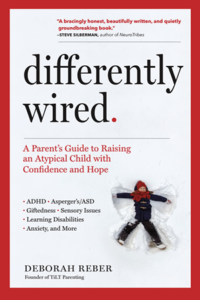
Yeah, it’s kind of like a perpetual chasing after something that isn’t attainable. But we feel like when we get it, it’ll somehow make us whole. Right. But no, we just need the next thing. So it is very freeing. You know, just to touch upon your example, I wrote about this in differently wired that I, I really was pushing myself so hard and felt like such a failure, because I wasn’t making my own baby food because I lived in Seattle. Like everyone was making like at their home and I’m like, my God, I’m such a failure. So totally relatable. Okay, gosh. Okay, we’re gonna wrap this up. This has been such a fun conversation. I appreciate you. We kind of went all over the place and thank you for letting me kind of, yeah, kind of probe here and there. So I will just say that yes, I will have links in the show notes page to ADHD AHA and to, I’ll put all, you know, there’s a bunch of great podcasts that understood hosts and I’ll put links to all of them because they’re all really good listens, misunderstood, like they’re just really, they’re short, they’re powerful. So I’ll have links in the show notes page to that. Where else can people connect or would you like to direct people?
Laura Key:
Understood.org, if you are looking for information about learning and thinking differences, you can obviously check out all of our podcasts. you just mentioned, Debbie, check us out on Instagram, on Facebook. You can find us all over, but I’m really proud to work at Understood. I’ve been here since before we even launched, so I’ve been here from the very beginning. And we’re here to support. We’re here to help. So check it out. Check us out.
Debbie:
Yeah, that’s great. Awesome. And I’ll just, another plug for Understood when I, I’m in my 10 years now of launching Tilt and it was, thank you. And it was spring of 2016. And a few months later, I heard, I don’t remember who reached out to me initially, but someone connected me with David Flink, who I, I was under the Understood umbrella at the time and that I met Amanda Morin and then like, so I’ve been collaborating with and connecting with the Understood family for. almost a decade and I really do. It’s such a fantastic resource and you offer so much, not just for parents with neurodivergent kids or kids who learn to think differently, but for adults as well. So that’s awesome. Aw, thanks Laura. Thank you so much. This was so fun. I really appreciate it.
Laura Key:
Yeah. Well, we love you. You’re part of the family, Debbie. My pleasure. Thank you so much.
Do you have an idea for an upcoming episode? Please share your idea in my Suggestion Box.