Dr. Sharon Saline on Understanding Rejection Sensitive Dysphoria (RSD) in Tweens and Teens
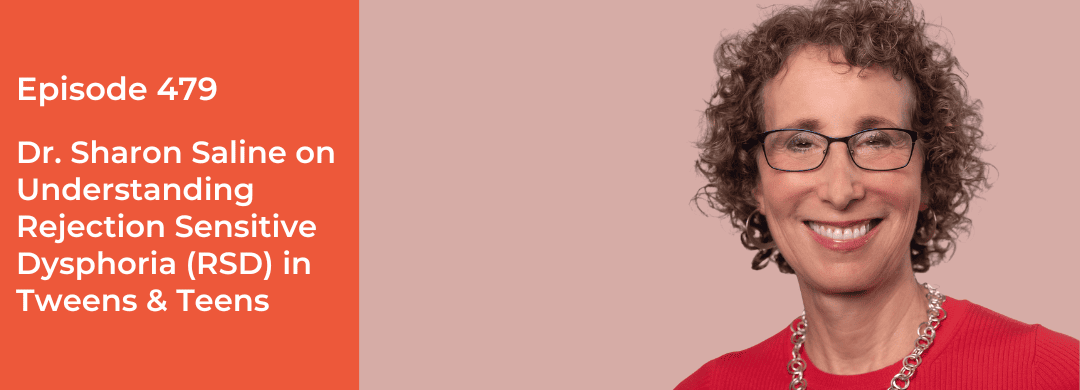
Today we’re talking about Rejection Sensitive Dysphoria (RSD), a deeply emotional experience that affects many individuals with ADHD and other forms of neurodivergence. My guest is Dr. Sharon Saline, a clinical psychologist who has spent over 30 years working with neurodivergent children, teens, adults, and families. In our conversation, Sharon breaks down what RSD is, how it shows up in daily life, and why understanding it can be such a game changer, for both kids and parents. We talk about the emotional and psychological impact of RSD, practical tools for managing it, and how to cultivate self-compassion and resilience in the face of painful rejection or criticism. Sharon also shares strategies for helping kids navigate social situations with more confidence and less overwhelm, and for supporting ourselves as parents along the way.
About Dr. Sharon Saline
 Dr. Sharon Saline is the author of the award-winning book, What Your ADHD Child Wishes You Knew: Working Together to Empower Kids for Success in School and Life and The ADHD solution card deck. She specializes in working with ADHD and neurodivergent children, teens, adults and families–helping them improve cognitive and social executive functioning skills, resilience, self-confidence and personal relationships. She consults with schools, clinics and businesses internationally. Dr. Saline is an instructor at the University of Massachusetts Chan Medical School, a part-time lecturer at the Smith College School for Social Work, blogger for PsychologyToday.com, contributing expert on MASS Live at WWLP TV, serves on the editorial board of and hosts a monthly live event for ADDitudemag.com.
Things you’ll learn from this episode
- How rejection sensitive dysphoria (RSD) shows up as an intense emotional response to perceived rejection or criticism
- Why many people with ADHD also experience RSD and how it can affect social interactions and relationships
- How RSD can trigger deep shame and emotional pain, often overlapping with social anxiety
- Why self-compassion, resilience, and reframing negative thoughts are key coping strategies
- How parents can support their children by validating their feelings rather than minimizing them
- Why understanding RSD is empowering and helps individuals navigate relationships with greater self-awareness
Resources mentioned
- What Your ADHD Child Wishes You Knew: Working Together to Empower Kids for Success in School and Life by Dr. Sharon Saline
- Dr. Sharon Saline on Understanding and Working with ADHD in Girls (Full-Tilt Parenting)
- The ADHD Solution Card Deck: 50 Strategies to Help Kids Learn, Reduce Stress & Improve Family Connections (created by Dr. Sharon Saline)
- Sharon Saline on What Our ADHD Kids Wish We Knew (Full-Tilt Parenting)
- Dr. Megan Anna Neff on RSD (Neurodivergent Insights)
- Sharon Saline on RSD (Additude Today)
- How ADHD Shapes Your Perceptions (PDF by William Dodson)
- Big Kids, Big Emotions: Helping Teens with ADHD and Rejection Sensitivity Improve Emotional Regulation (Webinar with Sharon Saline on Additude Magazine)
- Q: Are My Feelings Valid, Even If RSD Is Involved? (Sharon Saline on Additude Magazine)
- I Feel Judged & Attacked: A Teen’s View of RSD (Sharon Saline on Additude Magazine)
- Dear Dr. Sharon: Is Rejection Sensitivity All In My Head? (Sharon Saline’s website)
Want to go deeper?

The Differently Wired Club is not your typical membership community.
There’s something here for everyone, whether you’re a sit back and absorb learner, a hands-on, connect and engage learner, and everything in between. Join the Differently Wired Club and get unstuck, ditch the overwhelm, and find confidence, connection, and JOY in parenting your differently wired child.
Learn more about the Differently Wired Club
Episode Transcript
Debbie:
Hey Sharon, welcome back to the podcast.
Dr. Sharon Saline:
Thank you so much for having me, Debbie. I’m really excited to be here and I’m really excited about our topic today.
Debbie:
I am too. This is like one of my special areas of interest. I’m fascinated by the idea of RSD, which, rejection sensitive dysphoria, which we’re going to get all into. But I do want to, it’s been a couple of years since you’ve been on the show. It’s been a couple of years since you’ve been on the show. And the last time was actually talking about ADHD and girls. And then before that, you were on the show to talk about your book, What Your ADHD Child Wishes You Knew. I will have links to both of those episodes in the show notes. Listeners, go check those out. Great conversations. But I did a conversation on RSD a few years ago. And you’re like, oh, I want to talk more about this. This is really what I do. so I’m so excited we’re making this happen. Before we get into it, tell us why this is something you’re so passionate about and how this kind of fits into the work that you do in the world.
Dr. Sharon Saline:
So I am sort of a late diagnosis ADHD person. My ADHD was really, it’s more about emotional regulation, feelings of sometimes being flooded or overwhelmed, difficulty with time management or shifting. And the reason that I’m so interested in RSD is because I have it. And I have had it probably my whole life. When I was growing up, my parents and my brother used to sort of tease me and they would say, super sensitive Sharon, you know, like you’re just too sensitive as if that was something that was bad, something to be ashamed of. And actually, I feel like my sensitivity makes me a much better psychologist, a better writer, a better presenter. It’s an asset. But for a lot of people who live with neurodivergence, that would be ADHD, might be ADHD with a learning disability, that’s at least 70% of kids, ADHD so rarely travels alone that somewhere between 60 and 100% of children and teens with ADHD have a coexisting diagnosis. And that can be a learning disability. It could be a mental health issue. It could be a health issue. But it’s usually the first two. So if we’re going to talk about RSD, we actually have to zoom out a bit and talk about social anxiety disorder. So if we’re to talk about rejection-sensitive dysphoria, we really have to zoom out and talk about social anxiety. Social anxiety in neurodivergence in particular. Because social anxiety is actually a diagnosable condition, and rejection-sensitive dysphoria is not. So I see social anxiety as an umbrella condition. And underneath it, we have RSD.
We have perfectionism and we have imposter syndrome. So let’s say that we have RSD and perfectionism imposter syndrome under this umbrella, if we agree on that, then the question is, why are these all grouped together? And that’s because they share a core sense of deficiency, a belief that you’re not enough that you can easily fail or fall behind or be excluded because you’re different. You have ADHD or neurodivergence and you don’t maybe deserve positive accolades. You’ve had years of receiving criticism and experiencing judgment. And all of these kind of compound into developing a core sense of deficiency. This can also happen for people who’ve experienced some sort of trauma. There is some indication, of course, there’s been some research that links social anxiety to trauma. And some people think that RSD actually is a bit of a trauma response. I’ll talk about that a little bit later. Social anxiety is an intense fear in advance of an event or a situation where you think you’re going to be embarrassed and you’re expecting a kind of judgment and criticism. Social anxiety is a situation where you think that you know what other people are thinking about you, which you do and you cannot. The reason that RSD falls under the social anxiety umbrella is because it takes these worries to the next level. It occurs in response to not just real rejection, but perceived rejection or criticism. And so it’s because it’s not a formal diagnostic category and a lot of people don’t know about it.
It’s actually a syndrome that was named by my friend and colleague, Dr. William Dodson, after years of observing these traits and behaviors in his patients with ADHD. I just want to say something about perfectionism, which is an ineffective coping mechanism for managing anxiety related to disappointment, insecurity, or embarrassment. And it’s directly related to a need for and then imposter syndrome, which is about feeling like a fraud or a phony because you’re not perfect and you can never achieve perfection, then you’re fundamentally flawed. And so I think it’s important that we have that groundwork. We know that about nine to 10% of children and adolescents across the board have a social anxiety disorder. If we’re thinking about children and teens with ADHD, Or as I like to say, the late Dr. Thomas Brown speculated that that was closer to 33% and for adults. And it’s true of anxiety disorders in general that we see about 9% of those in children and teens and for kids who are neurodivergent and have ADHD, it’s at 40%. And I think that’s low and most of my colleagues do too, but that’s, you know how it’s being measured in the research. It’s not necessarily having a lot of traits of anxiety or experiencing anxiety.
Debbie:
Ok, so I’m taking a ton of notes. And so this is where my brain is like, where do I go next from here? But what I’d love to do is talk about what RSD might look like so listeners can kind of have a sense. Because I will say when I first read about it, it really just clicked for me in so many ways and it made so many things that I observed and experienced make sense. So what would RSD look like or what might it look like? It’s probably different for everybody, but what are the common traits?
Dr. Sharon Saline:
Absolutely. you know, the thing is, it’s these intense feelings related to the belief that you’ve made a serious mistake, an unfixable mistake, or you’ve failed at something, and as a result, people are going to pull back their support, their love or respect. And RSD causes emotional pain. It’s almost a physical sense for people. And it plagues children and adults with ADHD. Even when no actual rejection has occurred. So some of the key traits are in these intense feelings based on a belief that you’ve let people down or embarrassed yourself, difficulty letting go of past hurts and rejections, a heightened emotional sensitivity, intense mood shifts, shame, and I would say an intense shame related to any missteps or mistakes. So it’s very hard to recover from personal criticism. People with RSD can remember very specifically times when they were criticized or put down or blamed or shamed. And they can hold on to unkind words or actions directed at them for months or even years. Like it’s very hard to shake it off and it’s very hard to bounce back. And so you’re kind of living in a one down position.
And the difference between the mood shifts that come with RSD and the mood shifts that come from a mood disorder is that these mood changes with RSD come from clear triggers versus with bipolar disorder, depression, or other mood disorders. They don’t necessarily relate. Those mood changes don’t relate to the specific triggers. And it’s that quick drop into shame, quick drop into humiliation or embarrassment. A lot of people with ADHD are people pleasers to avoid conflict, to avoid the of the disapproval. And there are two types of RSD. So there’s internalized, where the negative feelings and the strong reactions are directed to and in state inside of a person. And we see this related to heightened anxiety or panic. And then there’s externalized where we see these responses in aggressive behavior or outbursts. Now, As I said, there’s some thinking, well, is RSD a form of complex trauma? Dr. Dodson says no. Other people disagree, because what people say is, if you’ve been judged and criticized and made to feel like you’re not enough or you’re bad or you’re too much, there’s sort of a kind of complex trauma that a lot of people who are neurodivergent have, and that is kind of because there’s a developmental aspect to it. And so it would make sense that if you feel marginalized and you would be careful about avoiding rejection. So I think it’s a little bit of both. A lot of people with RSD are really ashamed of their overreaction. They’re ashamed of the kind of rumination that goes on and they try to hide their pain or distress.
Debbie:
Okay, so I had two things that I wanted to touch upon based on what you just said. One of them is I’m wondering, is there an age where we might start to see RSD in a child, would it be more of a school age after they’ve had some experiences that might have provided negative feedback?
Dr. Sharon Saline:
Usually it’s after school age. I think we really see it starting in middle school with adolescents and then on. Many adults have RSD. And sometimes young children can be sensitive. I will say that I was kind of a moody child. I was sensitive. Things hurt my feelings pretty easily. And You know, I actually really love theater and I did a lot of theater, but I couldn’t go into it really as a profession because I honestly couldn’t deal with rejection. You know, so I do my own thing and, you know, created my own little cabaret shows as an adult or did some improv or something like that, that were the lower.
Debbie:
Yeah, yeah, makes sense. And also, as you were talking, I was thinking about this generalization. This is something that I’ve observed. This like, everybody always thinks this about me, or it doesn’t matter what I do. This always happens, right? And I was thinking that’s like a cognitive distortion, right? And I’m wondering, does RSD fit into that umbrella of cognitive distortions.
Dr. Sharon Saline:
Of course, because many people with ADHD are black and white thinkers. They’re all or nothing thinkers. It’s all this or it’s that. They have a fixed mindset. And that would play into having ADHD, having, excuse me, RSD. You know, one of the things that, you know, I have some strategies that I’m sure we’ll talk about, but one of the strategies is Q-tip. Quit taking it personally that a lot of times for people who have RSD, really there’s a need to zoom out and to really see, what’s yours in a situation or conversation and what someone else’s. I know that Mel Robbins has her let them theory, which is huge. I think for people with ADHD, it’s not let them, it’s what is them and what is me for with RSD, it’s me. It’s about me more than I think it’s about someone else. And that has to do with that history of growing up, particularly, you know, when you have ADHD and some other stuff going on where you’re kind of going along in your life and you think you’re fine. And then, oops, you know, someone tells you you’re too loud or oops, you’re you know, you need to keep your body parts to yourself or oops, you know, you didn’t remember to study for your math quiz or whatever it is that then you start to mistrust yourself. And that kind of self-doubt dovetails with rejection-sensitive dysphoria because people who have RSD struggle with being able to practice self-compassion and a growth mindset. So I made a mistake. I tried this thing, it didn’t work out. That’s not a big deal. I’m going to regroup and try again. And that’s hard for a lot of people, particularly those with RSD.
Debbie:
Yeah. Yeah, and I think too, when people mistrust themselves, that means they’re really trusting others more than them. And that can put them, would think, in very vulnerable positions in relationships and social communities in general, if you’re kind of feeling like everybody else’s perspective of you holds more weight than your own.
Dr. Sharon Saline:
Absolutely, you know, and it has to do with actually what I call holding out your ADHD approval cup to others. So, you know, it’s empty and you’re holding it out to other people to fill up. And really what we want to do is help our children learn how to fill it up themselves. So instead of saying things like, you know, I will embarrass myself. I make bad first impressions. People won’t like me. I’m not very smart. I will do or say something wrong. We want to help our kids learn how to say things like, I’m stronger than I think. My mind is uniquely wired and creative. I can make a mistake and still be a good person. I can’t get hurt and bounce back.
Debbie:
Yeah. Yeah. And I imagine, again, because these kids are fixed mindset, often they’re going to need a lot of evidence of that till they, I mean, this is a really complicated way to move through the world, right? So, and we will talk about strategies, but I just think about as our kids kind of get older and kind of launch like this is something that can really impact their ability to thrive in workplaces and to just, because there’s so many opportunities to perceive criticism or to get feedback or to get a grade that might not reflect what you think. And so maybe you could talk about that, like how this shows up beyond the kind of a social relationship or something like that, but how can RSD really impact a person’s life?
Dr. Sharon Saline:
Well, I think one of the ways that it impacts a person’s life is that feeling of overwhelm when you have a big feeling, hurt feeling, a sensitivity that then kind of paralyzes you. So it’s a kind of overwhelmed paralysis and emotional paralysis so that you’re not able to be present in what’s actually happening around you. And that’s actually one of the interventions for social anxiety. It’s what’s becoming present around you, learning how to respond if someone says something that, you know, at work or you’re at a job or you’re in a classroom and says something, it gives you some feedback. What are you going to say instead of sort of melting? You know, we have to help our kids come up with some phrases for that. Thank you. I’d like to think about that and get back to you. I’ve worked with a number of kids in learning to say that in social situations, but also in work situations or in the classroom, things like that. How do we help our kids zoom out? Zooming out is really important because for a lot of people with RSD, they get into an over-focused loop and they drop into the shame spiral, you know, ending up in this, what I call the pit of dejection. And so they’re unable to, you know, sort of forgive themselves or have perspective on something that happened. And they’re replaying this incident over and over again and telling them that they’re telling themselves how they’re bad and, you know, they don’t get things right. And essentially what we want to help our kids understand is that we’re supposed to make mistakes.
We’re supposed to stumble. It’s how you respond that’s so important. And with RSD, this means you have to have some positive self-talk phrases that will quiet that inner critic, a few that are in your pocket, that we are reinforcing our kids’ strengths, what they like about themselves, what they enjoy doing, what they think they’re good at, so that they have you know, a source of self-esteem that will carry them through various situations and how to manage big feelings by slowing things down. So you might need a pause in the action. You might need to talk about what you’re going to do next, then do that next thing and give yourself some time to recover. I call that stop, think, act, recover, star. So that you’re able to shift from negative self-talk into a different perspective one thing that I think is really helpful in terms of doing this is Is having at dinner and I do believe in having family dinner, it’s really hard for so many families but three at least you know three times a week to have a dinner and go around and say happy and a crappy day so that you so that your child can see other people have things that don’t work out for them and to get some feedback about a situation. And that’s another tool, which is like when someone says something to you, pause to be able to you’re going to have your kids are going to have the reaction. You’re going to have a reaction. But run that by somebody who you trust. I was really upset when someone said this to me. I just am trying to see if I’m off base or not.
Debbie:
Yeah. It’s a great strategy. I still love the happy and crappy. I’ve never heard that before. I’ve heard like the bright spot, low spot, all that stuff, but happy crappy works for me. So just to loop back to something you were saying before, just in the way you were describing how kind of almost the brain of an ADHD person is really wired to conspire against them when it comes to rejection sensitive dysphoria. Like I didn’t… those same things, the hyper-focus, all of those things can actually exacerbate these symptoms. And it makes sense to me in kind of a new way. It feels really intense. And I’m wondering, I remember sending an article to a therapist who was working with my kiddo about RSD. And it was like complete news to her, never had heard of it before. And so where are we in terms of there being understanding about RSD as an actual thing that our kids are struggling with.
Dr. Sharon Saline:
That’s such a good question. I was talking yesterday in a suburb outside of Boston and someone raised their hand and said, you know, I’ve asked my kids therapist about RSD and they have no idea what that is. And I’ve asked around and no one knows what it is. I think it’s just kind of coming on the scene. If you’re interested in RSD, not to be shamelessly self promoting, but I’ve written a bunch about it. It’s for Attitude Mag and and also on my website. So check those out. I think that Dr. Dodson, of course, has written a number of articles, particularly for AttitudeMag.com and on his own. Most people kind of confuse a highly sensitive person with rejection-sensitive dysphoria, and they’re actually different. A highly sensitive person is like a sort of physical sensitivity to various things. Rejection sensitive dysphoria is really about the dysphoria, the unhappiness, the distress that is specifically related to rejection. Most of us don’t like rejection anyway. It doesn’t feel good. But for people with RSD, it’s like you kind of run it over in your head. You think, my God, you what should I have done differently? What could I have done? How, you know,
Why is this person not like me? I don’t understand why this person is acting this way and not really thinking like, hey, you know, this actually, might not be about me at all. This might be a them problem and not a me problem. And so we want to help our kids understand that because a lot of times kids with social anxiety disorder, you know, and or RSD engage in avoidant behaviors, you know, or safety seeking behaviors or they’re like lost in their own thoughts at the lunch table instead of being present. And so we wanna help them like be able to be present by knowing what do you say after someone makes a comment in a conversation? Do you talk about whatever random thought you had in your head? Usually not the best idea, you wanna respond. You could ask a question. You could repeat back what you heard them say. What else instead of an avoidance could you do? Like what’s one small tool you could practice? What’s one sentence you can say to yourself when you’re feeling insecure or unsure in a situation? And the best thing that we can do as adults is help our kids recall situations when they were uncomfortable. When they may have received feedback that they believed was negative and what they did to overcome that, to kind of metabolize it, to move beyond that.
Debbie:
Yeah, that’s great. And I’m wondering that you must see some kind of rookie mistakes or just things that parents do wrong when they’re trying to support a child with RSD. Because I would think that some ways parents might instinctively want to respond to a kid who’s saying something that to us might seem completely irrational. Well, of course, nobody is thinking that about you, right? We might minimize things and that may actually reinforce or strengthen a story that our kid has in their mind. So yeah, so guess I’d love to know what are parents doing wrong and how would we want to respond to our kid who is struggling with RSD?
Dr. Sharon Saline:
So I think parents do three things that are not as helpful as they might think. One is they accommodate fears. Two is they reassure their children that everything’s going to be OK when you actually have no idea if it’s going to be OK and what kids really need who are having RSD, which again, I think is a form of social anxiety. So this would be true for any kind of anxiety response is not to reassure them that things are going to be OK, but to reassure them that they have the tools that they need. And if they don’t, what is a tool that they need? That you believe in their ability to figure it out. That you’re here to help them brainstorm what figuring out looks like. The third thing would be, so there’s accommodation, of avoidance, there’s minimizing, and then there’s giving reassurance. So minimizing, which I didn’t really get into, is kind of saying, oh, it’s not that big a deal. Why do you always get upset about that? I have a quote from someone in my practice who is, I don’t know, they were like 11, and they were in my office, and they were spinning around in my chair. And their mom said, I have some constructive, I’d like to give you some feedback about something. You know, some constructive feedback or positive feedback or something. And the kids spun around and looked at her mother and said, I don’t know why you adults think there’s such a thing as positive feedback. It’s always bad. I don’t want hear it. get sick of hearing it. And so if we are coming from that person, that position, that empathic position of my kid is expecting to hear what’s wrong with them. And so therefore they’re interpreting various interactions or situations negatively, they need some help from me to, you know, refocus the lens that they’re looking through.
Debbie:
Yeah. Yeah, and I would think so many of us are very intentional with the words that we use when we’re talking with our kids. I mean, I’ve completely changed the way that I communicate, even over text. I use declarative language, I’m very a lot of I’m noticing, or I’m observing, or I offer help as a guide, and those kinds of things. And I would think it would be similar is kind of in an authentic way, right? Notice small things and always be kind of sending that message that could help kind of bolster self-esteem or, you know, maybe counter some of those internal messages.
Dr. Sharon Saline:
Absolutely, we wanna build resilience, right? Because resilience is the antidote for shame and anxiety, low self-confidence. And so that means really nurturing a growth mindset. What are the islands of competency, those character strengths, those observed interests that your child has? When do you see your child doing something that really deserves a high five? Not you don’t have to bake a cake, but you just don’t say, wow, I really liked when you, or what was it like for you when you, or something like that. Who has empathy for them? Who is really their friend? I mean, I think kids need three friends. I would say adults too. Somebody to hang out with, somebody to hang out with when the first person’s busy, and a third person to hang out when the first person’s busy.
Debbie:
Words to live by.
Dr. Sharon Saline:
And so a lot of kids with ADHD kind of imagine, and RSD imagine that other people are just having so much fun and they’re so excluded when actually that’s not necessarily the case. And I think the third thing is, when has your child rallied? What helped them with that rally? And can you keep a list on your phone of the skills that they used Because if they have ADHD, it’s gonna be harder for them to access it, right? Because of working memory or processing speed challenges.
Debbie:
Yeah. So I’d love to know what’s possible. So, you know, what can we expect this to look like or what are we hoping for? Is it having coping skills? Do people with RSD struggle with it their whole life, but they manage it better? Or what is the trajectory like?
Dr. Sharon Saline:
I think it’s building coping skills and simultaneously building self-confidence and self-esteem to address that core sense of deficiency. It’s that core sense of deficiency. I’m different and therefore bad, inadequate, unlikable, that we have to help our kids shift. And you can tell your kids a million times till you’re blue in the face. You know, I think you’re smart. I think you are caring. That is not going to actually change how they think about themselves. These kids who are neurodivergent need very specific feedback. And I would say praise, actually. When you observe them doing something that is building a tool, that you work with your kids on the concept of a toolbox and having those tools in it so that they feel like I’m going to seventh grade or in my town that would be going to sixth grade, going to middle school. This is gonna be a tough, new situations are scary. But I joined a new soccer team last year and you as a parent say, remember you joined that soccer team last year and you made a friend the first day, what did you do? Very cognitive kinds of behavioral stuff to then lower the volume on that overactive self-critic.
Debbie:
Yeah, that’s great. And I just want to point out to you mentioned earlier that you’ve written a lot on this topic. And so listeners, I’m going to pull some articles from Additude and from Sharon’s website, and there’ll be a lot of resources. So please dive in to this and toward that. And I have personally found that like looping my kiddo in and just explaining this is a thing and being like, my God, yes, that is so me, right? That it can be really empowering, you have any favorite resources specifically for kids and teens?
Dr. Sharon Saline:
I don’t, but it’s a great idea that maybe I should create a little video for them. I love that idea. I think that one of the things that I do in my practice when I work with kids is I validate, like, you have sensitivity and that makes sense. It makes sense to me because of how your brain is wired and it makes sense to me given the situations that you’ve been in. These are all combined. It’s not like… one thing, right? You don’t one thing doesn’t happen, but there’s a combination of things that sort of come together that really contribute to RSD. And do people have it their whole lives? Well, I can only tell you that in my opinion, yes, but you learn tools to manage it better. So whereas, you know, when I was 10, my RSD might have been much stronger, you know, 50 years later. You know, it happens. I am not great with rejection and I do mull over it a little bit and I learned how to talk about it and really think about how to zoom out and what’s mine and what’s not mine.
Debbie:
Yeah, that’s great. All right, so we’re going to wrap this up, but before we do, you are so knowledgeable on this subject. Is there something that we didn’t touch upon that you would want to make sure listeners know about RSD?
Dr. Sharon Saline:
I think that one of the things that we want to remember is this idea of holding on, holding on to pain and running in your head that it’s going to happen again, that you are going to be vulnerable in this particular way and someone else is going to hurt you. And so the efforts that you’re going to make to try to try not to be hurt instead of feeling like I actually am I might get hurt, I might not. If I don’t, that’s great. If I do, what am I going to do to recalibrate, to self-soothe? Who do I talk to? Who’s a safe person? To really have some of those strategies available to our kids. And this is a good time to use technology on the phone. Create some voice memos or… a note on your phone that you can kind of look at. Who’s your lifeline? Who can you text in a situation?
Debbie:
I love those strategies. I not because I don’t identify as having RSD, but I do leave video messages for my future self so that when I’m having a really good moment, I will record it so that my future self who’s not having a good moment can go back and have some evidence.
Dr. Sharon Saline:
I love this so much. I’m going to tell people about it. That’s a great idea. It’s so great.
Debbie:
It works. Yeah, it feels kind of dorky doing it. you know, whatever, it works for me.
Dr. Sharon Saline:
Well, know, Debbie, it’s been researched that if you write down three good things at the end of your day and something you’re grateful for, it can actually shift your mindset. I do that as well. I don’t recommend things to people that I don’t do my that I don’t actually have tried myself. And, you know, just to write down little things about your day or big things that have gone well so that when you have a tough time, you can look back and say, look, you know, this was OK, just like your video is fantastic. That’s a great idea.
Debbie:
Mm-hmm. Yeah. Awesome. Wow. Okay. This has been such a fun, fascinating conversation. Thank you for everything that you shared with us today. Again, this is going to be a really extensive show notes page. So if you are listening to this and you suspect that you or your kids are navigating RSD, definitely dive into those resources. And Sharon, is there anywhere in particular you want listeners to go to connect with you?
Dr. Sharon Saline:
Well, first I want to say thank you. I want to say thank you for having me and for your knowledge ability and your excellent questions and actually paying attention to this issue. I’m so grateful. And I know so many people will really benefit. I think the best place for people to go is my website, www.drsharonsaline.com and follow me on socials. I’m on Instagram and Facebook and LinkedIn and threads at Dr. Sharon Saline. I forgot YouTube. YouTube. YouTube, yes. I forgot YouTube.
Debbie:
Perfect. Yeah, YouTube. I was on your YouTube channel earlier. Speaking of YouTube, you guys, this interview is on YouTube too, so you can check this out and I will tag you when I post it. So we’ll get some video left. Awesome. Alright, thank you again. Thanks for listening everybody. And yeah, thanks again, Sharon. It was a great conversation.
Dr. Sharon Saline:
Great, thank you.
Do you have an idea for an upcoming episode? Please share your idea in my Suggestion Box.