Helping Neurodivergent Girls Know They’re Enough, with Kate Rope
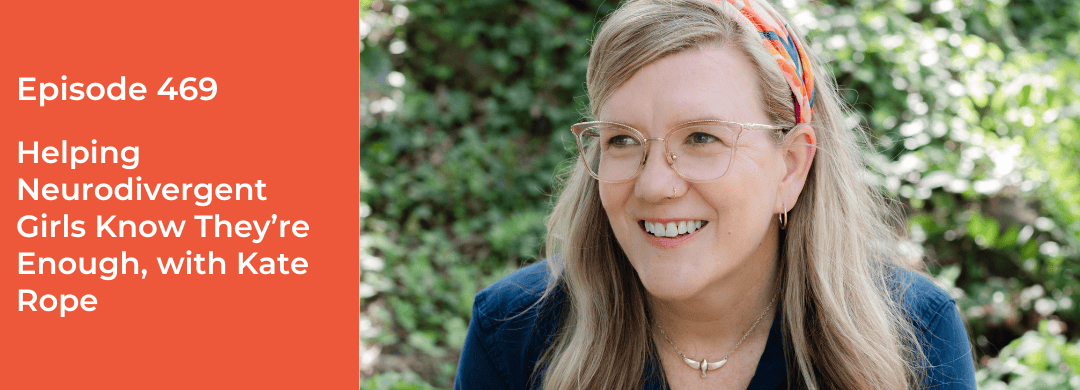
Today we’re talking about raising girls—what it means to help them feel strong in both body and mind, and how we as parents can nurture that confidence from an early age. My guest is Kate Rope, an award-winning journalist and the author of the new book, Strong as a Girl: Your Guide to Raising Girls Who Know, Stand Up for, and Take Care of Themselves. In this episode, we talk about empowerment, self-compassion, and listening deeply to our daughters, as well as the role parents play in creating a supportive environment. We also explore the importance of representing diverse experiences, including those of neurodivergent girls, and how to help our kids develop a strong, steady inner voice.
About Kate Rope
 Kate Rope is an award-winning freelance journalist and author whose work has appeared in The New York Times, The Washington Post, Time, and many other outlets. She is the author of Strong as a Girl: Your Guide to Raising Girls Who Know, Stand Up for, and Take Care of Themselves and Strong as a Mother. How to Stay Healthy, Happy and (Most Importantly) Sane from Pregnancy to Parenting, co-executive producer and co-author of the Audible Original Soldiers of Science, and a mom on a mission to help everyone be Strong as a Human.
Things you’ll learn from this episode
- How early conversations about self-advocacy can empower young girls to trust their voices
- Why including diverse experiences enriches the way we parent and support our daughters
- How validating emotions like anger helps girls embrace their full humanity instead of suppressing themselves
- Why neurodivergent girls often face extra layers of societal pressure and expectation
- How prioritizing self-worth over self-esteem builds a stronger foundation for girls’ well-being
- Why encouraging autonomy and practicing self-compassion are key for raising confident, resilient girls
Resources mentioned
- Strong As a Girl: Your Guide to Raising Girls Who Know, Stand Up for, and Take Care of Themselves by Kate Rope
- Strong as a Human (Kate’s Substack)
- Creating Neurodiversity Affirming Schools with Amanda Morin & Emily Kircher-Morris (Full-Tilt Parenting)
- Neurodiversity-Affirming Schools: Transforming Practices So All Students Feel Accepted & Supported by Emily Kircher-Morris and Amanda Morin
- Activist Emily Ladau on Demystifying Disability (Full-Tilt Parenting)
Want to go deeper?

The Differently Wired Club is not your typical membership community.
There’s something here for everyone, whether you’re a sit back and absorb learner, a hands-on, connect and engage learner, and everything in between. Join the Differently Wired Club and get unstuck, ditch the overwhelm, and find confidence, connection, and JOY in parenting your differently wired child.
Learn more about the Differently Wired Club
Episode Transcript
Debbie:
Hey Kate, welcome to the podcast.
Kate Rope:
Thank you so much for having me. I’m so excited to be here.
Debbie:
I’m excited to have you here. So as always, I have a lot of questions here. And for some reason, the first question I wrote is, why this book? Why right now? And as I’m reading that, I sound like some hard-hitting journalist, and that’s not what I want to do. What I want to do is ask you, how did you come about feeling the need to write your new book, which is just out. It’s called Strong as a Girl, Your Guide to Raising Girls Who Know, Stand Up for, and Take Care of Themselves. I’d love to know kind of a little bit about your story and what brought you to write this book.
Kate Rope:
Yeah, so it’s a journey because of the space between conceiving of it and selling it and then actually being able to write it. I have two girls, I’m a mom of two girls and I made a very conscious effort to, I was raised by a wonderful mom who instilled a lot of strength in me and taught me how to be strong and kind and I dedicated the book to her. So it wasn’t so much that I was trying to do something I didn’t have, but I was just really thinking about what are the, foundational aspects I want to make sure my girls have, knowing the challenges that can face girls just in general in society, if anybody who is female identifying, as well as specific to the moment we’re in. So that was the goal. This was kind of the book I always wanted to write. And I started working on it years ago. I don’t even remember, maybe 2019. And at the time, when I first wrote the proposal, it was during the Me Too movement. And I think I might’ve even had a working tagline that was like raising the not me generation. It was really in response to that moment of people coming out and speaking openly about what they had experienced in the workplace, abuse, assault, et cetera. And so there was sort of that backdrop when I first created the proposal. And then many things happened. I did a podcast with Audible and then I… worked at a suicide prevention nonprofit and time elapsed. And at the point that I started really getting it back out again with an agent, the landscape had changed. Like the conversations around gender and gender fluidity and neurodivergence and all these things had really exploded. And the Me Too movement, and it felt like a very empowered moment for girls. So there were different topics, but also like the moment felt still sort of very empowering. And then by the time, so then that’s when I sold it. And then by the time I went, that it was, you know, that I was writing it, writing it, we were in an era of this rise of misogyny. And so it’s just been a whole journey. I mean, I think the themes are the same, right? It’s about being comfortable. It’s about supporting a girl, you know, any, elementary age kid who identifies as a girl, so ages five to 12, it’s about supporting them in feeling good in their own skin and knowing how to advocate for themselves and being strong in their body and strong in their mind. So all that applies to any of these number of sort of different cultural moments we’ve been in or expansion of our understanding of what it means to be a girl.
Debbie:
Mm-hmm. Yeah, as you’re kind of talking about how the landscape has changed since 2019, that is a lot of disruption. And like, I can’t even imagine like trying to write about this. You must always be kind of pivoting and realizing, now, you know, this lens has changed. And it is, especially right now, as this book is coming out. What a fascinating time to be bringing a book about girls out into the world.
Kate Rope:
Yeah, in my opener, I talk about sort of examples of girls and women really like shining a light and showing the way for the next generation. And I say, know, from, I think I said from the halls of climate summits, thinking of Greta Thunberg to the presidential campaign trail. And I kept waiting to see if that would turn to the White House, which it didn’t. But yeah, but the presidential campaign trail was still a really strong place for a woman to be.
Debbie:
It did not.
Kate Rope:
Alas, I wasn’t able to change that opening.
Debbie:
Maybe in the update and a revised edition. Yeah. I mean, I will say, first of all, I really enjoyed your book. I was, you know, many, many years ago, before I started Tilt, I used to write books for teen girls and tween and teen girls. And I always describe myself as a recovering teen, you know, in my thirties. And part of why I wrote those books is because I did not have that messaging when I was a young girl. And I felt like I was learning things so late, things that I wish I had known when I was much younger that I had had adult in my life sharing these messages. So reading your book really kind of brought all of that back and just made me realize how powerful it is. And especially for the age group. And I wanted to ask you more about that because I think most books on raising girls are focusing on the tween and teen years specifically. And you are looking at a younger demographic. So can you explain more about your reasoning for that?
Kate Rope:
Yeah, yeah. So most books are focused on the tween and teen years. And because of the nature of those years, they’re kind of a lot about damage control, right? They’re a lot about sort of what’s already presented itself as a challenge, as an obstacle, and how do you navigate that? And I really felt like this was my approach with my girls. And the book I wanted to write was I wanted to like… wade in when the water’s shallow, the rocks are smaller, you can teach them the skills to swim so that when they hit the rapids downstream, both of you, she and you, feel more confident in managing them. And, you know, really just building a foundation to make parenting less scary for us too, not just to support the girls, but if you’ve put that time in early, you… Not to say you won’t hit the rapids, but you will feel more calm when you hit them. And the other thing is, it’s just an easier, like wading into a conversation about being the boss of your body when your kid’s on the slide when they’re six years old, is a much more mellow conversation than the one about when she’s 16 and going on her first dates or whatever. And if you’ve laid the foundation early, you’re practicing talking about the harder things, but in smaller ways. It’s easier for both of you. And also, you know, it’s the time in life when kids are programmed to listen to you, to look to you for guidance. And so they’re game for, you know, your wisdom. And then when they hit adolescence, they’re appropriately moving away from it. So it’s like you’ve put the money in the bank and you can, you know, draw the checks later.
Debbie:
Yeah, I mean, we are still kind of favored sources of information when we’re, you know, when we have little kids, they still really listen to us and respect what we have to say. Not that they don’t when we’re older, but we might not realize that they’re listening to us or respecting our perspective. Yeah.
Kate Rope:
Right, right. And they’re developing their own core, right? So they’re turning inward to see things. And so you want to be able to have done everything, at least I believe, you want to be able to have done everything to help them really know that core so that when they’re making their own decisions and their own value judgments, you know, it’s coming from a place of real centeredness and self-knowledge.
Debbie:
So you and I had a chance to talk when you were researching this book and I was really excited when you reached out to me because you, you wanted to be sure that you captured the experience of neurodivergent girls and those of us raising neurodivergent kids in this book, which always makes me excited. Cause oftentimes we’re kind of an afterthought like, and here’s like a little paragraph on this, but This was part, you really wanted this book to kind of capture the complexity of being a girl and all the different ways, whether that’s race or neurodivergence. Can you talk a little bit about that lens that you wanted to provide and how you went about doing that?
Kate Rope:
Yeah, I will say the impetus for it comes from my first or my last book, Strong as a Mother, where I had a difficult pregnancy and I had very severe postpartum anxiety and I felt very alienated by all the books that were out there about being pregnant and there was no space for someone who felt so conflicted or who was having such a challenging time with it. And I’ve just taken that perspective forward, which is that I don’t want a parent or caregiver to read this book and feel like, well, none of this applies to my kid. So now I’m alone again. You know, I want and obviously I can’t, you know, create an encyclopedia of all topics, but I wanted to think about where are the areas where girls are living at the intersection of identities and that they could benefit from specific support related to those identities and also have specific strengths related to those identities that should be talked about too. So I reached out to, well, first I made sure that the experts I spoke with, like you, I went to the experts for any topics that, I mean, I went to experts for the whole book because I’m a journalist, not an expert, but specific topics that I definitely know I am not qualified to speak on such as living as a girl of color in America, LGBTQIA kids, neurodivergent kids and girls, girls living with physical disabilities. So I knew I wanted to talk about experiences in different communities. So I reached out to experts who work in those communities. I reached out to caregivers whose kids are in those communities. And then I created focus groups with girls of, you know all kinds of girls, but I made some that were specific to a certain experience. So girls of color, neurodivergent girls and kids, LGBTQIA+ kids, so that we could be in a safe space and they could just, and essentially what I told all the girls in my focus groups was, and they were about ages 11 to 22. So it’s girls and young women because I was having them reflect back on their elementary years. I just said, look, let’s pretend that we’re in an auditorium of parents and caregivers and you get to tell them how they should do this. Like what were the things that when you were a child were really helpful related to being a girl, being a person, being someone with a physical disability. And then what were some things you wish, inputs you wish you had had or experiences you wish you had had. And I took all that and sprinkled their words throughout the book. But those… those were hands down the best part of writing this book was being in the rooms with those girls. I mean, I just didn’t want our time to end. They were so insightful. They were so forthcoming. They were so naturally inclusive. They were positive and upbeat. They spoke about hard things, but they really had like a bright outlook. And that just made me feel great. I mean, obviously. So, and they were just funny and enjoyable to be with. So that’s how that was one of the main ways I did that.
Debbie:
I do love that age group. used to be a volunteer coach with girls on the run. And so that was like third through fifth graders. And I just love that age group. Like they were so, yeah, just cool and open and interesting and so smart in ways that I wasn’t when I was that age, I’m pretty sure. But it’s fun that you got to spend that time with those girls. I’m curious to know in addition to just how open they were and interesting, Were there any kind of big surprises that came out of those focus groups?
Kate Rope:
That’s a good question. Anger came up a lot, that there’s really, they feel pressure that they can’t express anger and that girls are expected to feel, to go along and get along and emotions that they felt like this one young woman out of Soye would say like she thought about deep things at age six. And I have a deep thinking kid who’s no longer age six, but was at age six too. And people would say, you don’t need to worry about that. That’s not for you to think about. That’s not a problem. And one of the big things we know in the world of child development is that being able to experience all the emotions and express all the emotions is the key to being healthy and resilient. So the fact that a lot of them felt like either they didn’t have a safe space to express, the difficult emotions or they felt like they were suppressed when they tried. And what else surprised me? You know, the focus group with neurodivergent kids was fascinating and so enjoyable. This was literally the best two to three hours. I mean, it was the longest focus group I did because these were all kids who were clearly getting supported at home for their differences and being celebrated for who they are. And I know that this wouldn’t be the experience of everybody, but because of that, because their neurodivergence was something that was being like celebrated, addressed, supported in their home, they interacted with each other. I mean, they ran the support group and they, you know, one of them, Goldie, really had a hard time not interrupting and explained that early on. I interrupt, that’s what I do, I just interrupt. And there was a lot of interruption in the beginning and everybody else rolled with it. And then eventually they muted themselves. They said, I’m gonna mute myself because I can’t stop interrupting, but if I mute myself, then I won’t be interrupting. And you could see them animatedly wanting to respond to, or responding to everything, but it was so self-aware, and it was so… comfortable with I’m gonna make this adjustment because this adjustment is good for me and this adjustment is good for you and then similarly the the respect with which When they differed about things They talked to each other about it like there was a genuine I see you I see You know this thing about you. It is slightly different than this thing about me But I want to let you know I see you and also I need to be able to say this It’s gonna be different than what you just said or whatever. I mean, all the girls were very respectful of each other in all the groups, but it was the self-knowledge is really what stood out to me in that group. And I said, I thought to myself, like, these are kids who, you know, I’m sure their families go through struggles, they go through struggles, but they are seen for who they are. They are loved for who they are. They’re supported for who they are. And it was just, was wonderful. And then by the end, they were all best friends and they had all exchanged everything. And I was just sitting there while they chatted.
Debbie:
That’s awesome. I love that. Yeah, there’s nothing like, and it doesn’t happen all the time, but when neurodivergent kids hang out with each other again, no matter what their differences are, there tends to be this kind of, the surface level acceptance is just, it’s a given and you can just kind of like move on. Like there’s no kind of judging about, that’s been my experience again, not to say that that’s the case for everybody, but that has been my experience for sure.
Kate Rope:
Right. Well, and I think, you know, I obviously reached out to parents who reached out to their kids to see if they wanted to participate. So again, we know that this is a supported, connected situation, you know, well resourced. I mean, there’s a lot of things going into that, but it was just, it was phenomenal. Yeah.
Debbie:
So a question that I have based on what I said earlier too about my own kind of personal search, I haven’t raised a girl from a young age. So even though I wrote books for girls, I always assumed I’d be parenting girls. But instead, I was reparenting myself. And that’s what a lot of neurodivergent parents are doing as they discover their own neurodivergence through their kids. There’s a lot of reparenting. Like this, did not get this as a child. I want to provide this for my child. I’m wondering if that was part of your lens or how you kind of support parents’ moms specifically reading the book because presumably the generation you’re talking to, there are many of those moms who did not have this kind of language provided for them or they didn’t grow up with feeling strong as girls.
Kate Rope:
Yeah. Well, so that my, My approach is that we all deserve support, just every human being on the planet. We’re deserving of dignity, care, support, respect, and space to be vulnerable and space to screw up. So my whole orientation toward parents and caregivers is like, this book is for you too. You know, I’m not here to tell you, you should be doing this. And if you’re not, it’s bad. You know, I’m here to say, here are some things that are really supportive for girls and you may be doing a lot of them already. Some of them you may not have thought about. Some of them may be really challenging for you because of whatever your experience growing up was. And so there’s room within all of that for error and excelling at some things and sucking at others and reaching out to people to help you with the things you suck at. That’s not very self compassionate language, but I’m being facetious.
And self-compassion. I actually have a whole chapter on self-compassion and I believe that that is just as important for the caregiver and the mom, the dad, the grandparent as it is for the girls. And that you can’t really teach it if you don’t practice it. So it’s like a win-win. You get to learn how to take care of yourself again. And I think reparenting is the right word. Like in so many topics in my book. You’re re-parenting yourself, know, body image is a big one, you know, and that can feel very overwhelming for some people because of our, the difficult, you know, relationship our culture has with bodies. But yeah, I really, I try to always put in like space to screw up, space to check in with yourself about how you’re feeling and how you’re what, you know, and get yourself space, you know, in big moments, you know, if your kids having huge emotions, how do you protect yourself also in that moment as well as be there for them? Because I, you know, it’s a family, you know, is a community and, you know, we are all part of a larger community. So I think we all deserve to feel strong in whatever, for whatever that means for us, you know.
Debbie:
I’ve never heard that, a family is a community. I love that. It’s so true. Okay, that was a mic drop moment. So, yeah, no, that’s definitely, because you brought up self-compassion, I really love that chapter and again, you touched upon the self-esteem movement, which was definitely that was the space in which I was writing for girls was all about self-esteem. It’s like, no, now we went, now it’s self-worth. And I love that you’re like, actually it’s self-compassion. Could you talk about that a little bit more and why that’s so critical?
Kate Rope:
Yeah, so I have to first say this is mostly from the research of Kristin Neff, who’s the premier self-compassion researcher in the country. And she started out in the field of self-esteem as a grad student or PhD student, I can’t remember. And they were quickly discovering that there were pitfalls related to self-esteem. That one, it’s based on success. So it’s based on I’m good at this. So then if you aren’t good at something, your self-esteem isn’t there to support you. That’s really big for girls because girls derive so much, unfortunately they do because this is the water we swim in, they derive so much of their value from their appearance. They’re told that that’s their number one value, that that’s something they don’t even have control over. So if their self-esteem is based on their appearance, it’s not even something they’re able to build in themselves, right? And so self-compassion is, I like to say it’s like the hug. when you’re down, you know, it’s the, I have a line from the book, now I’m flubbing it, nevermind, we’re gonna edit that part out. Anyway, self-compassion is basically just accepting that you’re human and that you’ve had an experience that is hard and you wanna give yourself some love for that experience and also know that like that experience is what connects you to the world. You’re suffering in whatever moment you’re in. And then the support to, you know, take care of yourself and move forward and figure out what do I need next? And so self-compassion really, if you’re able to forgive yourself and be with yourself when you’ve messed up, when things are hard, that is a huge factor in your resilience.
Debbie:
And there are great examples in the book of how to do that and language that we can use. That is one of the things I’ve done a lot as a parent is when I notice I’m verbally beating myself up, I’ll say, you know what, I’m going to, I’ll just like out loud, I’ll say, I’m going to be nicer to myself. I’m going to say this differently because this is just part of the human experience. But I love that you include examples in there of of language that we can help our girls kind of start to say to themselves when they are being especially hard on themselves. And you wrote going back to what you were just saying, that their self-worth or self-esteem is often based on appearance. You wrote that research shows that by the time girls are eight, nine and 10 years old, they can no longer see themselves from the inside, that they tend to only see themselves. from the perspective of other people and how they’re reflected in the eyes of other people. That kind of blew my mind that that happens at such a young age. Could you say more about that?
Kate Rope:
Yeah, that came from Soraya Chamali. it’s just that girls are taught to embrace a gaze because they’re looked at with this gaze, right? They’re looked at with so much focus on their appearance, how they present, being nice. You know, I think boys need a ton of support and I think we can do a way better job supporting boys in becoming strong too. But they don’t get held to those standards. They’re sort of allowed to be messy. And that’s problematic in themselves, because they get ignored, right? When they’re probably being messy because they need support. But they’re allowed to be messy and girls are not. They’re praised for when they raise their hand. They’re praised for when they stand in line. They’re praised for when they share or are kind to a friend. And so they come to conflate their goodness with being good versus just their goodness for being a person. You know, so that you can, you know, your teacher can call you out because you didn’t stand in line the right way or, you know, whatever it is. And you can still be a good person, even though you, you know, made a choice that in that moment wasn’t the choice people wanted you to make.
Debbie:
And these aren’t just things that we’re doing in our homes, right? As parents, we need to counter messages because I’m assuming these are ubiquitous throughout society and schools and all the kind of environments our kids are interacting with.
Kate Rope:
Yeah, I mean, I think that’s one thing that is a challenge because I write in the parenting book space, but we have such a large, we have such an inflated sense of our influence over our kids. And, you know, they are in the sea of education, social media, media, peers, and we’re one input, you know, so, it is something like for instance with appearance. I just decided from an early age, when my kids were an early age, that I was never gonna comment on their appearance. Now, I think I may have taken it too far in the other direction, but whatever they wore to school, they wore to school. Even if it was like maybe not appropriate for the weather, I might say, bring a jacket in case you get cold or whatever, but I let them choose. I didn’t say if things weren’t matching. I didn’t tell them to brush their hair. I didn’t say, let’s do a nice hairdo. If they got interested in that, which my older daughter definitely did, and now my younger daughter who’s in middle school is starting to have that same inclination, then of course I supported it if it was coming from them. But if they were like, how does this outfit look? I would say, how do you feel? How do you feel in it? And how do you feel about it? And are you comfortable? Always I focused on that. So I just, there were certain areas where I knew everybody else was gonna be on that train and I didn’t need to be on that train.
Debbie:
So you mentioned earlier that your favorite two to three hours in working on this book was when you were sitting down with neurodivergent girls. And so I’m wondering what you learned from that or what did you want to share in the book that’s so important in terms of maybe additional challenges that neurodivergent that neurodivergent girls are facing at this age?
Kate Rope:
Yeah, well, so the big one of the big things that came up in those focus groups and in the experts I talked to is that it’s just what we were just talking about these expectations about how girls are going to behave. And, you know, one of the girls in my focus group, Jillian, was like, the world expects girls to be nice and quiet and not loud and noisy. And my neurodivergence makes it impossible for me to do that. Like, I will be loud. I will be noisy. And so there’s there’s sort of that direct like experience of being female, experience of being neurodivergent confluence there. I think, know, specific to neurodivergence, but applicable to the whole book is just really helping girls feel good in their own skin, especially if they have, you know, some aspect of themselves that… other people are gonna point out is a reason for them not to belong, not to fit in. And so really emphasizing from an early age, being open about, and this is a bunch of this I learned from you. So being open about a diagnosis early, being really open to whatever their experience of that is, not, know. trying to label it or force them to feel a certain way about it, letting them have their own journey with it. I don’t think this came up in the neurodivergence section, but maybe in the physical disabilities section, being able to say as a parent, we’re going to work through this together. I don’t have all the answers. I mean, no parent does. But especially in a situation where you’re, as a parent, navigating a new reality that you’ve maybe never navigated before. Being able to say to your kid I am here and we will figure this out together and we will get the right supports together You don’t have to be an all-knowing person and that can be a really lovely journey that you guys share and they can and they can give you input which is one of the huge things I’m trying to emphasize in the book is just listening just pausing and listening to girls so that They know people want to hear that what they have to say It reinforces their own sense of themselves and and the world and how they view it and makes them feel heard, you know? And so all of those things, you know, the experience of being a person really, but I’m talking about girls in this book, but the thing I say in the front of the book. So there is that section that you mentioned where I do more of a deep dive into girls of color, neurodivergent girls, LGBTQIA kids, girls living with physical disabilities. And I say in the front of the book, you know, choose your own adventure here. Like if you can read it all the way through, and I hope you do because I wrote it and that’s how I make my living. But if you’ve got one issue, know, eating disorders, I have a huge section on eating disorders. If that’s what you’re dealing with, feel free to jump ahead. And then I talked about the fact that I’m going to talk to specific identities and experiences. And I was like, I encourage you to read that section of the book, even if you think even if your child doesn’t relate to those identities or you think they don’t, which by the way, you may not know when they’re six, you probably don’t because of the concept of universal design, right? So I’m sure you’ve talked about it a lot on your podcast. We know that like when we have ramps for wheelchairs, they benefit people with strollers and joggers and everybody else. And similarly, like the same openness and supportiveness with which you would talk with your daughter about her autism diagnosis and letting her know that she is exactly who she needs to be and she will get the support to continue to be who she needs to be is the same openness that would help any girl do anything. Right? So, so I think those are some of the specific things we talked about. And just making space for feelings and, you know, changes on your neurodivergent journey and, and a lot of agency, I think.
And actually that was big in the physical disabilities section because girls living with physical disabilities are often, you know, treated as if they have absolutely no agency over their bodies. And one of the girls in one of the young women in one of the focus groups said, you know, it wasn’t until I was 19 that a doctor actually addressed me in a visit and said, this is your body. I’m not going to tell you what to do with it. So that’s if you’re living with a physical disability, being in charge of your body, there’s a whole other layer added to it, that the whole medical profession, a lot, I mean, I’m sure there’s good providers out there, but a lot of the medical profession and people in general are gonna think that you don’t have control over your body, you don’t want control over your body. And so that’s a whole other layer to fight, to say that I am in my body and I do have control and I do have a say and this body is for me and not anybody else.
Debbie:
There’s so many things I want to touch upon. First of all, the last thing you just said, my body is for me. You mentioned that that’s one of your favorite five words that you learned in writing this book. And it is such a powerful concept. And I want to mention that you talked with Emily Ladau, who we’ve had on the show, and she wrote Demystifying Disability. And so I really appreciated her insights that you shared in the book. Circling back to universal design, you talk with Amanda Morin, is a friend of the show, mutual friend of ours, I know. she wrote, most recently, she wrote her book Neurodiversity Affirming Schools with Emily Kircher Morris. But what I loved about that book that you were just touching upon too is this idea that what’s good for neurodivergent people is good for everybody, right? And that’s such a powerful takeaway. And I did want to mention a quote of Amanda’s that I pulled out that I loved. It’s not about overcoming. It’s about becoming. Would you kind of share what that what she meant when she was saying that?
Kate Rope:
Well, I think she was speaking specifically to neurodivergence and disability and the idea that these are obstacles that you have to overcome, that that’s the kind of classic narrative. And she was saying, you don’t need to be anything more than what you are and who you are. And she was talking about how there’s a lot of pressure. And some of the girls in the focus group that I had spoke to this, that if you… like Emily said, because I was in a wheelchair, you know, because I moved in a wheelchair, I felt like I had to be an excellent student. Or one of the girls in the neurodivergent group, Kat said, you know, just because I am, you know, neurodivergent and I have a big imagination doesn’t mean I love art or, know, like, don’t don’t ascribe things to me or have things that have to make up for right that just you are, you are just who you are. And you’re just going to grow more and more into that. And I think that applies, you know, I have a section on introversion, you know, when I say strong as a girl doesn’t mean you have to be out there like this. If that’s your personality, if that’s who you are, great. But if, you know, if you’re introverted, wonderful. Let’s find out where you would like some support to be more extroverted, because we know the world runs on extroverts. So let’s find out where you feel like you want some support to speak up or engage more and then let’s respect when you don’t want to and let’s respect, you know, and let’s give you space and time. it’s, none of this is about becoming a certain kind of girl. It’s all about just being the girl you are, that you came into this world as, or that you’re becoming in the case of, you know, a child who’s gender fluid or, you know, transgender and just becoming more of that person. Just allowing just all of us being able to get out of our own heads because we’re in a society that tells us a thousand messages about how to raise kids, get out of our own way and just see that this is a person in front of us with incredible self-knowledge and intuition. And our privilege and responsibility is just to give her the space to experience that. And that’s actually less work for you. I think we feel like we have to work so hard, but actually pausing, listening, letting her drive the car when she’s ready and can is actually less work for you.
Debbie:
And really infused throughout the whole book is this message of encouraging our kids’ autonomy, sense of agency. You do talk a lot about bodily autonomy, which I, it was really kind of, you kept coming back to that. And I so appreciated that because I think, yeah, that is just not something I think maybe in our generation, it just wasn’t part of the conversation. And I don’t think it can be overstated. Always making sure girls know that they are in control and they get to decide and that my body is for me. And you talk about in relationship with food and kind of all different aspects of life. But I love that kind of message agency respect. It’s just, that’s what we’re doing here. And so There are so many other things I want to touch upon, but I also want to be mindful of the time. So let’s kind of wrap it up with My last question here, if parents did just one thing consistently from the ages of like say three to 10 to nurture a strong inner voice in their girls, what would you say that should be? What’s the most bang for the buck perhaps?
Kate Rope:
Listening. Listening more than you talk.
Debbie:
Yeah, so easy to do, right?
Kate Rope:
So easy, mean, yeah, no problem. Because we’re not busy with a thousand things. I mean, I have one little tidbit there, which is I have one child who externally processes at all times from the moment she wakes up to the moment, well, no, she’s a little quiet in the morning, but till she goes to bed. And there’s no way I can listen to all that. There’s no way I can be present for all that. And so we’ve developed something, and actually I think my husband and I developed it when we were dating, called a keyword. So if they’re talking to me and I’m in the middle of writing a work email or I’m stressed, whatever it is that I know I’m not accessible, I’ll say, I’m so sorry, I really wanna hear what you’re saying, but I just can’t right now, but give me a keyword and I’ll ask you about it at dinner or when we’re in the car or whatever. Just give me a keyword to remind me what it is you wanna share with me. So I’m showing her, them that I respect, that I want, that I am interested and I truly wanna hear, but I’m also a human and there’s no way I can do that at all times.
Debbie:
That’s great. I do that I do that, to some extent, but not with the keyword so i’m going to incorporate incorporate that into my parenting I did want to. yeah.
Kate Rope:
The problem is as you get older, you forget the keywords. So my husband and I will tell each other, we’ll be like, keyword this. And then later he’s like, oh, you gave me a keyword. And I’m like, yeah, I don’t remember. I remember what a keyword is.
Debbie:
It’s gone. Classic. I also just want to mention, Katie Hurley is in your book quite a bit, and we’re also huge fans of hers. And there’s a question that you shared that goes along with this idea of listening. And you’re talking about teaching girls how to tolerate difficult emotions. And the question is, hey, you don’t seem like yourself today. What’s different? And I was just like. That is just such a gentle, loving, curious question. And I just so appreciated that. Questions like that and suggestions for how to talk about things are, again, of infused throughout the book. And they’re so helpful because it’s just, again, it wasn’t modeled for so many of us to talk to our girls this way.
Kate Rope:
Yeah, well, know, Katie’s a professional and so she knows, you know, open-ended questions, but exactly what’s different? There’s something about that question that makes someone’s wheels turn, right? They’re gonna think of, even if they don’t wanna tell you, they’re gonna think to themselves, what’s different? Why am I feeling this way or that way, you know? But I do think, yeah, tell me more is my favorite because, you know, if a kid comes to me, if one of my kids comes to me with something, especially if it’s a big topic, especially if it’s something that could be upsetting to both of us, that’s way to let me pause, tell me more. And also then my answer or my support will be much more targeted to what they actually need, gives me a minute to breathe if it’s like someone was being super mean to me at the playground or this guy sent me this text in the case of a teenager, just tell me more before you jump in, I think is huge. And the reason I do include so much conversation starters, mantras, is because when you read a book and it’s like, have an open conversation with your kid about sex. Well, if you’re a parent who knows how to have an open conversation with your kid about sex, you got it, more or less. I mean, sure, there’s improvements or changes or support you could have. But if you don’t know how to have an open conversation, does someone telling you to have an open conversation help you? Like doesn’t, what does that mean? I don’t know. I’m not comfortable having an open conversation. Like how do I start? What’s the baby steps? So I try to put those things throughout the book to give like, you know, a concrete way to try out what I’m talking about or what an expert is talking about.
Debbie:
Yeah, it’s so helpful. Let me ask you one last question then for listeners who are raising daughters and who are listening to this and they’re realizing or just thinking, gosh, I’m not really, I haven’t been doing this the way that I would like to. How do you help parents or what would you say to them about changing course?
Kate Rope:
Thank you for asking that because that is a huge theme of the book. I would say that making mistakes and then making repairs is some of the most powerful parenting work you can do. And it’s them seeing you be human. It’s them seeing you be responsive to them. You know what I figured out? It turns out like this isn’t the best way for me to talk about whatever the topic is. So I’m going to work on changing it. I may not get it right every time, but I realize now that that’s not the most useful way or helpful way to do it. This is a very small example, but after I wrote the intuitive eating chapter, I realized that like every week when we get sushi from the takeout place and my daughter had one piece of broccoli in her udon and I’d be like, did you eat the broccoli? Can you eat the broccoli? Would you just eat the broccoli? And then they’re like, that’s not how you get your kid to eat broccoli. And it’s actually really harmful and whatever. And so that I was like, the next time she got, we got it. was like, so by the way, I’ve learned from writing my book that that’s not the most helpful thing. So I’m not gonna, you decide if you eat your broccoli. So you always, kids are so forgiving and they appreciate honesty. And so you always have a chance to say, know, I’m, gosh, there’s a better way to do this. And I didn’t know about it till now and I’m gonna try. And also there are topics like body image, potentially neurodivergent, know, raising a neurodivergent kid. If you have neurodivergent experience growing up that is, you know, really traumatizing in the way you were treated. There are some topics that you might need support. to support your girl with. And that’s okay. If talking about food is just that hard for you because of whatever you were raised with, whatever messages you got, I really recommend getting some professional support for you so that you can process and be kind to yourself and then be supportive to your girl. And I do include a lot of low cost and culturally responsive mental health resources in the book.
Debbie:
Yeah, tons of resources at the end of every chapter, books that people should read, organizations. It’s super practical and super helpful. listeners, again, the book is called Strong as a Girl, Your Guide to Raising Girls Who Know, Stand Up for, and Take Care of Themselves. Kate, it’s a fabulous book, so congratulations. And where would you like people to connect with you?
Kate Rope:
Thank you, thank you. Sure, well, they can find the book anywhere books are sold. And I am on Instagram at Kate Rope Writer. My sub stack is strong as a human and katerope.com.
Debbie:
Awesome. So listeners, as always, I will have links in the show notes to all of those places and to the book. And yeah, thank you. Congratulations again. Thanks for everything that you shared with us today.
Kate Rope:
Thank you and thank you for your help with the book.
Do you have an idea for an upcoming episode? Please share your idea in my Suggestion Box.