Dr. Stephen Porges and Karen Onderko on the Safe & Sound Protocol
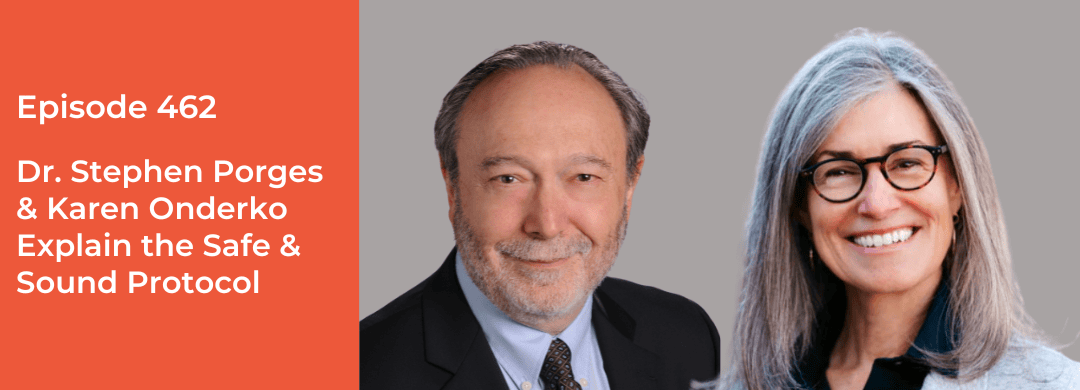
I’m thrilled to share this conversation with Dr. Stephen Porges and Karen Onderko about the Safe and Sound Protocol (SSP), a therapeutic approach grounded in Stephen’s groundbreaking polyvagal theory. Stephen, a Distinguished University Scientist and originator of the polyvagal theory, has spent decades helping us understand how our nervous system shapes behavior, connection, and healing. Karen, who was instrumental in bringing SSP from the lab into clinical practice, has been a tireless advocate for expanding access to polyvagal-informed care around the world.
In this episode, we dive into the origins of SSP, the science behind it, and what makes it such a powerful tool for supporting emotional regulation—especially for people navigating trauma and neurodivergence. Stephen and Karen share stories from real-life applications of the protocol, explain how co-regulation plays a central role, and highlight the many ways SSP can foster connection and resilience. Whether you’re new to polyvagal theory or already familiar, this is a hopeful and inspiring conversation about what’s possible when we work with the nervous system to support healing.
About Dr. Stephen W. Porges
 Stephen W. Porges, PhD, currently holds positions as a Distinguished University Scientist at Indiana University, Professor of Psychiatry at the University of North Carolina and the University of Florida College of Medicine in Jacksonville, and Professor Emeritus at the University of Illinois at Chicago and the University of Maryland. He has published more than 400 peer-reviewed scientific papers that have been cited in more than 58,000 peer-reviewed papers. He holds several patents related to technologies involved in monitoring and regulating autonomic state. He served as president of the Society for Psychophysiological Research and the Federation of Associations in Behavioral & Brain Sciences and is a former recipient of a National Institute of Mental Health Research Scientist Development Award.
Dr. Porges is the originator of the Polyvagal Theory, a theory that emphasizes the importance of physiological state in the expression of behavioral, mental, and health problems. He is the creator of a music-based intervention, the Safe and Sound Protocol ™. In collaboration with Anthony Gorry, he co-created a Sonocea® Enhanced acoustic technology, engineered to support homeostatic functions and embedded in the Rest and Restore Protocol™.
With Karen Onderko, Deb Dana, and Randall Redfield, he is a cofounder of the Polyvagal Institute. He has authored several books including the Polyvagal Perspectives: Interventions, Practices, and Strategies (2024). He has coauthored Our Polyvagal World: How Safety and Trauma Change Us (2023) with his son Seth, and Safe and Sound: A Polyvagal Approach for Connection, Change, and Healing (2025) with Karen Onderko.
About Karen Onderko
 Karen Onderko is a passionate advocate for advancing the understanding and application of polyvagal principles to improve care, connection, and acceptance among people. She played an important role in bringing SSP from the laboratory to the clinical world, conducting the initial testing, developing the training, and supporting the SSP provider community. Together with Dr. Porges, she has written a book about SSP titled Safe and Sound: A Polyvagal Approach to Connection, Change and Healing. Regularly witnessing the transformative power of a polyvagal-informed approach, she is eager to support the promotion of education and access to PVT for people in diverse communities throughout the world. Karen is a founding board member of the Polyvagal Institute.
Things you’ll learn from this episode
- How the Safe and Sound Protocol (SSP) draws on polyvagal theory to support nervous system regulation
- Why melodic voices and filtered music can help calm the body and mind
- How SSP offers a non-invasive, evidence-based option for individuals dealing with trauma and anxiety
- Why co-regulation is a key part of making SSP therapy effective
- How real-life case studies show powerful transformations when SSP is used, often alongside other therapies
- Why the ultimate goal of SSP is creating greater flexibility in the nervous system’s response to stress
Resources mentioned
- Karen Onderko (at PVI)
- Safe and Sound: A Polyvagal Approach for Connection, Change, and Healing by Stephen Porges, PhD and Karen Onderko
- Randall Redfield (at PVI)
- Doreen Hunt (at Unyte)
- Safe and Sound Protocol (at Unyte)
Want to go deeper?

The Differently Wired Club is not your typical membership community.
There’s something here for everyone, whether you’re a sit back and absorb learner, a hands-on, connect and engage learner, and everything in between. Join the Differently Wired Club and get unstuck, ditch the overwhelm, and find confidence, connection, and JOY in parenting your differently wired child.
Learn more about the Differently Wired Club
Episode Transcript
Debbie
Hey Stephen and Karen, welcome to the podcast.
Karen Onderko
Thanks for having us.
Stephen Porges
Hi, thanks for having us.
Debbie
Gosh, I’ve been looking forward to this interview for months. I’m so excited that I get to sit down with you and I had to really do a lot of prep because as I said before I hit record, there’s so many things that I want to kind of get into with you, but I’m really excited to explore the Safe and Sound Protocol and your collaboration and your new book. I’ve already done an introduction with your credentials, but would you take a moment to introduce yourselves kind of specifically in relating to the work that you do together? Because I know you collaborate on a very deep level.
Stephen Porges
Okay, I’ll just start with that. I had developed a protocol that I called the Listening Project Protocol, which really were basically the characteristics of what became Safe and Sound. And I didn’t know what to do with it, basically. It was a laboratory product, and I was very frustrated because you want to be helpful to people, and you can’t do that. It can’t be helpful to too many people if you’re just using a research-based tool, because I’m not a clinician either. So I had the, let’s say, serendipitous opportunity of meeting Karen and Randall Redfield from when they were ILS, Intelligent Listening Systems. And I’ll give it to Karen because she’ll tell it from the other side.
Karen Onderko
It’s true. I wrote a fan letter to Dr. Porges to say, first of all, polyvagal theory explains so much. And we actually thought that perhaps it could even explain the effectiveness of a therapy that we had been working on, the total focus system from Integrated Listening Systems. I was thrilled when he responded to my letter and like actually jumping up and down excited. But then I found out that he really does respond to most people. Anyway, but he was so generous to invite us to his home to record a podcast with him. And that podcast turned into conversations. We ended up spending the whole afternoon together. And from that afternoon, talked about collaborating on bringing what’s now the Safe and Sound Protocol, or SSP, into the therapy world. It’s been a great journey. It’s almost a decade now, and it’s been so rewarding to hear all of the stories of transformation and change that have come from this small but mighty tool.
Stephen Porges
I’m going to add one other point. It’s one thing to come up with an idea of an intervention. It’s another one to translate into practice. And Karen became the guardian of the Safe and Sound Protocol. She created the relationships with the therapists. And the product of those relationships happens to be the book.
Debbie
Yeah, I heard, I’ve listened to a bunch of interviews with you, you all talking about the book and this process. And that’s something that really jumped out at me, Stephen, is this idea that you were working on this for decades and this theory, which is so powerful. And I feel like it must be really fascinating to watch how it is just becoming so widely known really quickly, I think, in the past five to 10 years. But then to have the opportunity to actually, okay, what do we do with it? How do we make this work with people?
Stephen Porges
Yeah, well, Debbie, what I frequently say is that people don’t understand, the audience tends not to understand the frustrations of being an academic. And that is you create ideas and then you have to sit there to see who will create a portal of using those ideas, if anyone. And to me, the Safe and Sound Protocol and working with Karen was this extraordinarily rewarding journey in which I could see my ideas having a positive impact on healers.
Debbie
It’s really like, just, you know, that feeling when a collaboration comes together in this way and I can just see the energy. It’s exciting when you get to do that. Not everybody even has that opportunity in their lifetime, right?
Stephen Porges
I think you have to start, well, for me, I had to start honoring these opportunities, especially when parents and individuals who had gone through the program would contact me and share their experiences. I remember sharing those emails with Karen saying, keep those, we’ll write a book about this sometime. Because they were wonderful stories and there were stories that needed to be heard.
Karen Onderko
That brings up the point. Sorry to just make sure that we were clear to say that this wasn’t just a collaboration between Steve and me and Randall, but all of the early SSP providers were collaborators in the development of SSP and in creating the protocols for delivery. And without them and their stories, SSP and Steve’s flexibility, the SSP could be a very different thing, but it’s proven to be very effective because of all of that input.
Debbie
Okay, so we are going to spend the majority of this conversation talking about SSP. And as I said before, hit record, we have talked about Polyvagal quite a lot, never with you on the show. But I want to focus on the Safe and Sound Protocol for this. However, just for context for this conversation, and the origin of the protocol, would you just kind of give us—I’m sure you have like an overview in a way that you kind of explain it if there are listeners who, for whom it’s a completely new concept.
Stephen Porges
Well, the Safe and Sound, okay, if you are a parent or a pet owner, how do you talk to your infant and how do you talk to your pets? Well, you use a very melodic voice. But why would a baby or why would a pet recognize the melodic voices trigger a physiological state of calmness and a sense of safety? It’s because it’s wired into us. So Safe and Sound Protocol leverages this neurophysiological and in a sense, genetic basis of why we calm down in the presence of prosodic voices that have intonation. So the Safe and Sound Protocol basically amplifies the prosody in certain frequency bands. So the body has to respond to it. It’s not like intention. And we, of course, in the world that we’re in, we think that our behavior is a product of our intentions. And what polyvagal theory teaches us and informs us is that our physiological state is a major mediator of how we react to the world. And by listening to prosodic voices, our physiological state changes, and we become more accessible, calmer, and more socially interactive.
Debbie
Sorry, I didn’t know if you had anything to add, Karen.
Karen Onderko
Well, I’ll just add that for me, polyvagal theory is such a forgiving and hopeful theory of the nervous system and how it maps our behaviors and how we respond to experiences in our environment, cues of safety and cues of danger. I think it’s forgiving because it tells us that our behavior is not our character. And that changes the story from judging to understanding, which I think is so important to know that our behavior really, it’s not volitional or intentional. It’s not a top-down thing. We’re not controlling our behavior from our brains. It’s a bottom-up experience, which is more spontaneous and reflexive and reactive based on our physiological state. And it’s hopeful because the nervous system can change, which is amazing. You know, it’s neuroplastic, just like the brain, and neural exercises and regulation practices and experiences in the world can help to shape and repattern our nervous system over time. SSP can be a part of that.
Debbie
Yeah. I mean, I know that Dr. Mona Delahooke talks a lot about polyvagal in her books, Brain Body Parenting and Beyond Behavior. One of the things she said to me when she was on the show was when you look at, in our case, a child who’s dysregulated, to really look at that child and say, what does your nervous system need right now? That question has just changed my life profoundly, just that shift. And I love what you said about this not being judgmental. Really, it takes all of the emotional charge out of that.
Karen Onderko
Yeah, the question is no longer how do we change your behavior? How do we eliminate that behavior? But rather, what is that behavior telling us about you and your needs? Yeah, it’s a big game changer.
Debbie
It is a game changer. Okay, so I did, first of all, I read your book, which I thought was great. For listeners, it’s called Safe and Sound, a Polyvagal Approach for Connection, Change and Healing. It came out this spring. And I think I was a little afraid that it was gonna be way up here, like over my head, and I was gonna be struggling to make sense of it. And I really found it so accessible. So I just want to just acknowledge that you’re sharing a lot of neuroscience in a way that I think is really understandable and the examples and the case studies are so wonderful. But if you could talk to us a little bit about what is actually—what is this protocol doing? You talked about it in broad strokes, Stephen, but what is happening inside our brain?
Stephen Porges
We can’t even start there. We have to start in the evolution of mammalian species. Then this becomes a real—well for neuroscientists, it becomes a very interesting story. So I don’t know if everyone will see the enthusiasm that I have for this. But what happened as mammals evolved from, it’s basically an ancient common ancestor for reptiles and mammals. But what made mammals different? Mammals were different because their physiological state was being conveyed in their voice and facial expressivity. What did that mean? It meant that they were signaling the other that they were safe to come close to or not. So everything in mammals’ lives are really signaling the other. Are you safe to come close to? Am I safe to come close to you?
What happens in mammals, especially humans, is there is a linkage between the vagal regulation of heart—that’s of course polyvagal—and the muscles that regulate our face and our voice. But there are also muscles that regulate our ears. In the middle ear are muscles. And when those muscles are given permission to, in a sense, become contracted, they enable us to pull out human voice. When they’re not given permission to contract, the whole array of acoustic information that we’re getting changes, and now we are bombarded with low frequency sounds. And that’s why many children—many parents are aware of neurodivergent children who are doing this—and are often accused of not paying attention. What is really happening is that their middle ear structures aren’t working like a neurotypical and so they’re being overwhelmed by low frequency sounds.
Now going back to Karen’s point, the theory is optimistic and says, well, that system isn’t working. It doesn’t mean it’s pathological. It may be locked into a state which facilitates detection of threat. And this is very common if you’re in a disruptive household or you had abuse, your nervous system is retuned, not rewired permanently, but retuned. And what the Safe and Sound Protocol is all about—it’s all about signaling the nervous system to come back to its more accessible calmer state, the state of connection with others. And that’s why other people like Mona, like Deb Dana, they’ll talk about co-regulation. But co-regulation is not an imperative. It’s an invitation, allowing you to access me. That is what Safe and Sound Protocol is about. It’s about shifting that physiological state from this defensiveness to this accessibility.
Debbie
And so how does—I know how it does it, but could you explain what actually, you know, the Safe and Sound Protocol as an experience is? So what are people who are participating or who are using this protocol doing?
Stephen Porges
Well, it tends to be a seamless experience because what we’re doing is signaling our nervous system to do what it knows how to do, but has basically has not wanted to. It’s almost an intentionality because that accessibility was now associated with vulnerability. So it’s seamless, like it sends these signals, just like if you had, let’s say, brought home from a shelter a rescued cat or dog, you’re going to have a gentle approach, but you’re also going to use your voice. Because the mammals of social mammals like dogs, cats, and horses have frequency bands that are used for social communication that overlap with humans. So that’s why we kind of bond with them. But this notion of like a crying baby who’s calmed almost instantaneously by the prosodic voice of the mother. But the reactive dad doesn’t do a very good job in calming the baby. It’s because the intonations are so powerful in signaling.
And this is the magic word. Signaling is a neuromodulator. It’s like, in a way, a vagal nerve stimulator. It’s like grabbing into the nervous system and saying, calm down. Not the words or the intentions to calm down. Because we all know if someone says to you, calm down, it’s not going to be welcomed. But if someone talks to you with a more melodic voice, you will calm down. So that’s the mechanism. The mechanism is that we are wired. We have to actually acknowledge is we’re wired to become accessible if we hear the signal of accessibility. And that’s why that whole norm structures that I talked about, I talked about them as being part of a social engagement system. And for the parents of neurodivergent people who may be listening, there are other pathways other than vocal to get that system. And sometimes it’s ingestion. And so what parents will often do is feed their kids, give them calm foods or calming foods, because the neural circuits involved in ingestion and sucking and swallowing are the same neural network that’s involved in social engagement.
Debbie
Fascinating. So can you describe—I mean, let me think of how I’m going to ask this question. So when I was first introduced to the Safe and Sound Protocol, this was a couple of years ago, my kiddo who is now 21 was working with a therapist who was trying to kind of front load and support my kid’s nervous system before going off on a gap year program. And so it was presented to me as, this is some music, you can listen to it and it’ll, you know, I was like, my gosh, this sounds great. Like it sounded like this magic, you know, thing. You don’t have to do anything. You just put on the headphones and, you know. So I think that was an oversimplification of what’s actually going on, but okay.
Stephen Porges
Not necessarily. You have to step back for a moment and think about what I call stealth interventions. Because our cognition, our top-down processes interfere with talking to our brainstem. So when our cortex starts playing its role, like we call it stress or work or memorization, mental effort, our brainstem is suffering. It’s literally in pain. It’s disrupting its homeostatic functions. But if we can signal the brainstem to go back into this homeostatic, calmer, peaceful way, then the cortex gets kind of relieved and can be creative and express and explore. So what your child may have felt after this is more optimistic moving on to exploration. So a gap year is an unknown and rather than seeing it as an evaluative threat, was probably quite excited about the opportunity.
Debbie
So yes, and I would love it if you could even explain just for again, listeners who aren’t familiar with what the protocol is—I know that there are several different programs. Would you actually describe what the therapy entails?
Stephen Porges
Let’s give this to Karen.
Karen Onderko
So the SSP is a non-invasive therapy. It’s evidence-based. It’s developed by Steve based on polyvagal theory. And it involves listening to music. The music, which there are multiple playlists you can select based on what you’re interested in. It could be classical. It could be songs you might hear on the radio. There’s a kids version with songs from Disney movies, et cetera. There are lots of playlists that you can choose from. Those are just the underlying playlists. But all the playlists are filtered in the same way. And they’re filtered to highlight the frequency envelope of human voice. That’s so—what Steve was talking about, how salient it is for us to hear a warm, melodic voice and how safe that makes us feel. And if someone has, because of trauma or because of consistent ear infections or Bell’s palsy or other reasons, their capacity of their middle ear muscles to focus in on that frequency range has been shifted. The music itself in the way that it’s filtered is just delivering those sounds only. So it’s almost like you can’t block them out. The sounds just come in.
And like Steve was saying, there’s no intentionality involved. You don’t have to believe in this or work hard or effort at it. The music will just come in and affect your nervous system directly. To watch some people who, especially children who can be so expressive and can immediately have a response to these sounds of safety and how that affects their nervous system. Some kids have been known to give their parents their first hug after having just even one session or to say their first words. There was a great quote of a young, I think a seven-year-old girl who after she took the headphones off, she said, “My stomach has a smile with eyes that blink very happy.” Just as a way of trying to describe this new feeling that she was having in her body.
So there’s five hours in total of this music. And so you’ll have consistent meetings with a therapist who is gonna be co-regulating together with you. Could be in person or we’re finding that online or virtual sessions are very effective. I think everybody found that out during COVID. And depending on the client, it can take three weeks or so of regular sessions of listening to some amount of music each time. And the sessions will typically also involve some psychoeducation about polyvagal theory. What is polyvagal theory? Learning about your own nervous system patterns, understanding what it feels like for you to be in a ventral vagal or a calm and connected state. What does it feel in your body to be sympathetic? And this is really good, valuable information for people to know for themselves. What do these states feel like? And then therefore to consider what caused this state and to make those kinds of connections. So that psychoeducation is really important.
Stephen Porges
So what I would like to say is it’s so seamless that sometimes people don’t realize something’s happened until like a child loses all the gains. So when a child might get a fever, and when the fever occurs, the whole neural regulation of the facial muscles change, hypersensitivities come back, then the parents are aware that something major had happened. And then they want, quote, their child to be fixed again. But it’s not a fix. It’s a neural exercise that is giving the nervous system permission to literally be what it is. Think of those who are, in general, hypersensitive. Why are they hypersensitive on a neural level? The nervous system is literally vigilant about injury. And you often find other things associated with it, like inflammation and other types of, quote, medical disorders, gut problems. And so the nervous system is really in a state of threat. And how do we, in the archetypical human calmness of mitigating threat, is the melodic voice of a caring other. And we see this not just with babies, but we see that with everyone, including our pets. The calming other has this gentle melodic voice of welcoming. And even my cat, if I use a melodic voice to mention her name, her tail reflexively starts to twitch, even though she’s not looking at me. So the point is that in her nervous system, the way I say her name is almost magical.
Debbie
I have that same magical relationship with one of my cats too. So just, I know what you’re talking about. So one of the things that I heard you say is that, which I just think is so incredible, is that this sends a signal that the body really can’t refuse to interpret as being safe. As you said, so many of, especially these kids, their nervous systems are wired for threat. I can’t imagine what it would feel like. I don’t know what that feels like to have a nervous system that’s wired for threat. So I can’t relate to that. And I can imagine that not being there could be kind of a profound experience too. I know you talk about that as well. And maybe this isn’t an issue so much with kids, the need to kind of titrate if that safety is uncomfortable for the client.
Stephen Porges
Yeah. I think this is a very important point because with adults who have had trauma histories, I mean profound trauma histories, and are also perhaps medical histories. So the part of that is that when their bodies have this reflexive accessibility, the interoception, their feelings from inside the body to the cortex triggers a reaction. That reaction is that of being vulnerable. And this is where we have to be very compassionate about people’s histories. Their nervous system has been, in a sense, re-tuned to keep them locked into a state of threat because they’re not in safe relationships or safe environments. And when their body, in a sense, gets into that moment of visceral calmness, it’s now associated with vulnerability and creates tremendous anxiety. And that’s where a psychotherapist with SSP working together starts to titrate through these experiences. Because just imagine you’re listening to some music and suddenly you have no associations with that music per se, but now your body goes into the state of which you do have associations. And suddenly it becomes a different journey of what you’re exploring about yourself. Because you can’t blame the person across the table from you for that change that’s inside you being triggered. And now you can kind of like contain it and learn from it.
Karen Onderko
Yeah. So you mentioned when you asked the question that it’s not so much children who have this experience and more adults. It’s likely that children don’t have that same experience because they are together with their parent often and can create, you know, they’re receiving that co-regulation right next to them often. And we know that dysregulation is highly contagious, but so is co-regulation. And that brings up a point that kids who are receiving SSP, often it’s helpful if the parent also receives SSP so they’ve got this sort of virtuous cycle going of the contagiousness of regulation rather than one of them remaining dysregulated and the other not because that could pass back and forth.
Debbie
Right. Yeah. Yeah, I mean, I did it for buy-in actually, as well. So, you know, there was a jigsaw puzzle on the table and, you know, we both had different playlists and we so we were together in that space. And I know that was important, you know, that we were kind of in it together. I’m wondering if the longer a person is lives with a nervous system that’s wired for threat, like I think—or maybe this isn’t true, but I wonder if that can become kind of a default habitual way of being. Does it take longer for the protocol to work?
Stephen Porges
Well, let me toss in another concept. I used to say that everyone’s hell is their own. The issue is our own personal hell is often predictable. And anything that violates predictability is a threat. So we have to understand why people have certain, what we would say, poor relationships, but they don’t leave them because the predictability of it in itself is a metaphor for safety for the nervous system. So the whole issue here is that our nervous system reacts to these things and we become—we don’t like new experiences. Let me put it this way. When we are in a physiological state that we would call more ventral, we love new experiences. We love exploration. We like uncertainty. But when we’re in a more defensive state, uncertainty is threat. And you can see this with obsessive people and you just, you realize there’s a whole portfolio of characteristics that are going with that obsessiveness. And it’s really, their nervous system is saying uncertainty is really horrible for me.
Karen Onderko
Well, yeah, I do want to say that, because you asked the question about does it take longer? The fact is that many mental, behavioral, and physical health challenges are as result of a nervous system stuck in a state of threat. And that’s what we don’t want for the nervous system is to become stuck. And when it’s stuck, it’s sticky, and it does take a little bit longer. And in fact, not only can you get stuck in one state of defense, but you could get stuck in a vortex or a cycle of defensiveness. For instance, what we call in the book, the cyclic defense loop. Someone could be in a sympathetic, anxious hypervigilant state and be feeling that energy, but the body can only handle that state for so long. It’s metabolically costly and the body just, and the nervous system just tips into a dorsal vagal state of being shut down and withdrawn. And that too is also metabolically costly. So you can end up being in a loop of this defensiveness, which really requires abundant cues of safety to be released from. But it is possible, and it’s happening. We’re seeing these stories all the time to finally be able to be released from that kind of a sense of constant defensiveness.
Stephen Porges
The perspective of going back and forth from anxiety to depression is like going from victim to aggressor. And this we see as the metabolic resources to fight versus the reduction or the conservation of resources to really cast oneself as a victim. And you start seeing this being overlaid, in a sense, the psychological portfolio being overlaid on these physiological states.
Debbie
Wow. Yeah. And just to, you know, touch upon, because a lot of the listeners, their kids are in different therapies. They might be working with an OT, an SLP, DBT, CBT, all the letters that, you know, could be doing different therapies. And just to clarify, this is something that could be done in conjunction with many different modalities, right?
Stephen Porges
Yes, think of it as an adjunctive therapy, not a standalone. And if the therapist thinks they could make better progress with their client, if the client were more accessible, this may be the pathway.
Debbie
So I was hoping you could just touch upon, there was, you know, I read the case studies in the back of the book with great interest and there was, I can’t remember her name. There was a teen girl that you write about. I think she was in the Pacific Northwest and was struggling with anxiety and depression and self-harming and just a lot of challenges as a teenager. Could you kind of talk about how introducing and using the Safe and Sound Protocol kind of shifted her experience.
Karen Onderko
Yeah, her name is Ruth and she worked with a terrific OT named Doreen Hunt. She came, the sort of the core or the beginning of the issues that she had was basically being in a highly evaluative academic environment and experiencing academic stress and feeling not capable or not able to meet the demands of her school. And that sort of rolled into a lot of other things, including anxiety and depression and self-harm. And the SSP was kind of a last-ditch effort. Her parents were considering sending her to a group home where she could, you know, get some work done. Her parents were considering, you know, a higher level of therapy for her. And someone recommended to her mother that she consider this sound therapy called the SSP. And they thought, well, we don’t know what that means or what it is, but we’ll try anything. And in fact, within the first listening session, she experienced a lot of calming. She had been hearing, she had been having hallucinations of a man’s voice and that voice disappeared completely. So she really benefited in a great way. And she’s actually—she should be on the marketing team of Unite because she tells all her friends, you should try this. This was so helpful for me. And I think her parents too are advocates.
Debbie
Yeah, I mean, from what I read, it just did seem such a profound change. And, you know, when parents have kids who are suffering that much, you just want to bring in all the reinforcements and to have access to this kind of support is really exciting. It’s just one of the reasons why I just wanted to have you on the show to make sure people were aware of this. I’m mindful of the time here, but what is kind of the long term, like with Ruth, for example. So I believe that you wrote that it’s something she continues to listen to. How do you—how do people continue to engage with the protocol once they’ve gone through that initial kind of set?
Karen Onderko
So Ruth is in college now and doing very well, we stay in touch. And she listens to another pathway of the SSP, which is, we used to call it SSP Light, but it’s called SSP Balance now. So it’s a filtered music, but the filtration is not sort of the therapeutic level. So people can listen to it on their own. And so she finds that listening periodically to SSP Balance is really helpful for her. So she may on her own just listen a couple times a week, but if something is coming up that’s more stressful, she finds it to be very helpful. So a lot of people engage on a continuing basis with SSP in that way, and even sometimes just listening to the actual underlying playlist is helpful. There was one woman in Naomi, in another of the cases, who found that even though the underlying music of the playlist that she chose was not her style of music, that listening to those songs or even thinking about them in her head was itself a calming experience. There’s another, you can also just listen to the unfiltered playlist as well.
Debbie
And the changes—you said at the very beginning that our nervous system can change, right? And through this kind of work, these are changes that are, they’re changing. It’s not just while you’re in the therapy, it is something—we’re actually rewiring the way that our nervous system responds to threat.
Stephen Porges
Well, I’m going to back off a little bit on that because the circuits are there and in a sense they’re being impeded by that cortical inhibition. So in a way we’re giving our nervous system permission. So it’s even less of a demand. We’re giving it permission to regulate the way it evolved to regulate.
Karen Onderko
Is it also fair to say, Steve, that we’re giving it practice? So that if we practice going from a place of defensiveness to one of being calm and connected, and you keep having that experience, that is really—
Stephen Porges
Yeah, that’s the neural exercises, moving between these states. In fact, we had Deb Dana on and that’s what she talks about within therapy, moving back and forth until we’re comfortable on that journey.
Debbie
Right, and I imagine—I always think about the more time our kids can spend in a regulated state, the more that becomes their experience, right?
Stephen Porges
Yeah, if we think of the regulation state, it doesn’t mean I’m turning off my mobilization circuit, but I’m mobilizing in the containment of my social circuits. So I’m playing with others. I’m not just running in the space in the presence of others. I’m playing and interacting. And when we see children playing, we see the smiles on their faces as well as their mobilization. And when we see just mobilization without the smiles, we don’t know what’s going on. We think they might be frightened or something is bad, maybe, yeah.
Karen Onderko
We’re not necessarily—the goal is not necessarily to be in a regulated or a calm and connected state all the time because we’re adapting in every moment. The nervous system is always going to be shifting, but what we want is flexibility and the capacity to move easily between states and not get stuck.
Debbie
Yes. Yeah, right. Makes so much sense. Gosh. Okay. This has been just so fascinating. Is there anything that we didn’t touch upon that you think would be really important for my listeners to know before we say goodbye?
Stephen Porges
Mentioning that a group that will benefit almost, I would say universally, is a group that has auditory hypersensitivities. Actually, that’s where it started from, but the protocol actually can work for many other things. If you’re auditorily hypersensitive, it’s kind of a signal that your body is stuck in a state of hypervigilance and threat.
Debbie
Yeah. And to define that, just, you know, are we talking about people with sensory processing differences, which we know most neurodivergent people experience?
Stephen Porges
Yes, but we are really saying that the filters that dampen those low frequency sounds are turned off. Those filters don’t work. Well, they work, but they can’t be recruited because it’s more important. The priority of that individual’s nervous system is now tuned to detect those frequencies because those are predator frequencies. So it’s not like you’re doing this intentionally. Your nervous system is re-tuned to be hypervigilant and it puts them in a different space of life experiences. And what we can do with SSP, if we’re many, is enable that system to come back.
Karen Onderko
Yeah, I just hope that a conversation like this or reading the book, even just reading the cases offers a sense of hope because that’s what the SSP is offering and that’s why we wrote the book together and that’s why Steve developed this therapy. So we hope that it helps as many people as possible.
Debbie
Well, yes. I certainly feel very excited. Literally, you should hear that. My whole family—it was a very family experience, me reading your book. So it is very exciting and hopeful. So thank you for doing this work and for making it accessible.
Karen Onderko
Thank you.
Debbie
I want to mention the name of the book again, it’s Safe and Sound, a Polyvagal Approach for Connection, Change and Healing. Listeners, you know I have an extensive show notes page, so there’ll be a lot of resources everywhere that you can connect with Stephen and Karen and find the book and the conversation with Deb Dana and those conversations with Mona will have those in the show notes as well. So thank you so much to both of you. I’ve so enjoyed getting to connect with you today.
Stephen Porges
Well, thank you, Debbie.
Karen Onderko
Thank you, Deb.
Do you have an idea for an upcoming episode? Please share your idea in my Suggestion Box.