A Conversation with Dr. Alissa Jerud About Emotion-Savvy Parenting
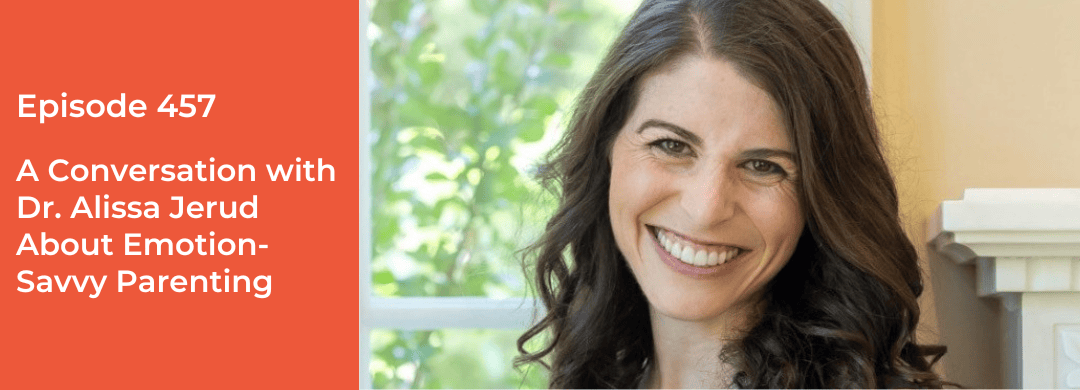
In this episode, I’m talking with clinical psychologist and author Alissa Jerud about her new book, Emotion Savvy Parenting. We get into how parents can better understand and manage their own emotions—especially in those intense, in-the-moment situations—so they can show up more effectively for their kids. Alissa shares her ART tools (Accept, Regulate, Tolerate), and we talk about strategies for staying grounded during emotional storms, including the ones that hit in very public places.
About Alissa Jerud, PhD
 Alissa Jerud, PhD is a mom of two kids, a licensed clinical psychologist, a Clinical Assistant Professor at the University of Pennsylvania, and author of Emotion-Savvy Parenting: A Shame-Free Guide to Navigating Emotional Storms and Deepening Connection. In her private practice, Dr. Jerud specializes in highly effective, exposure-based treatments for anxiety-related disorders, including obsessive-compulsive disorder (OCD), posttraumatic stress disorder (PTSD), social anxiety disorder, panic disorder, specific phobias, and generalized anxiety disorder. Additionally, she specializes in Dialectical Behavior Therapy (DBT) skills training and particularly enjoys helping other parents learn research-backed strategies for accepting, regulating, and tolerating their emotions, as well as their children’s. Dr. Jerud also trains other clinicians in exposure-based treatments and frequently gives workshops on anxiety, stress, mental health, parenting, and social support to companies large and small.
Things you’ll learn from this episode
- Why understanding the purpose of emotions matters for helping kids (and ourselves) live more fully and authentically
- How emotion-savvy parenting begins with our own emotional experience, not just managing our child’s behavior
- Why acceptance is a powerful first step toward emotional regulation and meaningful change
- How mindfulness helps us observe emotions without judgment, so they don’t take over our actions
- Why developing the skill to tolerate intense emotions can help us navigate parenting challenges with more calm and clarity
- How the cognitive triangle—linking thoughts, feelings, and behaviors—offers a helpful framework for understanding emotional reactions and building awareness
Resources mentioned
- Emotion-Savvy Parenting: A Shame-Free Guide to Navigating Emotional Storms and Deepening Connection by Dr. Alissa Jerud
Want to go deeper?

The Differently Wired Club is not your typical membership community.
There’s something here for everyone, whether you’re a sit back and absorb learner, a hands-on, connect and engage learner, and everything in between. Join the Differently Wired Club and get unstuck, ditch the overwhelm, and find confidence, connection, and JOY in parenting your differently wired child.
Learn more about the Differently Wired Club
Episode Transcript
Debbie:
Hey Alissa, welcome to the podcast.
Alissa Jerud, PhD:
Hi Debbie, thanks so much for having me.
Debbie:
Yeah, I’m looking forward to getting into your new book and your work. This is your first time on the show. So would you take a few minutes kind of beyond the formal bio and tell us a little bit about your work in the world? And I always ask people about their personal why. So if you want to slip that in, that would be great.
Alissa Jerud, PhD:
So I am a clinical psychologist and really I work with people to help them better manage their own emotions. Because as a human, as a parent, right, like I think that’s part of the hardest thing about living is just that we sometimes have some really uncomfortable emotions that come up. That’s part of being human. We all experience those. And so my why is all about how can I help people to better navigate that very human experience and to do so in as skillful a way as possible so that they can live more fully in line with their values. They can show up in the world as the people they want to be.
Debbie:
So I have to ask, I’m gonna push a little bit more. I don’t know why, I’m just wanting to know, like, is there a reason why this idea is so tied to you? Like, did you always know that this is the work you wanted to do? Because it’s pretty niche.
Alissa Jerud, PhD:
Yeah, I didn’t know. I knew in grad school or in undergrad actually, I decided I wanted to help people who had experienced a trauma of some sort and had post-traumatic stress disorder. And what I found in doing that work, I loved it. And it also really aligned very closely with work that I later did when I was at post-op, which was really treating anxiety more generally and helping people again learn how to navigate that anxiety skillfully. And also kind of moving back in time to grad school, also helping people to better manage, again, other emotions aside from anxiety and just realizing that at the core or the heart of the treatments that I was providing was this notion that we can feel strong and comfortable emotions when they show up and still choose to move through the world in an effective, skillful way, right? That those emotions are very important and very valuable. We don’t want to ever try to fight them or suppress them because that actually usually tends to backfire and causes more distress down the road.
And we can allow those emotions to tag along for the ride again without kind of pulling us away from what matters most to us. And so I think it was just in working with lots of people and even in my own life, seeing that, you know, kind of practicing what I preach and realizing there were moments where I maybe wasn’t allowing myself to be as skillful as possible, where those emotions were kind of hijacking me and calling the shots and realizing, like even though sometimes it feels almost impossible to refrain from giving into some of those unhelpful urges that accompany really intense emotions, it actually is possible. And so seeing that the treatments I was providing were helping other people to do that, they were helping me to do that, that’s what really hooked me because it’s really cool to see that transformation where somebody is struggling to not give in to every whim that comes with their emotions and then now feels like, wow. I don’t have to do that anymore. don’t, again, those emotions don’t have to control me or govern what I do or don’t do.
Debbie:
Yeah, and in addition to not giving in to every whim, I imagine that, and I’m imagining because this was my experience that, you know, there’s this idea among many people that some emotions are bad. And we also know that that is not the case, right?
Alissa Jerud, PhD:
Yeah, we’re actually evolutionarily programmed to feel all emotions, right? And if you think about it, those emotions that we often think of as bad or unpleasant are there for a reason. They actually serve an adaptive function. So if I don’t feel anxious when I’m crossing the street with a small kid, well, I might just walk right into the traffic. Right? If I don’t feel angry when somebody has caused me harm, then I might allow them to continue causing me harm. If I don’t feel jealous when, you know, again, we could go on and on for all those emotions, jealous, sad, all of those emotions. And so recognizing there’s a function to those emotions, there’s a purpose for them. And so as much as we might want to just turn those emotions off, one, we can’t. But two, even if we could, it actually wouldn’t serve us well. We’d be putting ourselves in the harm’s way. And so those emotions, we need those to be there. again, recognizing that they may not always be the best guide. Sometimes they can lead us to act in ways that aren’t so helpful for us, for others, or for our relationships.
Debbie:
So why don’t we then kind of pivot to your book? So you have a new book out and it is called Emotion Savvy Parenting. The subtitle is A Shame-Free Guide to Navigating Emotional Storms and Deepening Connections. So can you know, just zooming out, what is emotional savvy parenting? Why that title? What do you mean by that?
Alissa Jerud, PhD:
Yeah, so emotion savvy for me is about allowing those emotions in. Again, not fighting them, not rejecting them, because like I mentioned earlier, that usually doesn’t serve us all that well. But allowing those in without letting them. So often as parents we have this idea that we should, in order to be good parents, we should be calm, we should be happy, peaceful at all times. And I don’t think that’s realistic because if we were to do that we wouldn’t be human, right? Like again, we’re wired to feel those uncomfortable emotions. And my hope is with this book, I help parents? Like I’m hoping to help parents feel those emotions again without letting those emotions pull them away from acting as they’d like to when with their kids from showing up as the parents they aspire to be. So that’s what I mean by emotion savvy, right? Can we instead like, and I should know it’s not this thing that like it’s easier said than done. yeah, I’m gonna feel my emotions but not let them call the shots, right? Sounds great. It’s really hard. So the book is really, it’s rooted in that notion that we can, that that is possible. And it also consists of a number of skills to help actually make it something that parents can really do. Not with perfection, because none of us will ever be perfect. We’re going to make mistakes and sometimes those emotions will get the better of us. But ideally, more often than not.
Debbie:
And I just want to also point out that so many books for parenting are about how do we support our kids’ emotional development and their healthy expression of emotions, especially, you know, when we’re talking about neurodivergent kids who may have more outsized or bigger, intense feelings and emotions that we get to experience on a regular basis. But your book is focusing on our own behavior, which is one of the things I like about it so much. we’re focusing, Tilt has always been about like, what can we own in this and how can we show up better? So can you talk a little bit about that? Like what impact and what does it mean for a parent to really be savvy and how they navigate their emotions when it comes to that dynamic?
Alissa Jerud, PhD:
Yeah, yeah. Well, I actually, if it’s okay, I want to build off of what you just said there a little bit, because I think you’re right that so much of what is out there is either focusing on like, let’s support our kids to the fullest extent possible in managing their own emotions, but oftentimes maybe at the parents’ expense. Like, so we’re kind of like helping the kids, but we’re not providing parents with all that much. And, or I think there are those attempts to like, let’s help parents by changing the kids, right? And the thing with that is that really the only person we fully have control over is ourselves. And so I think those approaches that really focus on behavior change for the kids, one, we might not see the behavior change that we want to see, but two, I think it reinforces that notion that we sometimes have that in order to manage our own emotional discomfort, we have to find a way to get out of it, to escape it. So if I’m a parent and I’m feeling emotionally uncomfortable because of something my kid’s doing, I need to get them to stop right then and there so I don’t have to feel that emotional discomfort.
And so I want to help parents instead learn, hey, I can actually take care of my own emotions, right? And in doing so can help to model for my kids skills that they will hopefully one day be able to use as well. And also, like, when we are modeling that effective emotion regulation to your point of like, what does emotion savvy do? What’s the impact of it? I think it not only frees us from having to be kind of like governed by our emotions, but I think it also helps to model that for our kids and helps to support them with their emotions because so often what happens for us as parents is our kids are, you know, crying, screaming, hitting, whining, they’re doing something that’s pushing our buttons. And really underneath that behavior for our kids is a strong, unwanted emotion oftentimes. And so when we go in and we’re just focused on behavior management, well then we aren’t helping them to sit with that emotion. And so I think if instead we can recognize the feeling, wow, you’re really upset and support them in that, I can’t let you hit that hit. I’m not gonna, you I’m gonna help you here. But that feeling is okay. You’re allowed to feel that just like I’m allowed to feel what I’m feeling. Again, I think we can both kid and parent grow so much alongside each other.
Debbie:
Okay, so in the book you introduce the art tools and is it okay if I give a spoiler alert? stand for accept, regulate and tolerate. And I was hoping you could kind of walk us through and explain a little more about what that means.
Alissa Jerud, PhD:
Yeah, certainly. So these are science-backed that parents can use to help them better manage their own emotions, or even what I think of as relating more skillfully to those painful, uncomfortable, unwanted emotions. So, Accept is all about allowing those feelings to be there, recognizing that all feelings are valid, as we talked about a moment ago, even those really painful unwanted emotions have a purpose, a function. So can we accept those, let them be there and not jump into fixing mode, needing to get rid of them right away. Also recognizing that not only are emotions valid, but our thoughts are valid. Even if our thoughts don’t always make sense or map onto the facts, right? Like we can have those thoughts, they can be there. And same with our kids, their thoughts and feelings, even their behaviors, depending if they’re not harming anyone or anything else, their choices that they make, like how much they choose to eat at dinner, whether they choose to go to sleep when we turn off the lights, all of those things are things that ideally we can move to accept because the thing is is that when we reject reality, right, we say it shouldn’t rain when it’s raining. Well, that tends to add to our suffering because now not only is it raining, but like I’m kind of judging the fact that it’s raining and I’m, you know, I’m kind of dwelling in that stewing in that as opposed to just, yeah, it’s raining today. And so that piece of acceptance can go a really long way to actually bring about change. So in the book, I call it the catalyst of change in large part because we can’t actually change a behavior or a circumstance, a situation, even an emotion unless we first accept it and understand it exactly as it is. So accept is that first skill there. And really like the kind of the set of skills that fall beneath that, that will help us bring about that acceptance, are skills in mindfulness. There are lots of different ways we can practice mindfulness, but that’s like the main skill that helps us to move closer toward that accepting place.
Debbie:
And mindfulness, we’ve done episodes on that and we don’t have to go down that road too far. In the context of this conversation, I think of mindfulness as being able to just be in that moment, to notice, to observe, and to just be present with what is. Am I getting that right?
Alissa Jerud, PhD:
Exactly, without judging that moment as good or bad, right or wrong, or right, right or wrong, but instead just noticing exactly what is. And I will just add in here that I don’t know, again, we don’t have to talk too much about mindfulness, but oftentimes people think of mindfulness as something I’ve got to do, I’ve got to kind of remove myself from the situation, close my eyes, but ideally mindfulness is something that we can practice anytime, anywhere, no matter how intense those emotions may be in a given moment to help us better kind of, again, just be more present and accepting of what is in front of us. Practice it in bite-sized amounts. I can practice it while I drink my first sip of coffee, but I can also practice it while my kid is screaming at me because I will let them have that second scoop of ice cream.
Debbie:
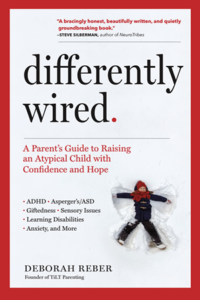
Yeah, and that’s like Jedi level skills when we practice it at that moment. And I do love the idea of acceptance. It’s something I talk a lot about. the quote that I have in Differently Wired, and I don’t remember who I got it from, but it is, when you argue with reality, you lose, but only 100 % of the time. And it’s just so true. But so many of us as parents we’re just kind of arguing with reality on a daily basis about a multitude of things. And that doesn’t ever really work out well. It’s just constant frustration. Okay. So that’s acceptance. Let’s talk about Regulate. What is that? What does the R in regulate mean?
Alissa Jerud, PhD:
Yeah. Regulate is about first in order to regulate is like how can we render ourselves less vulnerable to experiencing painful emotions in the first place and change those emotions when they do arise and aren’t serving us well.
And as part of regulate, again, because we talked about we can’t really change a behavior or an emotion, we can’t change anything unless we first understand it. Part of that regulate is also just understanding that our emotions are much more complex than many of us realize. And there are many different ingredients that go into each and every one of our emotions. And so if we can understand all of the different components of our emotions, well, then there are so many points of intervention that we can kind of places where we can intervene to, again, make us less vulnerable to those emotions and to change them when they do show up and are pulling us to move in ways that aren’t all that effective for us or for our relationships. So that’s regulate. And there are a number of different kinds of skills that fall under that larger umbrella of regulating that I’m happy to go into if you’d like. I will just first note that the tolerate skills are really those skills to help us better manage those really intense emotions that do arise, but those aren’t going to change because sometimes we’re just we’re going to be really angry. We’re going to be really disappointed or sad. Again, some strong unwanted emotion is going to be there and there’s not all that much we can do about that emotion, and how might we be able to feel that emotion, tolerate that emotion, without doing something that’s going to make the situation worse? Without doing something that we’re going to later regret, that might harm, again, our relationship or just even our sense of self a little bit.
Debbie:
So I want to jump in right there. Tolerating, this is a frequent conversation between my therapist and I when some of those really big emotions come into play specifically surrounding my parenting life. And sometimes I just say, feels intolerable. It’s too much. can’t do it. Of course I do. I’m still here. I’m doing it. So would you share, I don’t know if we’re skipping ahead, but would you share, How do we tolerate those emotions? I’m thinking of parents who are just in it, right? They’re really in huge emotional storms on a daily basis. So are these specific coping strategies that we learn to customize for ourselves? How do we tolerate those things?
Alissa Jerud, PhD:
Yeah, well, I think it comes back to that piece that I talked about with regulating that there are so many different components to our emotions. So it’s deciding, okay, right? This is really intense. Where am I going to intervene right now? And oftentimes when we’re in the heat of the moment, our prefrontal cortex, the part of our brain that allows us to make rational decisions, effective choices, almost goes offline. It’s like out the window. We’re again, we’re that’s why we say the term emotionally hijacked in those moments. And so one of the first things we can do is something that ideally gets our brains back online. And we can do that by maybe dialing down the emotional arousal a little bit, like the physical sensations that we have in our body when we’re when we go from zero to 100, right? Because usually when we’re really angry, I’m guessing that’s what a lot of parents are struggling with, who come to see, you know, who you talk with in your community. And when that happens, oftentimes our hearts are racing, you know, we’re feeling hot, sweaty, right? And all these physical sensations are there, and those pull us to engage in actions that aren’t so helpful. So sometimes the very first thing we can do is just use a skill to get our brains back. And so there’s actually a set of skills called the care skills that I have in the book that I really think are just fabulous skills.
And for your listeners who may be familiar with a form of treatment called dialectical behavior therapy, these skills are really the tip skills, what’s known as the tip skills from DBT, but I just kind of transformed them to the CARE skills because I find the acronym a little less clunky, a little easier to remember. And when we’re feeling strong emotions, we need to take care to make sure that those emotions don’t get the better of us.So CARE stands for cool with ice, activate your body, relax your muscles and exhale slowly. And I can walk you through each of those, but those are really like those strategies can within seconds really drastically reduce our emotional arousal. I’ve seen heart rates with the ice one in particular, very cool with ice. I’ve seen heart rates drop by 50 % or more in 30 seconds. That’s a pretty sizable shift, right? And then we can layer that, right? We can use one or more of those care skills and then follow that up with other skills. So oftentimes when we’re feeling a really strong amount of emotion, we want to, you we have these strong urges to act. We wanna yell, we wanna get in there and correct our kids right then and there, get them to change, right? Or we wanna kind of almost withdraw our love maybe, right, in a moment. Can we act opposite to those urges, whatever we’re feeling? And so that’s actually a skill called opposite action, which is really, again, about just recognizing those unhelpful urges and doing the exact opposite. Because if we act on those urges, that almost just feeds the emotion itself. But if we act opposite, if you’re really angry and you speak in a loving tone or gentle tone, it can actually help to further take the edge off.
Debbie:
Yeah. I think about, you know, laughter, right? That was something in my most desperate moments with a really little kiddo. I would just all of a sudden do something completely unexpected and silly, and it was amazing how quickly it could change the energy.
Alissa Jerud, PhD:
Right, laughter is almost incompatible with some of those really strong emotions, yeah.
Debbie:
Yeah. And when you’re talking about cool with ice, you’re literally talking about going to the freezer and getting ice.
Alissa Jerud, PhD:
Yeah, so okay, so what I will say first is we are wired. We are in very cold water. We are evolutionarily programmed to have our heart stop pumping so fast, right? In order or stop beating so fast in order. So basically what happens is our heart stops pumping blood to our extremities in order to heat our core our cores and conserve energy in that way. And so what we can do, we can actually mimic what we call the dive reflex. We can mimic that dive reflex by taking a cold ice pack like a flexible gel ice pack or even, this can get a little messy, but like a bowl of cold water, maybe put a few ice cubes in there, and you can either take that gel ice pack and put it over your head, or over your, sorry, over your eyes so that it’s like, you know, your cheekbones and your temples covering that and leave it there for about 30 seconds, or you can dump your head into that bowl of water for 30 seconds. And again, in that short amount of time, we can see those heart rates drop significantly. I will note if some of your listeners have heart conditions or even some other medical conditions, it’s worth checking with their doctors first before doing this, because again, it can bring about such a drastic decrease in our heart rates. And it’s just, if you’re able to do it safely, it is an incredibly powerful skill.
Debbie:
All right, that is good to know. I will keep that in mind. Okay, so in your book, you have something called the cognitive triangle. And I was hoping you could explain how we can use it to struggle less with something that is predictably hard in our parenting lives. And if there’s an example, maybe you could share with us, that would be great.
Alissa Jerud, PhD:
Yeah, so the cognitive triangle is that our, the idea that our thoughts, our feelings, and our behaviors are all really interconnected. So we just talked about some distress tolerance skills that we can use when those feelings are really intense to help us better kind of tolerate those emotions. And there are other distress tolerance skills as well that we can bring in. The, because, but the idea with the cognitive triangle is again, just because of that interconnection between those thoughts, feelings and behaviors, what’s neat about that is we’ve got then again, a number of different points for intervention. So maybe I go and I see, I recognize I’m having some unhelpful thoughts about my kids because, and I should note, it is so normal and natural to sometimes have those unpleasant thoughts. Oh my gosh, they’re being so annoying or like, why won’t they just listen? You know, those kinds of thoughts. Recognizing though that those thoughts sometimes actually be fueling our emotional distress and leading us to act in ways that aren’t all that helpful.
Similarly, our behaviors can also really have a significant impact on our feelings and on those thoughts, right? So if I’m like when my kids, you they’re making a big mess and I’m kind of like, you know, stopping in and I can’t believe you guys did this again. You know, we have people coming over like, how could you do this? Right? So that’s my behavior, kind of acting on that anger or frustration that I may be feeling in the moment. That’s gonna again, I’m gonna probably then have more negative thoughts about my kids afterward. And I’m probably gonna continue to feel angry with them for it. And so what the cognitive triangle suggests is that again, we can change what we’re feeling even if we can’t like turn off that emotion directly, but we can do so by reframing some of those unhelpful thoughts that aren’t all serving us all that well and also by targeting our behaviors by changing our behavior. that skill of opposite action that I mentioned for instance acting opposite to those urges to yell at my kids or acting opposite to the urge to if I’m feeling anxious about letting my kids do something and I’m tempted to let them you know to keep them home even though it’s like an objective safe thing.
I know there’s lots of different feelings about sleepovers, for instance. So maybe not everybody would agree that those are objectively safe. But let’s say I’m feeling anxious about a sleepover and yet I realize that it’s really important to my kid. I think it actually could be a really great experience for them to be able to have a sleepover. Well, maybe I could practice acting opposite to that urge to keep them home. And that, over time, might actually bring about a change in the feelings and my thoughts about safety of sleepovers because maybe my kid has sleepover after sleepover after sleepover and you know what they come home feeling really happy and kind of like more strongly connected to their kids and then I realized okay sure maybe you know sleepovers aren’t 100 % safe something could happen at a sleepover and just because that’s possible doesn’t necessarily mean that they are inherently dangerous or like wrong for my kid. So that’s just like one example there.
Debbie:
Yeah, no, that yeah, no, I appreciate that. And, know, you’re talking about CBT, which I know you use in your therapy, right? So really like knowing that our thoughts, I mean, the way I think of CBT is that our thoughts control our emotions. So if we can change the thought, we can change the intensity of the emotion that goes with it. So I really appreciate that example too, because I was going to ask you what about not something in the moment with our kid, like a high stakes you know, intense moment, but rather the ongoing behind the scenes kind of worries and fears and anxieties that a lot of parents are grappling with. So thank you for that. Let’s spend a few minutes talking about emotional storms. You say in your book that we should welcome the emotional storms. And you said, when we give into these urges to resist or hasten along our children’s emotional storms, we intentionally or unintentionally send the message that we’re not really OK with such outward expressions. So, you know, we’ve been talking about this, but let’s talk about it some more in the midst of the really big things that feel super uncomfortable. How do we say, opportunity, this is an opportunity for us to practice, you know, to build these muscles. How do we really lean in?
Alissa Jerud, PhD:
Yeah, well, I love that you frame it in that way, right? Because I talk about that all the time. Moments that feel so hard so intolerable where our kids are melting down and maybe we’re starting to melt down on inside Those moments are actually these golden opportunities in some ways like as much as they may not seem like it gifts from the universe to practice building those muscles for tolerating distress for relating more skillfully to unwanted emotions because if you think about it if things are ever only ever like easy peasy we don’t get a chance to learn, we can, we can deal with this. We can cope more skillfully, more effectively. We actually need those hard moments in order to practice using the skills that I talk about in my book and learn there’s a different way that we can relate to those feelings. so, it is so easy, so much easier said than done for sure. And I would say when we can recognize those moments as, yeah, like this is hard and can do this, right? We can allow those feelings to be there and let them be there, right? Like, you are really upset. I know that. Or disappointed or, you know, you’re so mad at your brother right now. I know that. And let that be there as opposed to trying to fix that. That can go such a long way, not only toward building our own muscles for tolerating distress, also for helping our kids and for helping them send the message that they can feel that way. It is okay to feel that way. We don’t have to sound the alarm. We don’t have to swoop in and save them or stop that experience. Neither do they. And so it’s such powerful, corrective learning for us, for many of us, because many of us, think, were programmed or were kind of taught to believe that those emotions should be avoided at all costs.
Debbie:
Yeah, yes, 1000%. That’s just what I was thinking as you were talking. It is a chance for us to heal and to raise children who have a much healthier relationship with their emotions. Can we, before we wrap up, spend a few minutes talking about emotion coaching? I haven’t heard about it in the way you described it before. So what is emotion coaching and how do we do it?
Alissa Jerud, PhD:
Yeah, so I don’t even talk so much about emotion coaching in the book, actually. I just reference that there are studies to support that parents who are trained in emotion coaching experience less emotional distress overall, that their kids tend to as well, and they have fewer challenging behaviors. Maybe even are, if I remember correctly, like they have better peer relationships. And so the idea is that when we, because emotion coaching is really more focused on helping our kids through those challenging emotions as opposed to helping parents themselves through those challenging emotions. So the difference between emotion coaching and like emotion savvy parenting, I think it’s really focusing more on the parents experience, knowing that in allowing the parent to sit with those uncomfortable emotions, we’re helping the kids. So my thought is, you know, it’s a very similar approach. It’s more just what I’m really stressing is more the parents experience in the moment, because I think so often when our kids are melting down, the thing that prevents us from helping them as skillfully as we could, as effectively as we could, our own emotions and thoughts, judgments about what’s happening for our kid. The thought, this is wrong. need like, you know, why are they always doing this? Am I ever going to have a kid who’s quote unquote normal, right? Those are the thoughts and then the emotions of discomfort or embarrassment or frustration, anger that tend to lead us to reject what we’re seeing in the moment to try to get it to stop teaching it.
So really more than doing anything to like even help the kid I think it’s first again that idea of helping ourselves so that then we can best help and support our kid and I don’t even know that I love the word coach because it almost suggests that we have to do something to like again kind of get them through the moment and I think really more it’s just like being beside them. Even if that means sometimes like I’m busy you know cleaning up the kitchen because I’ve got you know something to do later right so I my kid is kind of melting down and I’m you know just communicating acceptance of that. Yep I know this is hard I can’t help you right now but like I’m here for you right I’m with you and you’re allowed to feel however you’re feeling as I’m doing the many different things that I’m trying to do in this moment.
Debbie:
Okay. Well, you mentioned the word embarrassment in your response. And so I did want to just touch upon that because we do it often, especially if our kids are doing or having big emotions in a public way, that can be really challenging. That’s a whole other level of being able to show up calm and to stay grounded in ourselves and without kind of dealing with or like absorbing the judgment from other people. So do you have any advice for how to practice emotionally savvy parenting in a public space?
Alissa Jerud, PhD:
Yeah, I mean, I think when we’re feeling embarrassed, the thoughts that are coming up for us usually in those moments are, my goodness, like, what are people thinking about me? Maybe they’re thinking I’m a bad parent. Maybe they’re judging my kid. And like, maybe they think I should be doing something differently, right? Those are probably some of the most common thoughts. And I would say the more you can accept those as possibilities rather than facts, without letting those thoughts change your behavior, without letting the emotion change your behavior better. So I provide a lot of treatment for anxiety-related disorders and there a lot of the concerns are around what other people might be thinking about us or even about something else. A concern that something terrible might happen and what we know is that an approach that oftentimes is recommended is to go ahead and convince yourself that that’s not gonna happen. Nobody’s gonna judge you. People seem to like you. Everything’s gonna be fine. Reality is we don’t know that and oftentimes it’s the uncertainty of not knowing what other people are thinking that is fueling that embarrassment. And so rather than try to convince ourselves, it’s no big deal, I think we’re actually better off just accepting, you know what, maybe people are going to judge. Maybe they’re going to think poorly of my kid or me. And again, I’m still going to choose a parent in the way that I believe to be most effective for myself and for my kid. That’s what I would recommend. So letting those thoughts be there without letting those kinds of, again, you do or don’t do.
Debbie:
Right. And they’re feelings, not facts. And now I’m hearing another saying that one of my therapists from years and years ago said, was it a hassle or a horror? so, you know, just kind of like, can I tolerate the stares from other people? Yeah, I can. Like, you know, even if it happens, it’s not going to kill me.
Alissa Jerud, PhD:
And recognizing too that the more you practice tolerating that, the easier some of those other moments down the road are gonna be. In fact, I’ll just add that when I’m treating social anxiety, for instance, I purposely as part of treatment, and this is like, you this is what exposure therapists like me who treat social anxiety do, we actually have what we call social mishaps. We have people intentionally do something that would objectively be embarrassing or kind of like a faux pas in anyone’s eyes. So we do that so that they can practice learning, I can tolerate even that. And if I can tolerate that, that makes all the other moments that may come down the road so much easier. Because I know I’ve been there, I’ve done that, I can do that. And so the same idea here when we tolerate those really difficult moments that feel really embarrassing, the more we do that, the more we’re going to know, yeah, I can do that the next time around when my kid is doing something else that leaves me feeling really embarrassed.
Debbie:
All right, so we’re gonna wrap up, but I just wanna remind listeners the book is called Emotion-Savvy Parenting, A Shame-Free Guide to Navigating Emotional Storms and Deepening Connection. And would you share with us where listeners can connect with you and learn more about your work?
Alissa Jerud, PhD:
Yeah, certainly. So they can go to my website, alisajarod.com. I’m also on Instagram, though I’m still learning how to use it, but it’s Emotion Savvy Doc is the handle there. Yeah, so those are two places they can go.
Debbie:
Awesome. So listeners, as always, I will have links in the show notes page to Alyssa’s website, to the book, and any other resources that came up in the process of our conversation. So thank you so much. Congratulations on the book, and thanks for everything you shared with us today.
Alissa Jerud, PhD:
Thanks Debbie. It was so fun talking with you today.
Do you have an idea for an upcoming episode? Please share your idea in my Suggestion Box.