Dr. Laura Markham on Peacefully Parenting Siblings in Neurospicy Families
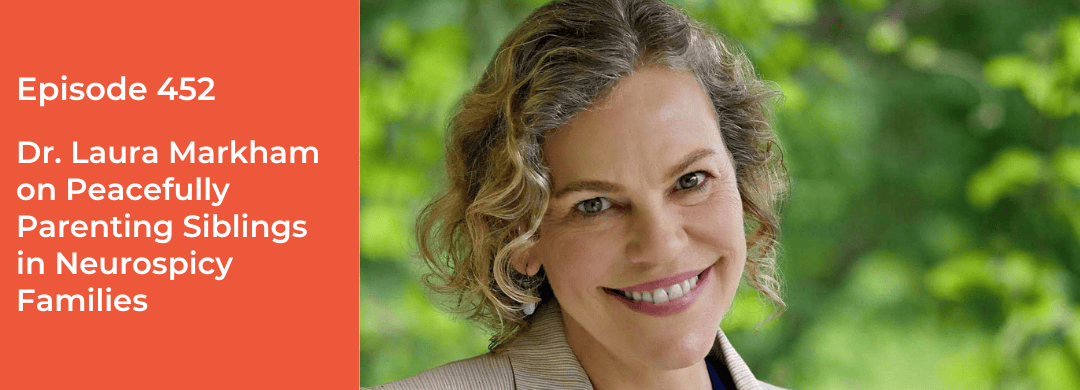
In this episode, I sit down with Dr. Laura Markham to unpack the often messy world of sibling dynamics—especially when one or more kids are neurodivergent. We talk about why peaceful parenting starts with connection, how to handle those inevitable “it’s not fair!” moments, and how to repair after conflict. Laura shares thoughtful, practical strategies for supporting each child’s unique needs while nurturing more positive sibling relationships, even when things feel really hard.
About Dr. Laura Markham
 Dr. Laura Markham is the author of Peaceful Parent, Happy Kids: How To Stop Yelling and Start Connecting, Peaceful Parent, Happy Siblings: How To Stop the Fighting and Raise Friends for Life, and The Peaceful Parent, Happy Kids Workbook: Using mindfulness and connection to raise resilient, joyful children and rediscover your love of parenting.
Dr. Laura Markham earned her PhD in clinical psychology at Columbia University and has worked as a parenting coach with countless families across the world. Over 170,000 moms and dads enjoy Dr. Laura’s free weekly coaching posts via email. You can sign up on any page of her website, Peacefulparenthappykids.com, which serves up Aha! Moments for parents of babies through teens. Dr. Laura’s aspiration is to change the world, one child at a time, by supporting parents. The proud mother of two thriving young adults who were raised with her peaceful parenting approach, she lives with her husband in New York.
Things you’ll learn from this episode
- Why parenting that prioritizes connection over strategy lays the foundation for healthy sibling dynamics
- How self-regulation in parents shapes the emotional tone and effectiveness of conflict resolution between siblings
- Why it’s important to embrace sibling conflict as a normal and teachable part of growing up, while guiding repair and emotional processing
- How acknowledging each child’s unique needs and avoiding comparison fosters a sense of fairness and individual worth
- Why modeling compassion, calm, and appropriate behavior teaches kids how to navigate conflict and build emotional intelligence
- How recognizing the goodwill in children and validating their feelings helps strengthen sibling bonds, even during tough moments
Resources mentioned
- Peaceful Parent, Happy Kids: How to Stop Yelling and Start Connecting by Dr. Laura Markham
- Peaceful Parent, Happy Siblings: How to Stop the Fighting and Raise Friends for Life by Dr. Laura Markham
Want to go deeper?

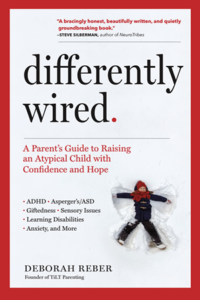
The Differently Wired Club is not your typical membership community.
There’s something here for everyone, whether you’re a sit back and absorb learner, a hands-on, connect and engage learner, and everything in between. Join the Differently Wired Club and get unstuck, ditch the overwhelm, and find confidence, connection, and JOY in parenting your differently wired child.
Learn more about the Differently Wired Club
Episode Transcript
Debbie:
Hey Laura, welcome to the podcast.
Dr. Laura Markham:
Thanks, Debbie. Glad to be here.
Debbie:
I’m so looking forward to this conversation. And there’s so much that we could get into. Once again, I have way too many questions here. We’re going to do our best. But the focus of our conversation will be on the sibling dynamic. But you do so much work in the peaceful parenting space. And I was hoping you could just take a few minutes telling us, or as long as you want. You could take more than a few minutes, but telling us a little bit about kind of your why your kind of core work in this space because you are such an important voice in the parenting ecosystem.
Dr. Laura Markham:
Well, I’m a clinical psychologist and what I do is work with parents. That’s what I have always done because as I was finishing grad school, I got pregnant with my first child. And I realized when he was born that I had read all these studies that the other parents around me had not read. And in fact, they didn’t have a lot to go on except what their parents had done with them. The only thing out there at the time was Mothering Magazine, where I could resonate, where I could feel like the guidance actually was applicable to what I was trying to do with my son. Over time, the approach that I was using, which was distilled from the research and then from my experience, really came into clear focus for me because I realized it was all about relationship and connection. And that, you know, it’s not a set of strategies parenting any more than a marriage is a set of strategies, it’s a relationship. And I also knew from the research that kids do their best and they have immature brains that are, when I say immature, their brains are still taking shape in response to repeated experience as ours are, but ours don’t change so quickly. And they don’t, they’re not born with much of a prefrontal cortex. They don’t have a lot of ability to self-regulate. They get that from us.
So I began to see that all of the research I’d read that we, of course, and now it’s been many much more time, many more, know, many thousands of studies later, we really understand something about self-regulation, co-regulation for kids and how children’s brains do take shape in response to the relationship with the parent primarily. But it’s the environment, but we’re the initial environment, right? So those are the first two parts of my approach, connection and coaching kids instead of trying to control them with punishment or threats or even bribes, but trying to coach them to be their best selves and support them, give them support to meet our expectations. So as I’m doing this work with parents, I’m noticing this is all well and good except that parents can’t always do it because parents are human too and parents have their own baggage that they bring. And parents can’t really self-regulate if they weren’t parented in a way that allowed them to develop that capacity. And every parent I knew was growing and sometimes really struggling and needed support. So the foundation of my work really became the parents’ ability to not just self-regulate, but be self-compassionate, and reparent themselves. So it really became calm, connect, and coach. And those are the three big ideas of my approach. I call it peaceful parenting. And I know that many parents are put off by this because many parents will say, there’s nothing peaceful about my house. You try coming to my house with my kids, but it’s not so much about the kids. It’s peaceful parent, happy kids. The kids are happy because the parent is peaceful. And that doesn’t mean we aren’t loud and boisterous and excited at times. It means that we are at peace in our own heart because we’re working on us. We’re taking care of us. We’re showing up for our kids with our whole heart, but we’re also showing up for ourselves because you can’t do this hard parenting work unless you show up for yourself. So that’s what peaceful parenting is about.
Debbie:
Yeah, it’s so wonderful to hear you describe it. And I just imagine in the time that you’ve been doing this work, the conversation has changed and evolved so much. I launched Tilt now nine years ago, and I’ve seen so much change in the language we use and just the understanding about concepts like co-regulation and all of these things. I’m just kind of curious you know, to know your thoughts on having kind of witnessed this shift and what excites you about that.
Dr. Laura Markham:
I feel that my observation is that there’s a wave of us. And by us, I mean people who are approaching children with respect for who that individual child is. And every child is an individual, right? parents and therapists and you know, teachers, anyone on the front lines, OTs, people who are dealing with kids who are appreciating that unique child, right? There’s a wave of us doing that work. And I don’t think it’s just about approaching kids with respect. I also think it’s about parents realizing that this is their work too inside themselves, because the work we do for, we’re motivated to do the work because we love our kids, right? This is hard work. But as we do that work, we grow and change and we evolve as humans. And I think the world becomes a better place by having more people who are committed to, you know, we’re basically taking what’s unconscious in us and making it more conscious. We’re bringing more awareness, conscious awareness to our own experience. We’re showing up with more presence. And that is of course what our children need from us, but it’s also what makes the world a better place. So I find the whole thing to be an exciting part of our human evolution.
Debbie:
I love that. And I love that you say there’s a wave of us because I do think of this as a sea change. So I like the water metaphors here and it is really exciting. And it’s also something like when we became parents, I certainly wasn’t thinking, well, I’m I’m really looking forward to all the personal growth I’m going to experience as a result of this. Right. I mean, now I’m so grateful most of the time for, you know, all of the work I continue to do on myself so I can show up for my kiddo. But I agree with you. It is how we all kind of grow and evolve as humanity. It’s really exciting when you describe it that way. So okay, let’s pivot a little bit. You have written several books, including Peaceful Parent Happy Kids. You also have a workbook on that, the Peaceful Parent Happy Kids workbook, but you’ve also written a book called Peaceful Parent Happy Siblings. And so when I think of you, I often think of you in the sibling space. And this is a big conversation among my listeners, especially when you have these kind of mixed neuro type households and there’s a lot going on. Let’s kind of enter the conversation of siblings. And I’m kind of curious as to what was it in your world that made you think, I have to actually create a resource just focused on this topic for parents.
Dr. Laura Markham:
It was the parents. Everywhere I spoke, parents would ask me about sibling issues. And there was no one really doing sibling work. To me, if you’re doing the kind of parenting I recommend, your kids are gonna get along better. That’s pretty clear, right? So to me, I thought it was handled, but they didn’t think it was handled. They said, I’m trying to do the kind of work you recommend with the kids. I still, my kids have their own relationship. They have their own issues and it’s still hard. And I realized, you know what? They’re right. There’s actually a lot of research that parents would it would benefit them to hear. Like one thing that’s really important, it’s okay for your kids to fight. It’s okay. They learn from it. What we need to do is support them. We need to do two different things. One is to support them to have the skills to fight in ways that they can actually work things out instead of the fighting being, eroding the relationship. That’s one thing. And that’s a whole discussion we can have about how you do that.
But there’s another thing. The research is pretty clear that what matters is that the kids have fun together, have fun positive interactions, so it’s okay if they fight if in fact they also have the positive interactions You know the the old research that was done that said five positive to every negative is necessary to maintain a relationship We don’t know no There’s been no work on kids as far as I know in this regard But it’s pretty obvious if you look at your own family if you have more than one child that if they’ve you know if they’ve had negative interactions there needs to be something positive to balance it. But the research even goes a step further. The research says if in general they have positive interactions, the valence of the relationship will be positive. Later when they are in their 20s, they’ll look back and they’ll remember the positive things. They will think of the relationship in positive ways. It does set the tone. So your kids are going to fight. That’s just the way it is with immature human beings. And honestly, with mature human beings, when there’s no human relationship without some conflict. But if we can learn how to fight in ways that bring us closer and we can make sure we also have all the positive things that serve as the glue and the motivation for connection and working things through and repair, then we can have good relationships.
Debbie:
So I’m curious to know, know, something you said in your last response. You know, I imagine a lot of parents, you know, really envision this really ideal relationship and the two or three or more children, really, they play harmoniously and you just said it’s okay to fight, which makes sense. But I imagine that there are a lot of expectations about what this should look like. And then when it doesn’t look like, especially again, and we’ll pivot more to neurodivergence, but it may look vastly different from what we want it to look like. And so what are some of the biggest worries and concerns, maybe some that are founded and some are unfounded that you hear about from parents?
Dr. Laura Markham:
I think parents will always bring their own baggage. So if you had an older brother who knocked you around or was always teasing you or mean to you, you’re going to be very sensitive to that dynamic. And you might really identify with, you you’re the second kid, you might really identify with your second kid and feel like anytime the older kid grabs a toy from the hands of the younger kid that they’re being a bully. So I think what parents have, yes, they have an idea that it should look perfect and beautiful and that older child should always be lovely. And of course you can have the toy from my hand, but there’s also the projection of the unconscious fears and resentments and baggage that came from their own childhood. So I see that often, that parents take the side of one of the kids, the one they identify with, especially if they’re observing, usually it’s the older kid, one kid to be pushing the other child around in any way, they get angry on behalf of them. Why does my daughter need to control everything? She never lets her little brother have anything. And so we have this idea that the minute we have a second kid and it’s a tiny child, a tiny baby, and the minute they’re crawling around and getting into the big kid’s stuff, or even just they’re in their little seat, and the big kid comes over and is teasing them in some way, here, play with this, let me take that back. And at first it’s a game and then it’s not a game. Parents get very upset on behalf of the little one and they look at the big one and they think, wow, he’s so big, she’s so big, they should be able to act mature. But the big kid is three years old, you know, went later.
I’ve had so many parents tell me, you know, now that my youngest is six or seven, I realized my older child, the oldest of the three was six or seven when the little one was born and there were two younger ones and they weren’t getting their needs met. And of course they felt terrible and were throwing themselves on the floor having tantrums. And I thought they were such an awful kid that they weren’t acting their age, but actually they were acting their age. So I think we, right away we think that the older children should be mature and grown up in a way that is really not appropriate, in fact, not age appropriate for them. And then, you you mentioned mixed neurotype families. You will always have kids who have different needs and different personalities. You’ll often have a kid who makes a lot of noise and a kid who’s more of an introvert and doesn’t like all that noise. But when you have the mixed neurotype families, you’ll also have a kid who maybe has, you know, needs to make certain noises to keep themselves calm. And that can be really irritating to the other kid. Or maybe you have a kid who has some sensory issues and the sound of their brother chewing next to them at the dinner table is just like they can’t handle it. And they just get more and more irritated. Or maybe you have a kid and the parent hasn’t really realized that they have some hypersensitivities, mean hyper in contrast to people who are more neurotypical. Maybe the parent hasn’t realized that they’re sort of, they have these hypersensitivities and they’re easily overstimulated and then all of a sudden they’re having to share their parent with this baby. The parent’s no longer running interference so much.
There’s constant, you know, there’s a lot of stimulation and that kid’s, you know, that’s a kid who needed more to begin with and maybe they’re not getting more that they need. We know that the kids who are higher needs don’t stop being higher needs because a baby’s born. And we know that the older kid sets the tone in the relationship. The first kid sets the tone in the, I guess when you have three kids, know, the two older ones said it, but the point is the child who’s older relates to the baby and sets a certain tone in the relationship. And if that’s a kid who needs more and is not getting more, I don’t, I’m not trying to, comply that it’s all on the parents. But I do think that when you have a kid who needs more, you’re showing up like a saint. You’re giving more all the time. And this is not news to your listeners. And so part of what’s going to allow your children to have a good relationship with each other is you making sure that each of their different needs are met and that you help them run interference, that they’re able to, you can coach them to say, I’m having a hard time with the chewing. Could I move in a different seat? Or you know, we expect, of course everyone’s going to eat dinner together, but maybe that’s not what should be happening. Maybe there’s a way that we can do something different, at least for now, right? Maybe things won’t look quite what we thought they would look like if we have a kid who has, you know, higher sensitivity in some ways, right? And that doesn’t mean those two kids can’t build a relationship. They can build a relationship in other ways. They can have fun. I think it’s really important that parents find ways for those kids to have fun with each other that does work for each child. But it’s a lot for the parents.
Debbie:
Yes. And I’m thinking about, you mentioned this projection of their own fears, you know, on that, depending on what we come into our parenting lives with and the relationship we had with our siblings, if we had them when we were younger. And then I’m thinking about the feelings of guilt, which I hear about all the time, guilt that there isn’t enough of me to go around and you know, this one requires so much more attention. The other one is kind of getting the shaft and what other kinds of emotions, you know, bringing it back to the parent. Cause as you said, in the very beginning, this is really us doing our work on ourselves. What are some of the other emotions that you hear from parents that they’re grappling with that can make the sibling dynamic even more challenging?
Dr. Laura Markham:
I think when parents compare their kids, it will always worsen the sibling dynamic. And that’s true when you have two neurotypical kids. You why can’t you just brush your teeth without a fuss like your sister does? Well, that’s not good for the kid who’s being compared. We could just say, time to brush your teeth. I need you to brush your teeth, as opposed to any comparison, because then they resent the perfect sister. But also, it’s not good for the sister who now has to keep the sibling in a one down position. Yeah, he didn’t brush his teeth again, mom, because she needs to maintain her special place in the household. But when you’re comparing kids, when you have a mixed neurotype family and you’re comparing two kids, you’re basically setting one kid up to, they can’t be what their sibling is. They can’t just choose to suddenly have more impulse control. They can work on it, but they can’t choose to be that kid, right? They’re, they are going to have whatever the issues are, they’re differently wired. So you’re setting up a relationship where there will be more resentment, where they will not, where you’re creating resentment between them. And you’re also setting up so the kid who’s more neurotypical feels like they’re only acceptable in the parents’ eyes if they toe the line and they’re normal and they don’t make a fuss and they don’t have big feelings. So you’re actually setting that kid up too, right? So you’re setting up resentment between the kids, but it’s also unhealthy for both kids and their self-esteem and their connection with you, the parent, right? So one thing that we often have a hard time, we as parents sort of automatically are comparing our kids. And it’s, I think, super important to work against that.
Debbie:
So you were talking about this resentment that can crop up, especially if there’s comparison involved. And I think this is a question I get all the time. There’s a lot of concern that resentment is going to build because perhaps, not comparison based, but maybe one of the siblings is getting a lot more support and accommodations in areas like maybe there’s a sibling who really needs, you know, I’m just thinking of screen time to regulate and it goes, it’s kind of a different guidelines, right? And so, and we know that every child has different needs and but how do you suggest parents navigate it when two or more children have such vast needs and they want to be sure, you know, well, what, that’s so fair. Why does she get to do X when I can’t, you know, do this? How do we get through that?
Dr. Laura Markham:
Yeah. Yeah. I think we have to have ways of talking about each child’s unique needs that are respectful and valuing that kid, not painting them as being a problem. And at the same time, understanding that they have different needs. The kid who has sensory issues and they can’t handle the lights and the sound, that’s something that other kids, that the sibling can understand usually. They may not love it, that may mean that it impinges on their life, but they can usually understand it. Or the kid who has to make some noises to settle themselves or to keep themselves calm while they’re working. Usually we can accommodate those kinds of things, it’s more in the area where there’s something that the child wants and the sibling is getting that they don’t understand, well, why wouldn’t I get that? And I think then we have to talk about it as based on the unique needs of the kids. Like you need, you know, a new pair of shoes or a bigger bike this year because you’re getting bigger. And your sibling doesn’t necessarily need a new pair of shoes or a bigger bike this year because they, you know, are okay with their old one. So you’re going to get those things. And your sibling does need more screen time because there are certain things they can’t do. Your sibling also might have things that you don’t do like go to see the OT. You know, you don’t do that, but your sibling doesn’t. Your sibling doesn’t love doing that, but they need to do it because just like, you know, you need to go to the doctor for your asthma inhaler and your sibling doesn’t have to do that.
So I think really approaching it from the perspective of you’re two unique people and our job as parents is to work with each of you to help you to meet your needs and also to help you meet our expectations. We expect you to do certain things. I don’t expect your sibling to do all the things I expect from you because actually your sibling can’t do some of those things even if you’re the same age, you know, your sibling can’t do some of these things that I expect of you, that you can do. Now, you’re, this is a really important part of the discussion. Your child will have some grief about that and some anger, right? Your child will be like, how come I have to, I’m expected to be polite and meet strangers in a polite way and, you know, look them in the eye and shake their hand. But my sibling doesn’t have to do those things, right? But actually the sibling can’t do those things. And the kid knows that. They know that their sibling on the spectrum isn’t going to be able to greet that stranger in the same way. They don’t have that capacity. And so they do know it, but they wish that they could not.
You know, it’s a little hard for them to have to rise to the occasion and do it and they wish they wouldn’t have to do it. So I think for the parent to acknowledge, yeah, it’s hard for you. And I do let your sibling have X amount of screen time. You get half of that that is true. And here’s the reasons and I need you you’re you’re spending more time with friends Your sibling actually doesn’t have the have those friends that you do It doesn’t have friends as you do in that same way and your sibling needs to do things that are going to work for them and they’re unique you know who they uniquely are and The screen stuff is actually really engrossing to them actually helps them with impulse control helps them develop the skills They are that need to develop up and you’re, I, I, it’s important to me that you get outside and play with your friends which you know your sibling also goes outside some but doesn’t, isn’t, can’t just go out and play with the neighbor kids in the same way you can without it being a problem or whatever.
So, you say all that and the kid does hear you and does get it but there’s still some jealousy, some resentment and I would say some grief like how come I am expected to do these things and meet your expectations. How come they get off easy and get to just do these other things? How come they’re allowed to have tantrums when you expect me to pull it together? I mean, might even be that’s, how come they’re, how come they’re, they yell at me right in my face and I’m not allowed to do that to them, right? There are all kinds of things that the child could have questions about. I think it’s really important that the parent acknowledges that those, that sense of unfairness. hear you. I hear you, sweetie. You don’t think it’s fair. Your sibling yells right in your face. And your sibling has done that to me many times also, and it’s not a pleasant experience. And I expect you not to push them down. I expect you not to even yell back. I expect you to move away from them, just say, we’ll talk when you calm down, and later to tell them that it hurt your feelings or your body. And I expect you to act much more mature than they’re acting and yet you’re basically the same age or whatever. I hear you. That’s really hard for you. And it doesn’t seem fair to you. I hear you. you wish it was different. And I wish it was different too. And the truth is your sibling wishes it was different. But this is not something. They’re working on it. They’re better than they were a year ago, right? And they do not, their brain does not work the same way yours does exactly and they have a much harder time when they get upset. So I think our ability to acknowledge the unfairness of it to the sibling who’s feeling they’re shortchanged is critical and to acknowledge the grief of it and the embarrassment of when the kid does come out into the neighborhood and the other kids are like, your brother is really weird, right? So if there’s embarrassment in public. And just the sense of, I think every kid needs to feel uniquely seen, valued, loved, appreciated, and also that they’re not a bad kid for feeling that jealousy and that resentment and that anger.
Debbie:
Gosh, that was like a little masterclass right there, like just, you know, for parents who want help with the language for in those moments, it was so nice to hear you as if you were speaking to that child. Because I think that validation, we know it is so important and it can be hard to do. And I imagine that, you know, as you were sharing all that, I’m thinking it’s also really important that parents make sure that they’re not enmeshed with the child who’s hurting because we want to show up and validate, you know, not feeling like, yeah, I get it. Or like really like putting our guilt or our worry for that sibling on them. We want to be kind of neutral, I would imagine. And so we want to do our own work.
Dr. Laura Markham:
I don’t know if I’d use the word neutral. I would say we want to hold the light. If somebody’s in a dark pit and you climb down there with them and you don’t have any light and you’ve forgotten where the ladder is, it’s not going to help anybody. But if you go down there and you have the light and you say, I see you’re hurting. I’m right here. holding your hand. You can do this. I’ve got your back. Come with me. Here’s the ladder.
Debbie:
Love that. I love a good metaphor. The latter, that’s a good one. Okay. And the light. Love it. Thank you. Let me ask another question. This comes up a lot in my community. I hear from parents who have a sibling who, the older sibling, which as you said, sets the tone and I hadn’t thought of it that way, but it makes total sense. So the older sibling who’s setting the tone maybe is modeling behavior that is really not what we want our younger kid to be modeling. And so parents feel really extra triggered by this, whether it’s swearing or physical behavior, whatever it is, and they see the younger sibling, maybe quite young, starting to mimic it. Do you have any ideas around how to navigate that?
Dr. Laura Markham:
That’s hard because we want to, if we’re just negative toward that behavior, the younger child sees it as being negative toward the other child, right? We’re not wanting to model that we’re less than compassionate to anyone, right? So we’re not just showing up and with our fear because when we’re acting out of fear it’s always going to come out as control and criticism and dominance and negativity. That’s how fear is. The first thing to do is to reassure ourselves. We always have to start with ourselves And so I would say the first thing is your younger child who’s copying, this is a temporary thing. They’re very little right now. So they’re copying this; they don’t know the difference. They will get that there’s a difference when I say set the tone. It’s within the relationship itself if someone if you’re little and your big sibling is mean to you You’re gonna want to be back to that person. And yes, of course they’re a role model for you, but they’re not the only role model. The parents are the role model, the nursery school or whatever is a role model, other kids. So I want to reassure parents that that’s not the only role model for your child. And yes, your child thinks it’s funny right now, your little one, your toddler thinks it’s funny to mimic the older kids swearing or huffing around or whatever they’re doing.
So I’m gonna give you, you said it was useful to hear the words the other day, so in the other example. So I think you would, first of all, always, your older child is doing this, you would say, I see how mad you are. The kid is swearing and huffing around or whatever. I see how mad you are. You can’t find your such and such or you wish I would let you do such and such or you weren’t ready to turn the screen off. You acknowledge whatever they’re upset about. I see how upset you are. You really wish you could use your screen more. It’s always hard to get off the screen, I know. I’m right here to help. What can we do? And maybe the kid, at that point, because they feel connected to you, actually can pull it together and stop scurrying and huffing around. They may turn and yell at you, you know, but you made me turn it off. They may, you know, when people feel understood, often everything really rises to the surface. So you have to hold it together. Another, it usually takes at least three times of our compassionate outreach for the other person to get past their resentment, their anger. And so your kid may turn around and yell at you, toddlers watching all this right and you say when they yell at you but you made me turn off I did ask you to turn it off it is time to turn it off because blah blah blah blah blah we need to get ready for bed I I know it’s hard and I know you wish you never had to turn it off and they at this point because you’re not fighting back, they do start to feel safer. Because remember, the reason humans get angry is because they don’t feel safe. It’s always that the nervous system gets dysregulated in response to threat, always.
So when we turn off a screen, especially for a kid who’s neurodivergent, you turn off a screen and they were using that screen for all kinds of things, to feel good about themselves, to self-regulate and that it goes off, there’s a threat to their wellbeing. And they’re dysregulated and everything looks like the enemy, including you but when you can show up with compassion and calm and love your kids like all right well I guess she’s not really the enemy and they start to settle down because they start to feel safer they may still be ready to you know snap your head off but they’re a little they’re not on the attack the way they were a minute ago and you say let’s figure out what we can do now that’s going to help you to feel better. What can we do? Would it feel good to have a nice warm bath? That nice hot bath, would that feel great? Do you want to listen to your book in the bath? Do you want to, whatever. Now you’re problem solving around how they can do some self care that’s going to shift their mood. And the kid settles down. You get them squared away.
Meanwhile, your toddler is like swearing and stomping around and laughing because they think the whole thing is funny. And you go to your toddler because other one is now situated and you say your brother was having a really hard time he was saying those loud words and he was stomping right you’re you’re acknowledging what they because this was their experience was something happened that was big and they don’t quite know how to process it might have been a little scary might have been they’re laughing because they’re uncomfortable with the whole thing right they don’t quite know what to do with all this you say your brother was having a really hard time he was really mad right? Yeah, sometimes do you get mad? When do you get mad? Do you have a hard time sometimes? What do you do? Right? And, you know, I think the swearing is too hard for them to really understand what it is, but you can say, when you get mad, you can always say to me, mad mommy, and I will always listen, and I will always try to help. I helped your brother, and I will always help you.
Now at some point your kid’s going to be old enough maybe as a two-year-old they’re not really old enough but maybe as a three-year-old where you can say you are mad so you’re saying x swear word like your brother did. That’s a mad word but it’s a mean word. The reason people say that is when they’re very mad and they want to hurt somebody. But you don’t have to get mad and use a word. When you’re mad, you don’t have to use a word like that to hurt me. You can tell me, mad mommy, and I will always help. I think that’s a concept that even a three-year-old can get, and they will test you. If you get flummoxed by your kids swearing, it’s like not the thing to have your focus on. The thing to focus on is what are the, I mean that behavior is communication. They’re telling us something. And so underneath that behavior, there are feelings that we want to speak to. And that’s true whether it’s the three-year-old or the nine-year-old, 10-year-old, 11-year-old.
Debbie:
So helpful. Yeah, I mean, the swearing, it’s such a button for so many parents, especially if it happens in public or in front of family members, it can be very… So I just love the way you walked us through that. I really wish I could have a do-over a lot of times here. And maybe that’s where we kind of start to wrap up our conversation. You talk a lot about repair. Could you spend a few minutes talking, maybe giving us an example about after a really not so great conflict between two or more siblings, why do we want to repair and what might that look like?
Dr. Laura Markham:
So if you don’t repair, both children will feel that they were the victim because that’s the way humans are when they fight. If you think about a fight that you’ve had with your partner, your colleague, your sister, you always felt like the victim and probably so did they. Nobody’s in a fight thinking, I’m fighting with this person because I just want to be right. I mean, that might be secretly part of what’s true, but we all feel like, no, she offended me in some way. That wasn’t fair what she did or she was disrespectful, right? So both children feel they were wronged. That’s the place to start from in your understanding. And both kids usually need, if it’s a very simple thing in the moment, sometimes you can coach it right in the moment and you can say, Wow, I’m looking at your face and it looks like you really didn’t like what your sister just said. Seems like you that was that really hurt your feelings. Notice you haven’t said a word to the sister who just said something sort of mean, but you’re talking to this kid who feels hurt and offended. You say you can tell your sister. Don’t call me names. And the kids like. Don’t and you can tell your sister how it made you feel. Don’t call me names. I feel bad. I feel mad at you. You know whatever, and the sister’s like, whatever, you know, and the kid’s like, and then I feel like you don’t even care when you say whatever, right? So you can be coaching them. You’re not just taking that kid’s side. You can say now to the sister, you said whatever. It seems like you don’t wanna make it, you know, don’t wanna really take responsibility for that. It looks like you’re feeling like you’re not gonna really engage, but I’m hearing your siblings say that it really hurts their feelings when you call them a name. Now you might even invoke your house rules. Our house rule is to treat others with kindness and respect, and that includes no name calling. You know that. So notice I’m not asking the sibling to apologize, as my daughter used to say to me, that would be asking me to lie. I’m not sorry. He shouldn’t have, you know, right? So, so, so the siblings, you know, not been asked to apologize, but we are saying, are you hearing what your sibling is saying? And she’s like, so and we can say, did you hear what your sibling said? Can you tell him what you heard? I heard you say don’t call you names that hurt your feelings. So you heard that. So can you agree to not call your brother names? All right. Right now notice this is all grudging. She’s not liking doing it, but she knows this is right and she’s not super triggered so she’s able to do it. Right?
And now then you say, so did you hear what your sister said? She said she’s going to try not to call you names. Does that help you? Does that make you feel better? Yeah, but she doesn’t really seem to mean it. So now we’ve got the problem of the feelings, even though she’s agreed, because I sort of pulled it out of her, there’s no there’s no actual ruff roshmon emotionally, right? So you say, sounds to me like we got two kids who are both feeling a little unhappy. You didn’t like it that your sister called you names and you didn’t like that you had to promise not to call him names of the future. I know that and now I’m trying to make it light. I know that’s really hard. I know you think of names you want to call him probably a lot, right? Because you get annoyed a lot at your brother and I know you love your brother and you love your sister even though she calls your name sometimes. Is that right? Okay, what are we gonna do? You know and then you start like a rough housing thing or something that that gets it’s lighter.
That’s the way you handle it when people are not super triggered. You can’t do that when you have kids who are triggered. And if you have a mixed-neurotype family, you’re going to have more triggering than usual. And you’re also going to have kids who build up some resentment that they always have to give because their sibling’s always more dysregulated, right? So in that case, you’re going to have to do some work with each of them individually so that you can help them work through their feelings. And what that means is since they feel like they were wronged, you have to listen to why they feel they were wronged and have to acknowledge it. You may not even agree with it. Maybe you don’t agree that the sibling is, that this particular child is always getting the short end of the stick, but that’s how they feel. Or maybe you do agree and you feel terribly guilty about it. Sometimes that happens too, but you’ve to get your own feelings out of the way and just say, I’m doing my best as a parent.
I don’t feel guilty about this. I’m showing up for this kid right now and supporting them with their feelings. So in much the same way we acknowledged before, it feels unfair that you always have to be the bigger person. It feels unfair that your sibling is dysregulated so much more often than you are and has such a harder time with it. And so we really acknowledge, we allow them to talk, we allow them to vent, we really acknowledge it. And at some point the conversation, the emotional charge shifts. And the kid is like, whichever kid it is, and you’re doing this two separate kids, two separate times, maybe in the same hour. And the kid is like, I know he really can’t help himself. Or the kid is like, but I wish I could have controlled myself. I didn’t mean to scream in her face, right? So there’s starting to be some feeling of like, I’m not happy about what happened and my part in it. At which point we say, I know you really love your sibling. I wonder what you could do now to make things better. And sometimes the kid will say, I really need my siblings to extend themselves. And you say, because you really still feel wronged by your sibling. I wonder how your siblings feel. And you really acknowledge that. You acknowledge it three times if you need to. And then you say, and I wonder how your sibling feels. I wonder if they feel wronged too in some way. And once they get, even a seven year old can get to that. Really even some version of this can be done with a four year old. And so they can get to, yeah, it’s true. They grab the toy out of my hand, but then you know. It’s true that I’m wronged, but they’re wronged too. I mean, even a four-year-old can see that. And at that point you say to each kid, I wonder what you could do that would make things better. And then you bring them together and you do a version of what I did a minute ago where you help them listen to each other and what each one said and you ask them how they think they’re going to repair it. And you, it’s really, I think what’s the final thing I’ll say about this is the most important part in addition to listening and acknowledging, is when you bring them together, you’re de-shaming. Nobody’s bad, nobody’s wrong. We all had a hard time. Every human sometimes has a hard time in their relationship with other people. And some part of you wanted to punch your brother or did punch your brother. Some part of you loved your brother. And what we’re doing is we’re making this repair so you can remember more often not to punch your brother even when you’re mad because actually you love him.
Debbie:
So good. You’re sharing so much affirming and wonderful insight. I know this is such a gift to our listeners. So thank you for that. Let me ask you one last question. For people who are listening to this who are really in it right now. Again, you’ve shared so much that I know is going to help them right away. Is there anything you know that you would want them to really give them some peace that even if things are really off track right now and they’re feeling really hopeless about the dynamic as it currently stands, what would you want them to know?
Dr. Laura Markham:
I would want them to know that it’s not their fault and if they can give themselves compassion, right, if they can just tell themselves, of course it’s hard, anyone would have a hard time in my shoes at this moment, I’m doing my best and remember that they actually have more power than they know. So just waking up tomorrow morning with total compassion for themselves and for each child. Maybe they have five, you know, for each child with their unique needs and like, okay, I’m the grown-up. I’m gonna be the grown-up in this situation and I’m gonna try my best to meet the needs of each child and that might be as simple as obviously you’re meeting their physical needs you’re trying to get them all fed bathed into bed whatever but also allowing them to have their feelings acknowledging their feelings that goes a long way to humans being able to heal and reconnect with each other.
And it doesn’t have to be, as I started, you know, what matters in the long run is that they have good times together. It’s okay that they fight. So the more you can, sometimes the good times you try to do are gonna go completely wrong. And you’re gonna have kids, you know, who started having a good time with water play in the backyard who end up covered with mud and screaming at each other. You will have, sometimes the good times will go wrong. But sometimes after all that, they’re laughing, with mud, you know. So there is just the goodwill in the hearts of your kids is there. They sometimes need your help to sort of for them to share the negative things, to get that negative stuff out of the way, the stuff they filter, they’re sibling, the built up resentments in order to access it. But the goodwill is there and the future does hold place for that goodwill to surface more if you can continue the hard work now of just showing up with presence and loving your kids through it in the most validating way you can.
Debbie:
So good. So good. I want to let listeners know, first of all, I have an extensive show notes page. So if you’re listening to this, I will have links to Laura’s website, which used to be Aha Parenting, right? And now, yes.
Dr. Laura Markham:
Yes, yes, for those aha moments. But you know, my book is Peaceful Parent Happy Kids, which came from the publisher. And since everything else I do is Peaceful Parent Happy Kids, I thought it’s so confusing for people. So the website is now Peaceful Parent Happy Kids. Yeah.
Debbie:
Great. So I’ll have links to that listeners as well as all of Laura’s books. And she also has a new free gift that is focused on siblings that’s available on her website. So I will have a link to that on raising peaceful siblings. So definitely grab that if you want to dive into this more. And yeah, I just want to say thank you. I’ve so enjoyed this conversation. I’m having all these flashbacks of my relationship with my older sister. Things were handled very differently in my household than what you’ve just described. And somehow we managed to come through and be the best of friends today. But I just so appreciated everything that you shared with us today. Thank you so much.
Do you have an idea for an upcoming episode? Please share your idea in my Suggestion Box.