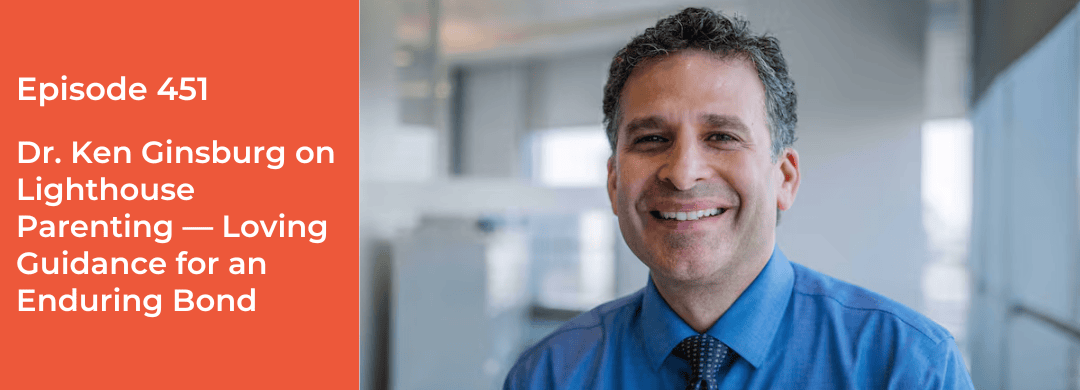
Dr. Ken Ginsburg on Lighthouse Parenting — Loving Guidance for an Enduring Bond
In this episode, I’m talking with pediatrician and author Dr. Ken Ginsburg about his new book Lighthouse Parenting: Raising your Child with Loving Guidance for an Enduring Bond. Ken shares his powerful framework for showing up as a steady, loving guide for our kids, offering both support and boundaries as they grow. We get into what it means to really know and prepare our kids, how to be their safe harbor in tough times, and why our own self-care matters just as much as theirs, especially in today’s world of social media and constant pressure.
About Dr. Ken Ginsburg
 Dr. Ken Ginsburg practices Adolescent Medicine at The Children’s Hospital of Philadelphia and is a Professor of Pediatrics at the University of Pennsylvania School of Medicine. Dr. Ginsburg practices social adolescent medicine – service with special attention to prevention and the recognition that social context and stressors affect both physical and emotional health. His research over the last 35 years has focused on facilitating youth to develop their own solutions to social problems and to teach adults how to better serve them.
He is the Founding Director of The Center for Parent and Teen Communications which works to empower parents with the skill-sets to strengthen their family connections and position them to guide their teens to become their best selves. It works to shift the cultural narrative about adolescence from being a time to survive to one in which development is to be optimized. His books include, Building Resilience in Children and Teens: Giving Kids Roots and Wings; Congrats- You’re Having a Teen!: Strengthen Your Family and Raise a Good Person; and Lighthouse Parenting:Raising your Child with Loving Guidance for an Enduring Bond. All of these works are published by The American Academy of Pediatrics.
He currently works with Covenant House International’s 35 sites to solidify and magnify their practice model rooted in the healing power of loving and respectful adult connections with youth.
Things you’ll learn from this episode
- What “lighthouse parenting” is and how it offers a research-backed framework for guiding kids to grow up as resilient, thriving adults
- What it means to be a “secure base” for our kids and the power of stability in fostering resilience in all children
- Why preparing kids for life’s challenges starts with feeling unconditionally loved and truly known
- Why self-care, authentic modeling, and genuine repair are essential for strong parent-child relationships
- What it means to “actively see the best in our child” and why it matters
Resources mentioned
- Lighthouse Parenting: Raising your Child with Loving Guidance for an Enduring Bond by Dr. Ken Ginsburg
- Congrats—You’re Having a Teen! Strengthen Your Family and Raise a Good Person by Dr. Ken Ginsburg
- Building Resilience in Children and Teens: Giving Kids Roots and Wings by Dr. Ken Ginsburg
- Dr. Devorah Heitner on Helping Kids Thrive in a Digital World (Full-Parenting)
- Dr. Devorah Heitner on Parenting Kids Growing Up in Public (Full-Tilt Parenting)
Want to go deeper?

The Differently Wired Club is not your typical membership community.
There’s something here for everyone, whether you’re a sit back and absorb learner, a hands-on, connect and engage learner, and everything in between. Join the Differently Wired Club and get unstuck, ditch the overwhelm, and find confidence, connection, and JOY in parenting your differently wired child.
Learn more about the Differently Wired Club
Episode Transcript
Debbie:
Hey Ken, welcome to the podcast.
Dr. Ken Ginsburg:
Thank you, it is really a joy to be here and have this discussion with you.
Debbie:
Thank you. I’m very much looking forward to it. And I always ask my guests, because I read your formal bio, but I always ask my guests in their own words to kind of share a little bit about who they are in the world. there’s so much that you’ve done. We could do a whole show on that. But give us a little brief introduction and maybe tell us a little bit about the Center for Parent and Teen Communication, which you founded.
Dr. Ken Ginsburg:
Who I am in the world is that I’m a pediatrician who’s an adolescent medicine specialist and I recognize that the best way to lift young people up is to prepare the adults that surround them. So kind of my life mission is to prepare adults to be the kind of people young people deserve in their lives. And a lot of what I do is professional trainings about how to work with young people who have had hard lives. But another part of what I do is work with the most important people in young lives, which is parents and families and caregivers. So my job is to strengthen them, to know how to show up and to show up effectively with unconditional love, absolute acceptance. And that’s what the Center of Parenting Team Communications is about. We are an organization that puts out free materials to help parents be effective, to check in multicultural materials, lots of different experts giving advice about how to show up in the most effective way while knowing that there’s no perfect answers, right? I’m definitely a guy with no perfect answers.
Debbie:
That’s great. And let me ask you, I’m just curious if there’s a personal why or some very specific reason that kind of drew you into doing this work.
Dr. Ken Ginsburg:
You know, I don’t know, that’s so complicated. If you asked my parents, they would have told you that I was a five-year-old protecting babies. I’ve been protecting children my whole life. in terms of part of the why, maybe, is that I have had a great life. I’m 63, I’ve had an awesome life. But I was very, very, very deeply depressed for about six months when I was 17 and told nobody because it was 1979 and I told nobody and so more or less this may be a direct why or not I’m not sure but more or less I became a guy who made sure that adults knew how to show up.
Debbie:
Great, thank you. Thanks for sharing that. So, all right, I wanna get into, as I mentioned before I hit record, I have way too many questions, which my listeners know is kind of the norm for me. But I wanna talk about your new book, it’s called Lighthouse Parenting, Raising Your Child With Loving Guidance For A Lifelong Bond. And we were, again, before I hit record, talking about even that metaphor of lighthouse parenting. talk a little bit about what you mean by that and how it’s not a fad, right? It’s not like the new trend of a specific parental approach.
Dr. Ken Ginsburg:
Yeah. So let’s be honest. People’s first response when I talk about lighthouse parenting sometimes is an internal eye roll, right? Cause they’re like, another one. This is not that. This is absolutely not that. This is not a guy picking a sweet word to describe what I think parenting should look like. The lighthouse parenting is rooted in six decades of research. We know what it is that produces young people with the best academic outcomes, behavioral outcomes, emotional outcomes, know, less depression, less anxiety, and the deepest long lasting connections with families. And that is the balancing act. It’s called authoritative parenting in the scientific research. It’s the balancing act, balanced parenting between loving your child, being responsive to their needs, meaning being flexible. You have the child who’s in front of you. You don’t have a child, you you react to who they are and you’re responsive to their needs. And that’s part of what love looks like with balancing with the importance of keeping them safe, right? And having boundaries so that they know that they’re safe. So we guide, but we don’t control.
And, Debbie, let me say something else. So, you know, six decades of research for sure. But you could ask your great-great-grandma what works in parenting. And I’ll bet you anything, she would have said kids need to know that they’re loved, they also need to protect them, and you need to let them fall down and get back up. I’ll bet you anything they would have said that. So why lighthouse parenting? Because people don’t speak the language of science. And a metaphor is incredibly important to give you an idea of what you’re supposed to be. And the concept of a lighthouse right there, it evokes this concept of a guide, of a stable guide who’s lighting the way but not doing for you. So I even have, as you know, the book breaks, you know, I have this kind of meditation or commitment statement and the book is just about how to do each little phrase in depth. Is it alright if I read that to you?
Debbie:
Please do. Yeah.
Dr. Ken Ginsburg:
So I choose to be a lighthouse parent. Stop there, Debbie. I choose, this is a choice, a stable force on the shoreline from which my child can measure themself against. I’ll send my signals in a way they will choose to trust. I’ll look down at the rocks to be sure they don’t crash against them. I’ll look into the waves and trust they’ll learn to ride them, but I’m committed to prepare them to do so. And most importantly in me right now, remain a source of light they can seek whenever they need a safe and secure return. Right? So why the metaphor? Because it just tells you that even without the statement of commitment, a lighthouse, I’m there, stable, I’m going to protect you, but not do for you.
Debbie:
Yeah, it’s a great metaphor. I do also love a good metaphor to be fair, but it really works. I think before we hit record, I was saying how much I just really appreciated this book. so much of it resonated with me now as the parent of an almost 21-year-old, which I can’t even fathom. But it’s all about the work that I’m currently doing. Like I’ve been doing my whole life, but it just gets more and more. Like I’m doing it more and more. I’m stepping up more and more because you have to show up in different ways for your kids. And so this balancing act that you talk about and being responsive to the child you have just felt so supportive, not judgmental, it felt supportive. You mentioned there’s authoritative parenting, there’s permissive parenting, and you know that authoritative parenting is kind of what we’re going for, but you also recognize that it’s okay if you’re in one of these other realms. Here’s how you can balance it a little bit more. So it just felt very like wherever you are, here’s how you can show up more for the child that you have.
Dr. Ken Ginsburg:
Exactly. You know, there’s very few villains in parenting. There are some abusive parents, right? But none of them are listening to your podcast. None of them are picking up books to try to figure out how to be better parents. So when we start with shaming and making you feel bad about what you’re already doing, you’re already losing. Like here I am trying to explain to parents how to show up. And if those parents come to me to learn and I alienate them by telling them what they’re doing is not good enough or not well intended, I’m not showing up for that. I want to invite them in. I want to take the talents and the skills they do have and just shift them a little bit to be more effective for their child. That’s the way to work. Not only that, that’s the way for our families to come together. Right? Parenting is one of those things that really separates families. I want families to come together. That means honoring each individual’s approach and moving in a direction that’s good for your kid, but not shaming the other parent.
Debbie:
Yeah, I think about that work of just being attuned to who our child is. And again, this isn’t like, this isn’t a parenting trend. I wrote a piece for my Tilt Parenting community a couple months ago that was kind of in response to an article about a specific parenting philosophy. I don’t think it was peaceful parenting or helicopter parenting, but it was another thing. And what I said in this article was like, okay, like you guys are all deciding how to be a parent. Well, those of us raising really complex kids, we’re just showing up. We are just having to really attune and pay attention to who this child is, follow their lead, and do our own work so that we can be the best parent for them.
Dr. Ken Ginsburg:
Amen. Love. Love is seeing a person the way they deserve to be seen as they really are, not based on a behavior they might be displaying, not based on a label they might have received, but seeing a person as they really are. That’s what love is. That’s what showing up is. That’s what unconditional love means. It doesn’t mean you like everything that happens. It doesn’t mean you agree with every point. It doesn’t mean you wish other things in their life couldn’t be smoother. It means I will show up. You know, people think that good, not people have ever had a child, but if you just like read stuff, you could think that good parenting is about having a child who has no problem. Such a human doesn’t exist. Good parenting is about showing up and standing by them no matter what and helping them know they’re not going to get through it no matter what. And being comfortable with the fact that you don’t have all the answers. And when you don’t have all the answers, the message to the child is, I don’t know everything. The only thing I know is you’re not going to navigate this world alone. That’s the only thing I know, because I’m here. Right? And then you’re good when you get them the services they deserve. By the way, did you hear the word deserve instead of need? Very important word.
Debbie:
I was queued up for another question, but you’ve piqued my curiosity.Say more about why you used the word deserve instead of need.
Dr. Ken Ginsburg:
Yeah, so this is true of any child. Neuro-typical, neuro-divergent, any child. When you use the word need, you’re implying a state of brokenness, emptiness, something that needs to be filled. When you use the word deserve, you’re talking about someone’s strengths and the fact that they deserve to elevate and rise to their potential. And it’s a very different word psychologically. If someone is filling my need, I feel beholden to them. If someone is offering me what I deserve, I feel like I’m in partnership with them in a healing process.
Debbie:
Hmm. I love that so much. Thank you. So, okay. One of the things you said, I just connected with something that jumped out at me in the first part of the book. And I want to go into some of the parts of your book. The first part is about stability. And I love this idea that our homes don’t have to look perfect or not be chaotic. And that in fact, though households that aren’t chaotic at all don’t necessarily foster the most secure young people. was like, well, that’s good news. That works for me. So I was wondering if you could talk to us a little bit about this idea of being that stable force on the shoreline and what it actually means to be a secure base for a child.
Dr. Ken Ginsburg:
Yeah, you know, I was doing another podcast when someone pointed out something that was obvious to me, but hadn’t yet come to my consciousness. And that is that almost all books are almost all blogs about parenting. You say whatever you want to say, blah, blah, blah, blah. And then at the end you say, and take care of yourself. And I begin and end this book with taking care of yourself. A stable force is stable because they are themselves secure. Why does this matter? Two things. One, you deserve to be okay yourself. But the second thing is you want to show up for your kid. Your kid has to be receptive to guidance, receptive to your support. And the only way they’re going to be receptive to your support is if they know you’ve got bandwidth. And if kids worry about us, and if they feel like their pain is creating pain in us, guess what? They don’t tell us when they need us the most. So it really is a great way to start. But now let’s get more directly to your question, Debbie. Good humans raise good humans. And perfect humans just make other humans feel less than. And so perfection doesn’t exist. Let’s start there, right? But when we create an image that suggests we are perfect, or infallible, that is a barrier to humans being able to make mistakes and learn from them and to seek you as a guide. On the other hand, when we are our truest selves and we don’t, you know, when a kid’s in crisis, you know, you look like you’re that duck gliding in the water and you’re like, hey, just follow me, I’m handling the ripples. But what we really want to show kids is, life can be really hard and I’m more like the baby duck on top of the water paddling like crazy. Let me show you how to paddle. That’s how we model. We are imperfect. We are human and we take active steps to right ourselves. That is someone I can learn from. I can’t learn from someone who intimidates me or lies to me about their perfection when they’re not really there, right? I can learn from that person.
Debbie:
Yeah, yeah, yeah, it’s permission to be messy, which I also appreciate very much.
Dr. Ken Ginsburg:
Yeah, I really almost want to tilt my screen so you can look at my corner of trash, which I just went whoosh doing a podcast. Right? Like, my whole life is messy.
Debbie:
Yeah, that’s great. And I do want to acknowledge I wrote down self-care creates bandwidth because that jumped out at me as did the fact that you do open the book. That’s in the first part of the book and so often it is the last chapter. It’s like, and by the way, do all of this, but don’t forget yourself. And I’ve been guilty of that too. I’m a big proponent of self-care. call it conscious maintenance because it doesn’t feel as, I don’t know, doesn’t maybe have as many negative like backlashes against it. But it’s not optional. So I just really appreciate that you included it right at the very beginning. So you just mentioned modeling as well. And so the next part of the book is called Modeling and Knowing. And you say human role models are imperfect. But what I didn’t expect in this section was this idea of knowing. And I love that so much because I just love the concept of knowing our kids so deeply. You say seeing your child in the best light is key to their positive development, but it’s also the strongest tool in your toolbox to prevent them from being derailed. Could you expand on that a little bit?
Dr. Ken Ginsburg:
My gosh, I wish we had hours. Yes. Why? Because life is going to be tough, right? On every human. And you’re going to get undermining messages throughout life. You’re going to get maybe bullied. You’re just going to, you know, you might be a victim of just low expectations for whatever reason. And there are moments when kids therefore don’t believe in themselves, especially during adolescence, when the big questions are, am I normal? Do I fit in? Right? And if people are telling you you’re not normal, you don’t believe in yourself. But when the person who knows you best, like all the awesome things about you, your generosity, your creativity, your sense of humor, the things that make it so that not only do you smile, but you can’t, know, you have, like I used to say to my kids all the time, they were like, why are you laughing? It’s like, because a smile isn’t enough, right? And, and, but when you know, all those things that are absolutely terrific about your child, and you know their limitations. You even know the things that you don’t like, the things that make you want to pull your hair out, but you choose to love them. That is the most protective thing in a human’s life. Debbie, why do we love? We love so that people learn that they are worthy of being loved.
That is an enduring lesson. That is what creates a lifelong bond. That is what, you know, when someone’s 70, 80 or 120, their fundamental questions are, is there something wrong with me or am I worthy of being loved? And when you know your child in their totality, you’re not just cheerleading the good stuff, but you know them in their totality and you choose to love. There is no more protective force in their life. So you use it both preventively, it gives you more joy in parenting, it helps them have self-esteem. But the reason it’s the tool in your toolbox, is things won’t go smoothly because life doesn’t go smoothly. And for you to be the lighthouse, remember I told you my favorite line was to remain a source of light they can seek whenever they need a safe and return. That wasn’t about keeping lights on in the basement so they can move back in. That was about them understanding there is someone who knows me and right now I’m not feeling like I know myself, but I am gonna return to that person who knows who I am. And it is your toolbox for when a kid strays, how to bring them back in.
Debbie:
How do we, I’m just curious, what are some of the most effective ways that we can make sure our kids know that we know them deeply?
Dr. Ken Ginsburg:
I think that you can tell them and enjoy them, but I don’t think this is a conversation, Debbie, as much as it is about showing up. What I don’t want is for life to feel so choreographed that every time your child is generous, you take them aside and say, I’m noticing your generosity, right? but they’ll know when you notice they’ll see it in the glint of your eye. They’ll see it in your pride. But occasionally, literally notice and point out what you’re seeing. But I actually, I don’t want to be too sappy, but I feel like this is actually a metaphysical thing. I think if you just actively see the best in your child, because otherwise, too often we think high yield parenting is about focusing on the problem, right? And spending our time talking about the problem. I think how you’ll parenting is being together, showing up and enjoying each other. And I don’t think this is something I need to teach. I think this is something that parents just need to notice. And when they do, they’re gonna enjoy parenting more and it’s all gonna be more effective.
Debbie:
Yeah. Well, I love that idea of actively seeing the best in your child. That really sums it up. I talk in Tilt about becoming really fluent in our kids’ language, not necessarily their verbal language, but how they express their needs and their wants and their emotions. so I also think part of this knowing them is anticipating their needs, especially if you have a child who has maybe more intense sensory needs or comes home from a tough day at school of masking and they really need some kind of extra support to calm their nervous system. So are those kinds of other examples of how we can help our child just feel really known?
Dr. Ken Ginsburg:
Absolutely. You know, one of the other chapters in the book is actually about knowing how your child is comforted, which is what you just said to me, right? You know, which is, and remember that when they’ve spent the day masking and they’re unmasking at home, it means you’re not always going to see them at their best behavior. So this means that when you show up and let them be them and understand that the behavior that may not be as polite as it was in school is them decompressing because you’ve created a safe place. That’s successful parenting, right? That’s good parenting. know, Debbie, as you know, in every chapter, know, so it’s organized along this concept of the statement of commitment. But in every chapter, we begin with a box and it says, “How doing this work is gonna make your adolescence more successful. And then this is how you’re going to, this is gonna contribute to an enduring bond. Because remember, my goal is not to get your kids till 20, it’s to get you till 120 when they’re 90 or 95, right? That’s my goal. And knowing how your child is comforted, right, is one of those things that creates a truly enduring bond, that they will be coming back to you when you are 120 for comfort, to be seen as they deserve to be seen. That’s what forms relationships is when we really see them and we serve as a guides. And just while I’m on a roll, even though you didn’t ask this question, and what interrupts relationships is when we’re overly controlling. Because when we’re loving, we know how to comfort, we see the best in them, they want us forever. When we are overly controlling, including not letting them fall down and get back up on their own, when we are overly controlling, they run away from us as soon as they can. Our goal is lifelong in her dependence.
Debbie:
Yeah. Yeah. And I’m a walking example of having a very controlling parent and being at 17, like, see ya. I’m out of here. So relatable. Okay, so protection. So I’d love it if you could talk with us about how you look at the idea of protection within this model. It really kind of resonated, I guess, you know, I’m, I’m parenting a kid. So when I read this book, I’m always thinking about myself as well as my audience, but say more about this concept of protection.
Dr. Ken Ginsburg:
Yeah, so let’s be honest. So, you know, I have my own kids. They’re now 29 and they’re like super that’s them when they were little, right? So, they’re 29. And if I thought they were in danger and I could wrap them in bubble wrap, even at the age of 29, I would, I would do absolutely anything to protect them. So I am not cavalier in the statement that I’m about to make. You can’t wrap them in bubble wrap. Life is not about always having a downy quilt around you. And everything that goes wrong in the helicopter, snow plow, tiger-momming approach is we know what the outcome looks like. The outcome looks like kids who initially succeed but fail when they’re on their own. The outcome looks like them being extraordinarily polite to you when they’re in your home and then fleeing for independence when they’re not.
We know exactly what it looks like. So the real way to protect your child is to prepare them. Preparation is protection. Right? So there are two kinds of things you protect your child against. One is the hand on the stove moments. Right? You didn’t let your two-year-old put their hand on the stove. You didn’t let your four-year-old run in the street. And you won’t let your 16-year-old get in a car with a drunk driver. Right? There are hand on the stove moments. There, I don’t care what you say, I care what you do. I care that your actions are immediate, that they’re very clear, that the boundaries are absolutely unbreakable. Everything else is about preparing kids. If it is not a immediate safety issue, anything you do to prepare them with communication skills, anything you do to prepare them with coping skills, which is one of the biggest things I write about in my book, Building Resilience in Children and Teens, we have hundred pages on coping at parentandteen.com free resource. have kids can come up with their own coping plan when people are prepared for life. and one of the other ways of being prepared, Debbie is not to imagine that life isn’t going to get hard, but it’s to have the relationships that are going to support you when they do get hard. So all of this bonding thing is really also about preparation, but that’s the key. You can’t prevent everything, but you can prepare your child to navigate life’s turbulent waters.
Debbie:
Yeah. Yeah. And when you talk about preparation, you say that our goal is to prepare our kids to have self-control and wise decision-making skills. And I wondered if you could explain how you would define self-control. Like what would that actually look like as our kids grow up in terms of what is the ultimate goal?
Dr. Ken Ginsburg:
The ultimate goal is to be able to make decisions thoughtfully. To be able to make decisions thoughtfully, we have to control that part of our brain that responds impulsively, the incredibly emotionally driven part of your brain. So I am one of the most emotional people you’re ever going to meet. It is my superpower, right? But I also know that because it’s my superpower, it is my Achilles heel. And what that means is that I need to make sure that the thinking part of my brain is not drowned out by the emotional part of my brain. So there’s some work that I have to do internally, even as a 63 year old guy, that I have to do internally to get my mind to be able to think wisely. So for example, if I begin going towards catastrophic thought, something happens and I begin saying, now this is going to happen and this is going to happen and this is going to happen. Once that happens, the emotional part of my brain is flooding out the rational part of my brain and I’m not making wise decisions. But equipped with a skill, which I do have, I’m a doctor. I need to get to calm very quickly when especially in emergencies. And when I say, let me return to reality what is actually happening, and I stop my mind from cycling, that’s one thing I can do. But what I’ve also learned is that once my hormones are going through my body, that adrenaline that’s saying, there’s a tiger, run, I can’t think. So if I am particularly nervous, I will go into a room and I will run in place for a minute to use up the tiger chasing my blood hormones. And once those hormones are used up and I can say my dad, I’ve outrun the tiger. That’s what I’m telling my body. Now I can think again.
This is all called self-regulation. It’s called self-regulation. But if you are a parent listening to this podcast right now and your child is eight, let’s be clear. The pathway towards self-regulation is co-regulation. It is about showing up and standing by your child and communicating with your loving, stable presence that everything’s going to be OK. And when you show up, it doesn’t mean it’s going be easy. And it doesn’t mean you have an answer. It just means they’re not alone. That we are offering that human support, that gives them the security to begin working on their own thinking patterns. And in time, they’re going to learn what it is you did to get to come. they’re going to be able to mimic it based on your role modeling, which brings us back to the beginning of the book. Right? That means that you’ve got to get to a place where you actually know how to get yourself to calm. It took me a very long time to learn. like I wrote these books not because I came out of the womb, like brilliance and co-regulation. It’s because like my nature, I need self-regulation. Right? That’s my.
Debbie:
Yeah, no, co-regulation I see as like our greatest superpower for sure. And as I always say, and my lived experience is that we get a lot of opportunities to practice and develop that skill, which is the great thing. It is a muscle. It’s a skill that you can get better at for sure. In the section on preparation, you have a great section that tackles a lot of complicated topics, including bad influence friends, social media challenges. Like it is really tricky times for parents of adolescents right now. I’m sure you know this more than anybody. So are there any kind of special, I mean, any kind of special things you would want listeners who are raising kids who are navigating this really kind of challenging, scary, they can be scary for us, they can trigger our own fear, experiences and how we can be that lighthouse parent even in the face of some pretty hard stuff, maybe not life threatening, but hard stuff.
Dr. Ken Ginsburg:
Yeah, I think we could talk about this endlessly as well. And I want to clarify a point, which is that I have a book that is designed for adolescents that’s only a couple of years old, which is called Congrats, You’re Having a Teen for parents of adolescents. Lighthouse Parenting is helpful for adolescents, but it’s really designed for the parents of the 6 to 11 year old about how to put into place all of those things to make it smooth for adolescents, during adolescence. Debbie, know, you asked so many things about what’s going on. So let’s begin with, in general, the world is not a kind place right now. And that is very confusing to the kids. Why is it that public conversations are about denigrating other people who disagree with you?
So we begin by doubling down on peace in our homes. We begin by choosing to be more compassionate, demonstrating and modeling kindness, demonstrating intellectual humility, meaning that when someone disagrees with you, you always know you have something to learn. These things matter now because kids are very confused growing up now. Another point you brought up was social media. And never does someone not ask me a question about social media. Let me say this. I’m not a social media expert, but here’s what I know. Once kids get involved in the world of social media, there are algorithms designed to radicalize and confuse them, enrage them, and engage them through that rage. Which means that we need to have real conversations with our kids. We need to have an idea of where they’re going. We have to have real conversations with our kids about the dangers of social media. But there’s also benefits of social media, especially, I would imagine, for kids who are neurodivergent. You can always find someone who thinks like you and engage on a different level. It can be a very, very beautiful thing. But no matter what, screens in general should be only a portion of our lives.
And that what we always have to be doing is making sure our kids have enough time to sleep, meaning no screens after bedtime, right? Otherwise they’re waking up at three in the morning. There always has to be time for our family to be together. Where there are no screens at the dinner table, on heights, during game night. We always have to do that because you know what kids are telling me? Kids are telling me, and there’s actually research to back this up, that their parents are not connected anymore. Because even at dinner time, the parents are checking email and going on social media, right? That is going to damage our kids. know, Debbie, even before we began talking and you began with the importance of just showing up, showing up means giving full attention to another human being. And when a phone is in our hand and we’re not giving full attention to our kids, that’s harming them more than what they’re doing on the screens themselves.
Debbie:
Yeah. Wow. Okay, thank you. And I just want to I’m going to mention for listeners that I will leave in the show notes page some link to an episode I did with Dr. Devorah Heitner last year about her book Growing Up in Public and she has some really great perspectives on how to kind of mentor our kids to have healthy digital lives, especially if they’re kind of growing up online. So I’ll leave that in the show notes. But gosh, okay, I think we’re gonna wrap up. I’ve so enjoyed this conversation. And again, your book just felt so just very supportive. And it didn’t make me feel like, oh, man, I wish I could have a do-over. I did this all wrong. made me feel seen in a good way, not called out, but seen. It gave me a lot of things to think about even with my older child. And thanks for also mentioning that this is actually for parents of younger children, because I think that’s important. But before we go, for parents who are listening today who are really in the thick of it, maybe they’re stuck in a bad conflict cycle with their child, or they’re feeling burned out themselves, or they feel like, I’m just doing all this wrong. Do you have kind of one small step or something you’d like them to think about today after they’re done listening to this episode that would help them kind of start to embody being a lighthouse parent.
Dr. Ken Ginsburg:
It’s going to be self-care. Self-care is not about goat yoga and bubble baths, even though I’m very pro bubble bath, right? Self-care is about living your real life. It’s about creating bandwidth and dealing with the realities that you’ve been given. And what I will tell you is that there is nothing like human connection. If you are in a place where you are stuck, then there’s a chance you’re feeling like a failure or you’re feeling ashamed. And if that is creating a barrier to reaching out to another human being, I beg you to lower that barrier. I beg you to know that we have all screwed up, including guys who’ve written 10 books on parenting. We are all screwed up. And it is the fact that we are humans that allows us to navigate this world. Reach out to another human being. And I bet you’ve learned that you’re not the only person who’s stuck right now. And then you rise up back together. So you take care of yourself. Your kids are watching from the sidelines. And that’s the way to re engage with them. And well, another thing I got to say. And if you did screw up with your kid, apologize. That is so excellent. Like, not an I’m sorry, darling, because that means nothing. But in the power of a real apology, I am sorry, step one, because I know I created harm. Step two, be incredibly explicit. And step three, moving forward, I will do better by taking this action. You will astound your child. I don’t care if your child is 30 years old. You will astound them with an authentic apology. You will model what it means to be for a human. You will model that connections can always be repaired.
Debbie:
Yeah. And you will most likely foster an even deeper connection. Like some of my biggest parenting fails have resulted in more connection because I did that. It’s so powerful. Thank you for sharing that.
Dr. Ken Ginsburg:
Amen, mic drop, Debbie.
Debbie:
Well, I just want to say, first of all, thank you. Thank you so much for everything you shared today. I really enjoyed this conversation. Listeners, the book again, it’s called Lighthouse Parenting, Raising Your Child with Loving Guidance for a Lifelong Bond. It’s available everywhere you can buy books. I will have a lot of links in the show notes to where you can connect with Ken and read the book and everything else that we discussed today. So thank you so much for this conversation.
Dr. Ken Ginsburg:
Absolutely, it was a privilege. Thank you for all your work, Debbie.
Do you have an idea for an upcoming episode? Please share your idea in my Suggestion Box.