Dr. David Yeager on What the Science Says About Motivating Young People
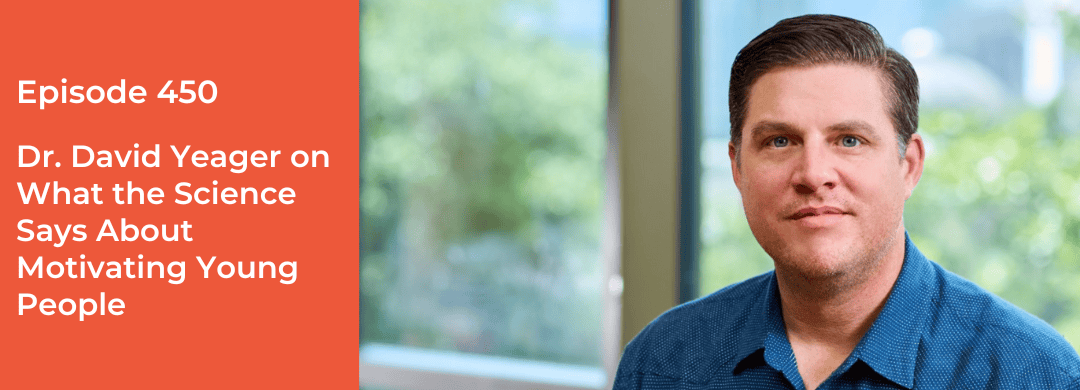
In this episode, I talk with psychology professor and author of the new book 10 to 25, Dr. David Yeager, about what really fuels motivation and a sense of belonging for our kids—especially neurodivergent ones. We unpack the different mindsets adults bring to the table—like enforcer, protector, and mentor—and how shifting into a mentor mindset can help kids feel respected, understood, and more engaged. David shares powerful insights about what helps adolescents thrive, and we explore how things like trust, connection, and belief in a child’s potential can make all the difference.
About David Yeager, PhD
 David Yeager, PhD, is a professor of psychology at the University of Texas at Austin and the cofounder of the Texas Behavioral Science and Policy Institute. He is best known for his research conducted with Carol Dweck, Angela Duckworth, and Greg Walton on short but powerful interventions that influence adolescent behaviors such as motivation, engagement, healthy eating, bullying, stress, mental health, and more. He has consulted for Google, Microsoft, Disney, and the World Bank, as well as for the White House and the governments in California, Texas, and Norway. His research has been featured in The New York Times Magazine, The New York Times, The Wall Street Journal, Scientific American, CNN, Fox News, The Guardian, The Atlantic, and more. Clarivate Web of Science ranks Yeager as one of the top 0.1% most-influential psychologists in the world over the past decade. Prior to his career as a scientist, he was a middle school teacher and a basketball coach. He earned his PhD and MA at Stanford University and his BA and MEd at the University of Notre Dame. He lives in Austin, Texas, with his wife and their four children.
Things you’ll learn from this episode
- Why motivation thrives in environments where kids feel respected and understood
- The three mindsets adults often embody when parenting
- Why belonging and a child’s belief in their potential are critical drivers of motivation and long-term success
- Research-backed interventions that can significantly improve a young person’s mindset and resilience
- How creating strong connections with adolescents, grounded in curiosity and collaboration, helps them feel safe, seen, and motivated to grow
Resources mentioned
- 10 to 25: The Science of Motivating Young People: A Groundbreaking Approach to Leading the Next Generation―And Making Your Own Life Easier by David Yeager, PhD
- David Yeager, PhD on LinkedIn
- Ellen Gallinsky Takes Us Inside the Breakthrough Years (Tilt Parenting Podcast)
- Rebecca Winthrop and Jenny Anderson on Disengaged Teens (Tilt Parenting Podcast)
- The Disengaged Teen: Helping Kids Learn Better, Feel Better, and Live Better by Jenny Anderson and Rebecca Winthrop
- 11-Year-Old Asher Talks About Developing a Growth Mindset (Tilt Parenting Podcast)
- Phyllis Fagel on Raising Resilient Teens in Turbulent Times (Tilt Parenting)
Want to go deeper?

The Differently Wired Club is not your typical membership community.
There’s something here for everyone, whether you’re a sit back and absorb learner, a hands-on, connect and engage learner, and everything in between. Join the Differently Wired Club and get unstuck, ditch the overwhelm, and find confidence, connection, and JOY in parenting your differently wired child.
Learn more about the Differently Wired Club
Episode Transcript
Debbie:
Hey, David, welcome to the podcast. Thank you so much for being here. I know you are very busy and I’ve had this book for a while. So I was very excited when I finally had time to spend with it because it’s very rich in story and research. And I really wanted to kind of dive into it. So I’m looking forward to talking about it today. And as a way to get into our conversation, I was wondering if you could tell us a little bit about what led you to write your book and I’m just I’ll name it because I tend to remember halfway through that I haven’t actually named the book. The book is 10 to 25: The Science of Motivation Young People. And another subtitle is a groundbreaking approach to leading the next generation and making your own life easier. So a lot there. So tell us about how this book came together for you.
Dr. David Yeager:
Yeah, I think the main thing was a need that I kept seeing from parents. You know, when you’re pregnant and you know you’re going to have a baby, you’re immediately reading a million books about pregnancy. And then when you’ve got a one year old or a toddler, you’re reading all these books about discipline and body training. And there’s a sense of optimism that we have when our kids are young. It’s as though, you know, this is a hard puzzle, but it’s a puzzle we can figure out. And when they start becoming teenagers, when puberty kicks in, we just give up as a society. It’s unbelievable. We’re like, there’s nothing I can do. Let’s lock them in a closet until they’re 25. And there’s a sense of despair and hopelessness. And that just feels weird to me. Like there’s no way that the crucible of evolution over hundreds of thousands of years created an entire age range that’s actually much longer than early childhood in which we are completely worthless as humans, like it’s unreachable. And instead, it just seems more likely that as our culture has evolved, we’ve kind of gotten worse and worse at connecting with that generation and setting it up for survival and success. And I really wanted to get to the bottom of that problem. I wanted to see at what level are we just thinking about young people wrong? Are there success stories? What lessons can we learn from failures? And how can we stop walking around feeling frustrated and crushed and pessimistic about the future and start being hopeful?
Debbie:
Yeah. Yeah, and I, you know, as I was reading your book and even just kind of getting started in it, I was thinking of The Breakthrough Years from Ellen Galinsky. And I know that she also has a very similar, like, this is an incredible time of life. And we’re doing such a disservice to young people to kind of painting them with a broad brush about what they’re not capable of or what all the problems are.
Dr. David Yeager:
Yeah, Ellen Glensky is a dear friend and we talked a lot about her book and she interviewed me for that. And then we’re talking to the same people with just a little different lens, but it’s a very complimentary book. And so is Jenny Anderson’s book, The Disengaged Teen, which sounds as a negative framing in the title, but it’s actually a very positive and optimistic book that I recommend as well. And I think that the book’s coming out on this topic in contrast to books like Anxious Generation, which have a very kind of explicitly pejorative frame on young people and kind of blaming them for having brains of mush because of their social media that like there, there is a sense in which people are tired of the world is falling narrative. And I think for good reason. And I think we want to know not like, do you just scare us into something, but how do we actually do something? And I tried to bring science to the conversation and I tried to bring stories to the conversation. More than anything, I tried to bring practical advice. So I’m a parent of four. I teach like 300 undergraduates every single year that are 18 to 22. I run a lab. have like 20 employees that are all 20 year olds. And then I coach baseball seven days a week for nine-year-olds and 13-year-olds. So I’m like constantly around young people never getting it perfectly right, having all kinds of mistakes, but I wanted to write the kind of book that would help me solve the kinds of problems that I had and that the people I cared about had.
Debbie:
I so appreciate the lack of scare tactics. Like I’m, I have a very similar visceral response to those books. And, there’s so much fear already in parenting and especially for this audience, right? Of parents of neurodivergent kids. so I really appreciate the optimism in the book. And I also would just want to, you mentioned, the disengaged teen, did have Jenny and Rebecca on the show. So I’ll have a link in the show notes listeners, should listen to that episode if you haven’t, because it will be very complimentary to this one. I’m wondering if you could talk a little bit about your, you know, getting into this through a growth mindset. That’s something you know, this show’s been on the air. I don’t know if you say that about a podcast. I’ve been doing it for more than nine years. And my neurodivergent kiddo is about to be 21. But way back when, at the age of 11, we did a conversation about growth mindset. I was homeschooling. We had a poster in our little classroom, and we would discuss it at length, and how do we shift our mindset? And so could you talk about how your work is taking that to the next level?
Dr. David Yeager:
Yeah, so just as a reminder for listeners, a growth mindset is very simply the belief that your abilities in any area can grow and develop, that they’re not fixed, they can change. And a fixed mindset is the belief that they’re static, that they can’t change at all. And both those ideas are available to us in our culture and people tend to adopt one or the other. And when they tend to adopt more of a fixed mindset, then what we found is, and by we, mean, my advisor, Carol Dweck, and many collaborators, I want to give credit to lots of people. We found that people shy away from a challenge and a fixed mindset. They feel like a failure means something big and global. It’s not just a temporary setback. It’s like a sign that you’re inadequate. And a growth mindset, though, changes the meaning of failure. Failure instead means that you’re growing, you’re learning. It’s a step in a process. It’s not an all or nothing thing. And so that’s a pretty good set of insights. That’s been pretty useful, but it turns out that especially young people, adolescents who are looking to adults that they notice inconsistencies and hypocrisies if adults say that you should have a growth mindset, but they don’t act as though they’re helping you to grow. So to be, give you a concrete example, a kid on a sports team where the coach is like, we have a growth mindset, everyone can improve and then play better. And, but the same kid plays shortstop and pitches every single time. And the same kid is right field and sits the bench every single time.
And that never changes, right? So you can say you have a growth mindset, but they’re not making it true. Similarly, a teacher might say, I have a poster on the wall that says have a growth mindset and here’s what a fixed mindset is. And the growth mindset is better. But then when the kid does the assignment, if they don’t get a hundred, there’s no way for them to look at their mistakes and improve their grade after they have turned in the assignment.
Now, of course, I understand why teachers might not do that. They have to grade more papers if they let kids revise things. But if you really say mistakes are your friend, then you can’t have one and done assignments because there’s no point for a kid to look at their mistakes. It’s idiotic from their perspective. And the teacher looks like a hypocrite. So that realization led us to say, well, who are the adults who create really great growth mindset? Relationships and cultures, the people who live it and embody it. And so a lot of what I did in the book was to go out and find these people, study what they do, try to name it and describe it. And then with Carol Dweck and Mary Murphy and many others, we’ve done experiments now to change adults beliefs, behaviors, et cetera, so that way they act with more of a growth mindset and they create that culture. In fact, just yesterday I was in West Virginia, training about 80 managers at McDonald’s. They’re managers who manage 15 to 22 year olds so that they have a growth mindset when they’re teaching you how to use the grill and the drinks and stuff like that, rather than saying you’re an idiot, you’ll never get another shift again. So we’ve gone from thinking about individuals’ mindsets to leaders’ mindsets and then look at the actions of the leaders. And then finally, how do you change the leaders so that way they authentically support growth?
Debbie:
Gosh, it’s like I can tell you how much you love doing this work. And just even hearing you share that, I’m like, oh my gosh, there’s so much potential here. Yes, there’s so many ways that this can really change the experience for young people. And that just has a trickle-down effect. It’s very exciting. So in your book, you talk about different types of mindsets. You talk specifically in relation to adults. And I just want to say that’s something I also love about this work is that it’s what we can do, right? It’s not about what our kids need to do. It’s how we can show up better for our kids. So you talk about the mentor mindset, the enforcer, and the protector. Would you give us a little overview of those?
Dr. David Yeager:
Sure, and I’m fully aware that your readers are getting five mindsets in this pot, your readers and listeners, and it’s more than they signed up for, but just to clarify something. We said we identified fixed mindset and growth mindset leaders. And yes, you can. But what changes those leaders? And it’s not just their belief about ability being able to change because of what we learned was that I could say I’m a math teacher. I believe my kid, my students can get smarter at math. Okay. But how are they going to get smarter at math? And if I think the way you get smarter at math is I threaten you with lots and lots of homework. And if you screw up, you’re going to get an F and that the fear of failure and fear of disappointing me will drive you to improve. And that if you’re sufficiently afraid, then you’ll practice and then you’ll get better. You know, that’s one theory of growth, but the kids are not going to say that’s a growth mindset teacher. Similarly, I might say, yeah, you can grow and learn, but incrementally with tiny steps, I’m going to break it down for you, make it very easy for you, prevent you from getting stressed out. Just kind of be a gentle guide that helps you one step at a time. Again, like you could believe that would help someone grow, really tough challenge is what pushes people to grow. It’s not reducing standards. And so I realized I needed to name different styles of fixed mindset leadership.
And because those two ones I just said, the tough, demanding, impossible standards, the nice, caring, friendly, supportive one, those are different ways of having a fixed mindset and the solution is not going to be the same. Similarly, I could have a growth mindset, but then believe, you know, the only way you’re going to grow is if I push you beyond what you know how to do. like the, you know, the source of growth is really the embracing of the challenge. So I could believe that, but then I can believe, you know, you’re not going to grow from that challenge unless I support you, because the challenge is beyond what you know how to do currently. And it would be cruel to just expect the moon or expect, you know, anything and then not support you. So that’s why I felt like I needed to describe the mindset of the adults so that they can create a growth mindset culture. that foreshadowing that you did was helpful.
So that of the three that I just described vaguely, the first is what I call the enforcer mindset, which creates fixed mindset relationships. And that is all standards, no support. So that demands compliance right away, kind of believing that the most important thing for a young person is to learn how to listen to adults without talking back to them. That young people are a danger to themselves and to society and therefore they need to be controlled. That young people are gonna make dumb decisions because they lack a prefrontal cortex. And so we with our smart adult brains need to tell them what to do when they’re dumb teenage brains. That’s an enforcer mindset. Okay.
Another version is instead of high standards, it’s low standards and instead of low support, it’s high support. So the protector mindset is low standards, high support. And in that mindset, you also have a negative view of young people, but it’s different. It’s more like, young people can’t help themselves. they’re, they’re, they’ve traumatized, they’re stressed out, they’re fragile snowflakes, and they’re going to crumble like a house of cards if I take them seriously. So it would be cruel for me to uphold high standards because of course they can’t meet them. And therefore I’m going to have very low standards, but be very caring and supportive. Okay. So those are two reasonable flawed, ways of thinking and I get it. Like I’ve fully been in those mindsets before myself and I understand it. But the third is the best of both of those, high standards, high support. And that’s what I call the mentor mindset. And it turns out that that is what creates the conditions for growth. And that’s what makes young people feel a sense of respect. They earn a sense of prestige, a prestigious reputation as someone who’s met a high standard, who’s impressed people, right? You only do that if you uphold the standard and get them across the finish line.
Debbie:
Thank you for walking us through that. made so much sense and it made me, well, a couple things. One is I was thinking about that mentor mindset also, you we talk a lot about scaffolding in this community, right? So would you see a relationship between this idea of scaffolding to kind of find that just right level of challenge for any given task or goal?
Dr. David Yeager:
Yeah, I think in neurodiversity, it’s really tricky because you have to define standards and support. And there’s a version of telling yourself you’re having a mental mindset where you expect a neurodivergent kid to act like a non neurodivergent kid. You know, just be normal or whatever. Right. And I’m not going to give up on you until you are. And this is like never going to happen. Like there’s real differences, right? But there’s another version that’s like, I want your competencies to be at the level of neurotypical kids, right? Or your outcomes or your, your choices or your abilities. So, but, but the route that you’re going to have to take to get those competencies and to have those options, that’s going to be very different.
And I’m going to have to accommodate that different route. I’ll tell you a very minimal version. So now as a professor, I teach undergraduate psychology. Psychology is the largest major at the University of Texas at Austin. And every year I teach about 150 students per semester who are predominantly, I get the transfer students. I asked for the transfer students because I want students who I’m their first experience at UT. I’m welcoming them. I’m showing them the rigor and the support. They learn about belonging and growth mindset. It’s a whole thing that we do for them.
The number of requests for accommodations I get now compared to five years ago is so different. I mean, now it’s like 40 % of students. It used to be like four students. And interestingly, almost nobody asks for accommodation of an easier assignment in terms of the intellectual work. They almost always want logistical flexibility. And a typical college professor is like, I’m going to uphold standards by being rigidly inflexible on logistics. That’s what it means to be a rigorous course. But that’s always felt weird to me. Really, my job is to get 100 % of my students to the level of intellectual contribution in the field. And if you have a learning difference, OK, then I’ll come. Like if your family member died or you’re studying abroad and you’re taking my class partially asynchronously, or you had to drive home because your mom’s dying of cancer, like, okay, let’s just accommodate that. But you’re still gonna have to do a great final project. And I think that’s more the attitude of mentor mindset for neurodivergent kids is like, we want you to have options and freedom and a life of contribution and meaning and purpose and so on.
And at the same time, we need to be able to accommodate logistical differences that you need. And I have a whole chapter on that in my book, chapter 10, where I studied this amazing research laboratory at Vanderbilt in physics that’s designed for autistic junior scientists. And the intellectual standard is very high. The students are publishing in nature, the top journal in the world. They’re getting jobs at NASA. And NASA doesn’t hire you to be nice to you. They hire you because you’re supposed to shoot down an asteroid that’s going to destroy the human race. You just like figure out how to drive a drone with a bomb to prevent Armageddon. Right? Like they’re not giving you a pat on the back. And so these students are getting hired at NASA not as a favor, but because they’re legitimately good physicists and scientists. But this lab is great at accommodating any differences they needed in order to get the science done.
Debbie:
Yeah, yeah, that’s great. I’m just curious to know what you have found in terms of any resistance you’ve come across from parents and other adults who you’re presenting this work to, who may kind of recognize, I am really an enforcer, or I am more of a protector mindset. Do you find it’s challenging to get people to recognize that and make the necessary kind of self-inquiry or do that work to pivot their mindset.
Dr. David Yeager:
Yeah, I think that there are a lot of things I have to clarify to parents, but the two most common ones are one, people don’t really know where the line is with standards and support. And so they convince themselves they’re being a mentor mindset, but they’re actually being an enforcer or they’re convinced they’re being a mentor and they’re actually being a protector. And so that’s hard. It’s usually like, you need to see what If in the parenting case, you need to see what your kids are capable of when other people are with your kids sometimes in order to realize that you have standards that are too low. And sometimes that’s going early to the afterschool program where your kid is and seeing how great that summer camp counselor is. And they’ve got your kids sitting quietly and listening and reading and whatever it is that they’re doing. And then of course, the second they’re with you, they’re a monster. And it’s like, okay, maybe I can expect this. All along, I thought they’re incapable of it, but it is possible. But another reason why knowing the line is hard is because often if there are two parents, they disagree over that line.
And so one parent thinks I have to be tough to be a mentor and the other parent thinks you’re being a monster enforcer. So then they yell at the first parent and then the first parent’s like, no, I’m being a mentor and I can’t relent on these standards. And then the other parent’s like, now you’re being inflexible or the other or the vice versa. Like one parent’s like coddling and overprotecting and stuff. And I guess that is what I have to do to be a mentor. And the other parent’s like, you’re being too easy on the kid. And so that causes a lot of marital conflict and relationship conflict. And my hope is that the mental mindset vocabulary allows people to figure out that it’s not either enforcer or protector, but that in fact there’s high standards and high support. And then people need to have an honest conversation about what you’re expecting of young people and under what conditions. That’s a negotiation. That’s the big one.
And then the second big issue I see is people just think mentor mindset takes a lot of time because they don’t want to, kids having a meltdown, you don’t want to stop and have a Socratic dialogue about all the kids’ reasons for why they wanted a cookie or something. And I get it. Like there are certain times where the kid is all up in their brainstem and you can’t talk to them. But in general, the more that you problem solve proactively through a mentor mindset, the more time you save later because the kid feels securely attached. They know what to expect. They know that there’s a conflict resolution loop that they’ll be fine in the end. They know that you won’t relent so they don’t keep pushing you. There are a lot of benefits to mentor mindset in the long run, even if it takes more time in the short run.
Debbie:
Yeah, absolutely. And it’s so respectful and that’s a big theme throughout your book is the importance of respect for young people. And that’s certainly the way that we want to show up for our kids. So one of the chapters that I took a lot of notes on just felt, it’s something we talk a lot about in this community too, is this sense of belonging. we know, actually I think Phyllis Fagel may have, no, maybe I’m thinking of a different book anyway. Sorry, let me say that again. I’ve had many conversations with my friend and colleague, Phyllis Fagel, on this idea of identity and belonging in young people. And I’m just kind of fascinated by it, especially because it is so protective and important for young people to have a sense of belonging. And it can be especially tricky for neurodivergent kids sometimes to access that. But I was wondering if you could talk a little bit about the relationship between belonging and motivation. And I’m going to maybe mention the it gets better example, which really kind of jumped out at me in that chapter.
Dr. David Yeager:
Yeah, so belonging is, let’s give it a definition. So there’s a version of belonging that is about what level you should be on. Like you belong in a remedial class or a basal player belongs in AA or AAA. It’s really, when I say belonging, I sometimes mean I’m evaluating your competence at a skill. And I get that, it makes sense. But another meaning of belonging is that you get to take for granted that this place in community and these relationships are for you. And non belonging is you don’t get to take for granted that you fit there. And so it’s constantly in question and you have to prove that you’re in the right place at all times. That’s what it means to not belong. Right?
So an example would be a bunch of teenagers in a circle, shooting the shit, telling jokes, you know? If you belong in that group of friends, it doesn’t matter if your joke bombs, you’ll laugh it off, you’ll make a sarcastic joke, you’re not gonna be kicked out of the friend group. If you’re worried that you don’t belong in that group and that they’re gonna exclude you and your joke bombs, you’re like, that was the kiss of death. And you want to just slink away and hide in a cave, right? You’ve never been more humiliated in your life. Okay. So when you talk about motivation and belonging, you know, I don’t think of it as like a level up or a power or like, it’s not energy. I think of it as when we take our belonging for granted, we keep doing stuff in that role or domain because it’s like, of course I am. If you’re questioning your belonging, you might quit doing what’s appropriate for that role or domain because you’re like, I don’t think I’m in the wrong place, right? Not cause you quote lack motivation, but you’re just like, this is, I’m in the wrong place here. know? Like if you’re a bad singer and you go to like the Chicago opera, and you’re doing vocal chords, you know, you might stop that if you look around, you see these professional opera singers, you know, and you’re not unmotivated. It’s just like, this is not for me. Okay.
So you could just think of adolescence as constantly trying to figure out, do I belong here or not? That they’re asking that question. Is this the kind of place where I can take my acceptance for granted or is it not? Now neurodivergent kids, it’s really interesting because on the one hand, there’s a suspicion that there’s always something they’re missing. Like there’s something about the social dynamic that they’re not picking up on and that is therefore making other people look at them weird. Right. And so it’s hard to say you get to take your belonging for granted in a club or on a team or in a group of friends. Right. On the other hand, for a lot of kids on the autism spectrum, they’re not picking up on those subtle cues. If somebody else is squinting at you like you’re an idiot, they might not notice that, whereas a neurotypical person would. So the threats to belonging might go over their head, right? And so I think that kind of stuff just is tricky on the spectrum and it makes it hard for parents.
Because what happens is kids come home and they’re like, I have no friends and nobody likes me and I’m alone. And therefore something’s wrong with me. Right. And it, easiest thing to say is no, they do like you. They’re interpreting it wrong. You know, look at all the people invited you to a birthday party or you’re on the baseball team or like you sit with people at lunch. You do have friends, but for neurodivergent kids, there might be something that is pushing away their friends. My son’s not on the autism spectrum, but he does have ADHD, Tourette’s, and some unknown emotion regulation issue, which causes him to do all kinds of stuff in middle school that is just not cool. The other kids really don’t like it, and it’s really annoying for them. And we have this conversation almost every day. It’s like, does everybody hate him? Or were they just trying to get him to stop blowing air in their face and singing Beauty and the Beast. And the fact that they’re asking them to stop it, does that mean they hate him or are they okay with him as long as he stops that stuff? so that’s just, that’s a constant struggle for parents. But I think we are, we are sources of information to help our young people navigate their belonging. And we should not be too quick to jump to all or nothing kinds of conclusions. There’s almost always something lost in interpretation. And for neurodiverse kids, it’s just really hard to know, like what is some, what’s the story they’re telling themselves in their mind and what’s a real story. And we have to get better at that over time as parents as we get to know our kids and get to know their friends.
Debbie:
Yeah, there was a story you told in that chapter. I was just thinking as you were sharing about it was a study that you did actually, I believe, where college students, first-year students were given a letter from someone in the past who kind of made them feel as though what they were experiencing was completely normal and how that changed. Would you mention that? Tell us a little bit about that.
Dr. David Yeager:
Yeah, there’s two key messages. One is that it’s normal and seconds that it gets better. and because I mean, if, if the message was, Hey, everyone gets crapped on by everybody in school all the time and has no friends. You’re not alone. like, well, it sounds like I shouldn’t go to school. It’s a bad place to be. So like, it needs to also be, it’s like, it’s hard now and it improves and here’s why. and, and that research is in some parts a response to conventional ways to help kids feel like they belong, which is just tell them it gets better. And if people remember, there was a campaign for queer youth that were at risk of suicide. And the campaign said, you know, basically don’t harm yourself because it gets better. And again, I mean, that’s a valid message. And it was right in the sense that you want the youth to reach the conclusion that it gets better. Right. But telling people the phrase, gets better does not help it. That’d be like someone having low self-esteem. which means that they don’t like themselves and think that they’re not a person of worth. And then you just say to have high self-esteem. It’s like, I can’t just do that. I think I’m no good. Like I need a reason to have high self-esteem. Similarly, you need a reason to believe it gets better.
So in our study, this was developed originally by Greg Walton. I adapted it later for high school bullying with Carol Dweck. But the basic idea is the way to make a case to somebody that it gets better is to first of all, show that other people who you typically view as belonging and having lots of friends and fitting in, they too had social struggles like yours, first of all. And second of all, they took active steps to make it better. For example, they joined a lab and then they talked to the professor and they met other students in the lab. They did some work. That work was noticed by the other students and they felt proud of it. And there’s a whole snowball effect. And that snowball effect led them to, over time, feel like they belonged. And what we’ve found in a number of studies, not just me, a lot of my collaborators at Stanford and other places, that students’ grades go up, especially if they’re from minoritized groups. And in high school, kids who are bullied tend to cope better with stress. They have less cortisol in their saliva. Their depressive symptoms go down. And we see their grades go up in some cases, even with only a 45-minute, even 30-minute version of this message.
Debbie:
So fascinating. Yeah, I kind of nerd out on the study. So I just appreciated everything you included in here. And I just want to say, like, we’re going to have to wrap up. I know you’re very busy. It’s late for me. And I want to wrap this up before I start. My brain starts going offline. But do you have time for one more question before we wrap up? OK. I wonder if you could just talk a little bit. We talked about respect earlier on in the conversation. Can you share some insights for listeners about why it’s so important and how we can communicate with young people with this mentoring mindset without compromising our own authority? Like how do we walk that tightrope?
Dr. David Yeager:
Yeah, I think that the main lesson of a lot of research on both animals and humans and what puberty does to the brain is that as testosterone and estradiol increase for both boys and girls, it sensitizes the brain to social experiences like status and respect. So the feeling of humiliation never feels as bad as it does in adolescence and the feeling of pride of earning a great reputation never feels as good. And so those become great motivators. Young people are very highly motivated to avoid humiliation and to approach pride. And that’s true even for neuro diverse individuals. Again, when I was speaking at the Frist Center in Vanderbilt, the idea that kids on the autism spectrum are imagining what everyone’s thinking of them at all time. That’s not necessarily the case in the way of a neurotypical kid, has a whole false narrative often. It’s called the personalized myth that everyone is watching my every move and they’re evaluating it and that I’m the hero of that narrative and I need to look the best. Neurotypical kids are doing that a lot. Neurodiverse kids not as much.
But then I asked, if your professor went out of the way and was like, you know, almost nobody could have done this right here. And it’s so important. And now that you’ve done it when almost no one else could, we’ve made a major advance. I was like, would that feel motivating? And they’re like, absolutely. I was like, how about a professor who was like, you couldn’t even do something that everyone else can do. And the fact that you failed means you are no good and don’t belong here. And you’ve really let me down. I was like, would that feel bad? And they’re like, absolutely. Right. So pride and shame are still motivating to people on the spectrum and off the spectrum. It might look a little different, but we have to pay attention to it because if we don’t, then we end up missing out on some of the most powerful motivations. And therefore we end up just yelling at kids like an enforcer or stopping expecting anything like a protector. So we need to maintain that mentor mindset by continuing to maintain high expectations.
Debbie:
Yeah. Wonderful. Thank you. So, okay. We’re going to wrap up. I’m going to just provide the name of your book again, because there’s, I just want to encourage listeners. If you’re interested in motivation and really understand it, like David goes really deep into it it is a fascinating read with lots of stories, which I always also appreciate the anecdotes to bring it to life. It’s called 10 to 25, the science of motivating young people. And is there anywhere in particular that you would want to direct listeners to connect with you and learn more about your work?
Dr. David Yeager:
I’m on LinkedIn so you can find me there, but also, and I’ve connected with lots of people so I’d love to meet you, but also we have a masterclass, Carol Dweck and I do, called The Power of Mindset on the website called Masterclass. And we’re really proud of it. We think it conveys a lot of what we know and it’s another great way to get up-to-date information on this content.
Debbie:
That’s great. That’s good to know. I received a Masterclass for a year subscription recently as a gift.
Dr. David Yeager:
Yeah, great. Yeah, we got Steve Young, the NFL quarterback was a special guest. And then Lorena Seidel, who’s a parenting expert in my book that I write about, she was a special guest, along with Jeremy Bohannon, who’s a police officer I write about. So it was really fun for Carol and I put it together and bring these special guests on and it’s gotten a lot of great feedback so far.
Debbie:
That’s awesome. Thank you. Well, thank you. I will let you go. I want to say thank you again for the work that you do for your generosity and sharing all of this with us today. And yeah, just for coming on the show. Thank you.
Dr. David Yeager:
Thanks for having me.
Do you have an idea for an upcoming episode? Please share your idea in my Suggestion Box.