Flex School Founder Jacqui Byrne on Supporting the Full Arc of a 2e Child’s Life
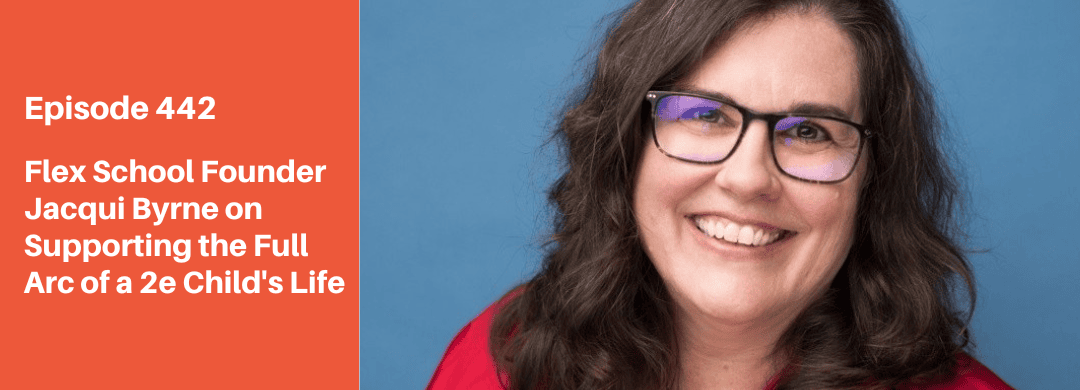
Today I’m talking with Jacqui Byrne, the founder of FlexSchool, a pioneering educational model designed specifically for 2e students. Jacqui is an award-winning educational leader, a sought-after speaker, and a passionate advocate for neurodiverse learners. She’s also a parent of 2e kids herself, and she built FlexSchool not just as an educator, but as a mom determined to find a better way for her own children, who were struggling at school. This is Jacqui’s second time on the show—the last time was six years ago (and I encourage you to listen to that episode too). I wanted to bring Jacqui back to talk about what she’s learned and observed in supporting the learning and growth of twice-exceptional kids over the years.
We get into all kinds of topics in this conversation, including the story behind FlexSchool’s creation and the philosophy that drives it, the power of talent-based learning, and how teachers and schools can become places of trust, safety, and joy for 2e kids who have often felt like misfits. Jacqui also shares insights into how behavioral issues in 2e students are often identity crises, and what it means to support their growth across the full arc of their lives.
About Jacqui Byrne
 Jacqui Byrne has a knack for seeing the brilliance others miss. As the visionary behind FlexSchool, she built a place where gifted and twice-exceptional (2e) students could thrive—quirks, challenges, and all. She didn’t set out to start a school; she set out to solve a problem. Too many gifted, complex learners were being overlooked, underestimated, or misunderstood, and that wasn’t something she was willing to accept.Jacqui never asks, “Why can’t they do this?” Instead, she asks, “What haven’t we figured out yet?”
An award-winning educational leader, sought-after speaker, and passionate advocate, Jacqui presents at conferences, school districts, and education associations across the U.S. and internationally. She is the 2025 winner of the New Jersey Association for Gifted Children’s prestigious Developing Minds Award. She serves on the advisory board for the Bridges Graduate School of Cognitive Diversity in Education and holds a degree from Yale University. She is the parent of twice-exceptional kids and knows firsthand what it feels like to watch a child struggle in either a gifted program or special education when they need both. That’s why she built FlexSchool—not just as an educator, but as a mom who refused to give up.
Things you’ll learn from this episode
- How neurodivergent language is gaining acceptance and shifting education toward more inclusive, affirming mindsets
- How Flex School’s talent-based model meets students where they are, sparking agency, creativity, and joy
- What Jacqui sees as key to teaching 2e students—modeling humility, building trust, and embracing their humor and uniqueness
- Why identity crises and masking are common in 2e kids and often drive anxiety and behavior challenges
- Why gifted kids may struggle with executive function or study skills despite high intellect—and how to better support them
Resources mentioned
- Inside the Flex School with Founder Jacqui Byrne (Tilt Parenting Podcast)
Want to go deeper?

The Differently Wired Club is not your typical membership community.
There’s something here for everyone, whether you’re a sit back and absorb learner, a hands-on, connect and engage learner, and everything in between. Join the Differently Wired Club and get unstuck, ditch the overwhelm, and find confidence, connection, and JOY in parenting your differently wired child.
Learn more about the Differently Wired Club
Episode Transcript
Debbie:
Hey Jacqui, welcome back to the podcast.
Jacqui Byrne:
Thank you so much, Debbie. I’m really happy to be back and talk about how things have changed. It’s great.
Debbie:
Things have changed. Yes. Before we even get into this, I am going to invite listeners to go back and listen to the episode from when you were on the show back in 2019, which just seems like a lifetime ago. I mean, we’ve been through a lot as a, as a world, as a country since then. Um, but I want to get into all that. So listeners go back and check that out. I’ll have a link in the show notes page, but they’re likely many people listening to this who aren’t familiar with you, who haven’t listened to that episode. So could you kind of talk us through a little bit about who you are in the world and why you created the Flex School and your work in this space?
Jacqui Byrne:
Sure. So, I have four kids, including a set of triplets, and I’m a single parent, so homeschooling was not really an option. And two of the triplets were really doing poorly in sixth grade, and they wouldn’t do the assignment if they thought it was stupid. If they did deign to do it, they’d forget to turn it in, and dropped out of gifted and talented. It was not going well. But at first, look, sixth grade is a good time to learn how to play school. And it’s a good time. If you’re going to fail something, that’s a really good time to learn your lesson. And I wasn’t that worried about it. But as the year went on, their anxiety and other issues sort of kept getting worse. And the one who ended up in the most trouble was at the sort of end of the driveway every morning heaving on armor to go to school.
And I was running the academic portion of an educational company I had co-founded. And I realized that what was an awkward fit was never going to be a fit. And it just was never going to work. And at first, like many parents, I was just desperate. And then one day, very naively, I thought, you know, I’m going to start a school. And how hard can it be? Well, yeah, my naivete has been knocked out of me, but it has been the most creative, wonderful, difficult journey of my life. And ironically, I’m grateful to those two kids because now I get to work with the kids I think are the coolest. that is, that’s basically the story. And the school grew from there and we started with seven kids and two of them were mine. And we now have a campus in New Jersey, one in New York, and a cloud campus with kids from around the world. It’s been quite a 10 years.
Debbie:
Yeah. Yeah. And just doing my math. the kids, those two kids that you started the school with, are no longer at that school. I talked to a lot of founders or people who got into this space, including me, because of who our kids are. And we were inspired to create what we needed in the world. And some founders, once they get through that season of life, they’re like, OK, I’m going to move on to what’s next. But you are still very much in this work. Can you talk about, I guess, where you are right now 10 years later in terms of your purpose and your vision? I’m sure it’s changed and evolved. And are you ready to keep charging forward? Where are you personally in that?
Jacqui Byrne:
I am all in and this really is what I want to do forever. And I think the most important part of that is that I love the kids and I see how much pain they’re in and see what transformations happen when they’re accepted in their entirety, their gifts and their challenges. Any, you know, behavior is understood as part of or an identity crisis or all of these things that are going on internally and they’re just coming out externally, but the way they’re showing is not the way that they’re perceived internally. It makes me really happy to watch a child change. And that’s why I’m here. And that’s more important than really anything to watch the kids grow and change and become adults.
Debbie:
Yeah. Yeah. And I will just say that I got to visit both campuses, you know, back when we were living in the States for a stint, we looked at the New Jersey campus, you and I had a nice conversation and it was something we definitely considered for our kiddo. And then I also got to see your campus in New York and there’s such a great vibe. First of all, I think you and I share mutual love for these humans, these really complex, quirky, bright, brilliant, unique, fascinating people, little people that we get to support, and the parents raising them as well. So anyway, the vibe is certainly just wonderful and does feel so supportive. And these kids are really embraced and seen for who they are. And I’m wondering. You know, I just recorded, as you and I are talking, last week was a nine year anniversary for Tilt, and I recorded an episode where I shared kind of nine shifts I’ve seen in the neurodivergent space, including even the use of the word neurodivergent being ubiquitous, which really wasn’t a thing. Yeah, it is a big change. And, you know, I talked about what we know about the nervous system and co-regulation and how polyvagal theory has become such a big part of this conversation. I’m wondering,
Jacqui Byrne:
That’s a big change, yeah.
Debbie:
In the year since you started FlexSchool, how have these kind of bigger shifts within the movement and the things that we’re now understanding better? How has that changed how you’re showing up for and supporting your students?
Jacqui Byrne:
A few ways. I think this shift toward the word neurodivergent has actually been helpful because 2E remains a concept that many people don’t quite know what to do with and it doesn’t explain the extent to which the kids feel different and neurodivergent implies the changes in the brain and in the reactions and sensory experiences that the kids have. So having that word get out there, I think has increased people’s understanding of who the kids are and what they might be going through. Think of the companies that are looking for kids on the spectrum to be in their company because they realize how many advantages those kids have for certain kinds of work and they’re brilliant. I think it’s been really helpful. I also think all of the understanding, especially of the sensory challenges that the kids have and that last into adulthood. That the acceptance of that and the allowance of headphones or a quiet space to eat lunch, those kinds of changes in a lot of schools have really made a big difference.
Debbie:
Yeah, yes, I would agree with that. I actually want to just going back to the term twice exceptional. I’m just curious to know your thoughts. Language is super interesting, right? There’s a lot of conversation about all kinds of language in the neurodivergent space. And sometimes there’s some pushback against this idea of twice exceptionality. And I’m just wondering if you’ve heard that feedback and what your thoughts are regarding that? Is it something you kind of consider in this work that you do?
Jacqui Byrne:
I do consider it. It’s funny, actually. I knew the kids because I had them and I was also teaching them professionally. so I didn’t know the term twice exceptional when I started, but I knew the kids. And we designed a school around the kids. We didn’t take a model that already existed. It seemed like they were unique enough. We should start from zero and really build something. And I like the term twice exceptional because it’s positive and it talks about exceptionalities as good things that work in tandem, that the challenges can augment and detract from the gifts, right? But I think over the years, it’s gotten a little bit diluted by the use of multi E and three E. And I think that that has made the umbrella a little bit less distinctive. so neurodivergence, I think, is ascending for a good reason. I still like twice exceptional. But now I kind of use them both interchangeably.
Debbie:
Yeah, no, that makes a lot of sense. Thank you for, yeah, I’m just always so curious about how language is evolving and also how strongly people feel about certain language in certain spaces. And as a thought leader in this space, I’m sure this is stuff you think about, and I’m always thinking about how do I kind of be as inclusive as possible, right? So everyone feels kind of safe and seen and yeah, it’s a tricky balance sometimes. I would love to, if you could kind of talk with us a little bit more about the model at Flex. So, I mean, obviously the name Flex, Flexible, and I know that’s part of how you designed the school, is that it is kind of really meeting the child where they’re at. Could you talk a little bit about the underlying philosophy of how to help these kids be successful in school, probably coming from places where they were not successful, right? And then also as part of that, if things have changed over the past 10 years, like what have you learned and how have you adapted your approach to teaching these kids?
Jacqui Byrne:
Yeah, a bunch of things have changed, actually. So I think the most important thing is to let the kids be who they are and where they are and not make a judgment about that. Many of our students have come out of special ed and that is more of a deficit based model. You know, this is normal, whatever normal is, and they want to bring, you know, every child up to that norm. We believe that allowing a student to use their interests and their talents and their gifts in areas where they struggle enables them to take risks that they wouldn’t normally be willing to take. And so we’re very much a talent-based program. Kids are in ability-based classes academically, so if they are three years ahead in math, that’s fine. If they’re you know, a little behind in reading and writing or just in writing, which is pretty common, then that’s fine too. We’ll put them in the right level class so ages are mixed. And I think that’s really important to allow the kids to be challenged where they should be challenged and supported where they need to be supported. So that’s a very big part. It’s the worst job we have is scheduling because figuring out kids in different ages, at different levels is not the most fun we’ve ever had.
When you think about someone who’s struggled. If they can’t be successful, then they’re going to shut down and they’re not going to take any risks. So when kids first come in, we have to make it so they can succeed. Right? We can’t take them where we think they ought to be because of their age or where we think they ought to be because we want them in three years to be at a different place. We can’t start there. We have to start where they are and then help them move from there, regardless of how long it takes. And I think that makes a huge difference in the stress level for the kids, in the pressure that teachers feel. Everything centers around the children and not, or young adults. Sorry for those high schoolers out there. If we don’t allow them to be successful, then we can’t also ask them to take risks. So it has to start with acceptance. And I think what’s changed over the years is that we’ve really learned what it takes to be a teacher at FlexSchool. And some people would never work anywhere else. Like, this is like the most fun they’ve ever had. And other people, you know, it is not where they wanna be. And so here are the three things we look for when we hire. The first thing is they have to know the academic material because there are a million questions coming, right?
And the second thing is less intuitive and took a while to figure out actually. And that is that the teacher has to have the kind of humility that will allow them to say to a child, I don’t know. Can you go figure it out and come back and teach me? Or I don’t know, why don’t we figure it out together? Or you know a lot about this revolutionary war. Why don’t you tell the class? And not every smart person can be less than the smart person in the room. And having that kind of humility is so important because when kids are really bright, from the time they’re two years old, one and a half years old, everyone’s telling them, you’re so smart. you’re so smart. you’re so good at math. You’re going to go to MIT. And everyone means good things, right? No one is, everybody’s trying to build the kids up. But the kids internalize that message. And then the first time they run into something that doesn’t come naturally or that they don’t understand the first time they hear it or read it, there’s this little doubt that’s sewn and they don’t tell an adult that this is happening. They just kind of keep it close.
And over time, those things build up and that sort of inner insecurity and doubt about whether they can live up to what other people think about them leads to, you know, kids do one of two things. They sort of defend their position and they, you know, might get a little braggy or they use humor to deflect the teacher from the question that they’ve asked because they don’t know the answer or they shut down and they think, well, I guess I’m just not smart after all. And that leads to school refusal. It leads to all kinds of things. And basically, behaviors that we see in TUI kids aren’t behavior problems. They’re in an identity crisis. It’s an identity crisis for that child. So if people can think of one thing in a classroom that when they see a behavior problem, it’s not a behavior problem. It’s an identity crisis and to go deeper because there’s something else going on there for students like this behavior is a communication for all kids, right? And it’s a little more complicated with kids who are both very bright and who have challenges. So the reason that’s so important for the teachers, I was coming back to that. The reason that’s so important is that if our teachers can’t model that it’s okay to be smart and not know something and to have to learn and have to work hard, then how can we ask our kids to do that?
The teachers are everything at the school and they are the models. And how can we tell the kids it’s okay to not know something and to make a mistake and to have to try really hard if the teachers don’t model that? So that is something that we’ve learned and it’s very, very important. And then the third thing we look for is that they think the kids are funny because they are hilarious. It’s always something. So funny. Many of the kids were chastised for their humor or that it was, you know, not quite said with the right tone, things like that. Okay, maybe that’s true, but it was really funny also. And so to have teachers who delight in the kids, even if we also say there’s a, you know, can we talk about different ways to say that so more people will think it’s funny? You know, I think that finding delight in them is a wonderful, wonderful thing. It’s wonderful for us, and makes every day interesting.
Debbie:
Delight. I love that word. OK, there’s so many things you just mentioned that I want to circle back to. One is I just have to acknowledge that when you were talking about how teachers need to have humility, I was thinking of that line that William Hurt says in broadcast news to Holly Hunter where he says, it must be hard to always be the smartest person in the room. And she’s like, no, it’s terrible. But to always feel like you’re right about everything, right? And I love bringing in a sense of humor. It makes me wonder, do you have a hard time finding teachers? It must be so exciting when you find the perfect fit, but do you find it difficult to recruit educators?
Jacqui Byrne:
We do, but it’s gotten easier. One, because we’ve gotten better at knowing whom to hire. And then the team is fantastic. And that attracts other people who are like the people we already have. As more people become aware of FlexSchool, we have people reaching out to us, people reaching out to us from the different grad schools that have programs for you know, about twice exceptional kids. So it’s gotten easier, but that sense of humility that we’re looking for is still almost more important than anything else. Because you can’t learn that if you don’t have it.
Debbie:
So you mentioned that two-week kids, if they’re having a hard time, it’s often because they’re having an identity crisis. And that really, like, something went off in my brain saying, yes, yes. And I want to know more about that. Can you take us a little bit more into the mind and world of a twice exceptional child or young adult or teenager and talk about what that identity crisis looks like and where does it really come from?
Jacqui Byrne:
If we start at the beginning and the child knows that they’re different, and it may be a very sort of loose feeling at the very beginning, but they know that something’s a little bit different. So they’re looking for a way to have a place in the world. And people start telling them, you’re so good at this. You’re such a good artist. They latch onto that as what makes them different. And nobody latches onto the negative things that are happening as their identity. They latch onto the positive. And so when they hit moments where things get really difficult, it’s often after the teachers have taught all the kids study skills. You know, they don’t hit the wall until later than other children in some, you know, sometimes, sometimes they hit it early, but, and for the first time, they really have to struggle and they don’t have the skills and the resilience to do so because they haven’t had to develop it yet. And when teachers see that happening, when the kids are older, It’s not an obvious thing for them to think, this child missed all of the study skills I taught two years ago. And so they’re floundering and they don’t tell anyone because they don’t want anyone to know. It’s a horrible feeling to want everyone to think you’re smart because you want that side of you to be the most out there. gifts, masks, challenges, challenges, masks, gifts, there’s all kinds of, There are all kinds of reasons that the kids are complicated and it isn’t always obvious what’s going on. And so, if a child feels trapped by not understanding, not being able to say anything to anyone because they don’t want anyone to know, think of the tension, the anxiety that goes on within that child. feel like they don’t have the wherewithal to deal with what’s happening around them.
And that’s really scary. And so if we look at kids with school refusal, kids with anxiety disorders, and you think about what might be going on behind there. If you don’t think you can do something, then you don’t want to try because you don’t want anyone to know. You don’t want to take the risk to say something in class because if you’re wrong, it’s going to be public. You don’t want to have to ask for an accommodation to be able to carry your backpack with all of your stuff in it all day because the hallways are so loud and there’s clanging in the lockers and it’s so crowded in the hallway that you just feel overwhelmed. Having to ask to carry your backpack makes you stand out and they don’t want to stand out for something negative because they only want to stand out for the positive things. And this really, you know, it’s very destabilizing. And they do have an identity crisis and they have to reconfigure their image of themselves. And at an age where they don’t necessarily have those skills and the adults who can help them aren’t necessarily clued into what’s happening because they don’t want to talk about it. you know, adults are trying to, and no one goes into teaching without loving kids, right? Everyone goes in with the best intention. And we had to learn all of this too. We had to learn the extent to which this was going on. I knew part of it when I started and knew that the feelings inside weren’t necessarily what was coming out on the outside. But the depth of this has been something that we’ve learned over time and how important it is for the teachers to model and for us to start with what they can do well.
Debbie:
Okay, I took so many notes as you were just answering that question because so much of what you said was kind of mind blowing to me. First of all, I’m thinking about anxiety. Is the anxiety coming from this or is this creating the anxiety? We’ve got imposter syndrome, which we know is a big deal. We’ve got perfectionism among this population. We’ve got a lot of kids who have rejection, sensitive dysphoria. that, like all of this, it just feels like such a kind of perfect storm. Then we have asynchronous development. So we do have these older kids who, again, could be doing the really complicated academics and socially, emotionally are much younger. And these are things that most adults would assume they would have learned at a much earlier age. So you’ve got these older kids like grappling with these huge issues. It is really complex.
Jacqui Byrne:
Right. And if you think about what that’s like when you’re 10, right, that’s overwhelming. And I think there are a couple things that people can do. Like we present this as this big challenge, right? And I think it’s important to say there are things you can do to help, right? So one thing is if you find yourself saying, I’ve told you this a million times, which is easy to say as a parent, as a teacher, whatever, like, oh, this again, right? And It’s hard to be an adult too, with a child who’s really struggling. So it’s easy to say things that you don’t really mean, but in the moment it sort of slips out. So if you find yourself saying, I can’t believe I have to tell you this again. Instead say, can I help you? That’s the clue there. If we assume like Dr. Ross Greene says we should, and I believe we should, that everyone is trying to do their best, that everyone has, you know, everyone is trying, that if they are doing the same thing over and over again, they’re stuck and they don’t know how to do it differently or they would. And so if we ask if we can help them, we’re acknowledging that inner world that they’re having, that they might need help instead of our frustration or annoyance. And I think it’s really important to bring the kids in when there’s a problem. How do you think we should solve this problem? You and I have this conflict over this. How do you think we could resolve this? And I think as parents and as teachers, it’s super easy to think you’re the authority in the room,
It’s respectful to ask the kids to help you come up with a solution. And then they’ve got agency. are part of whatever solution happens and they’re much more likely to be in it with you and to follow. I think that’s really important. And then the other important thing is that we don’t actually know what’s happening inside the child’s head. And we can assume we do, but assuming it’s not so good, right? So let’s say there’s a child standing near a lunch table, listening, but not participating, and everyone else is sitting at the table.And let’s say there’s a conflict, right? Somebody says something mean and the boy who’s standing up, you know, answers in an angry way. If we don’t find out what’s happening and why both kids reacted that way, then we can’t help because maybe the kid who said something mean was trying to be funny. And maybe something happened, you know, two classes ago that made him say that because he was annoyed. If we don’t first take the time to find out, hey, what were you trying to do? Then we can’t react because if he’s trying to be funny and it wasn’t so funny, that’s a whole different reaction from someone who’s, you know, annoyed and being annoying back. Right. And so taking the time to find out what’s happening and why, and then asking the child, do you want some help with figuring out how to do this differently next time? And usually they say no, by the way. Of course, they say no, but they will, it’s gonna happen again. They’ll come back.
Debbie:
Yes, it is also, yeah, it is, again, it is a fine tightrope that we’re often walking of like offering, I’m available to this, let me know, know, kind of without placing demands or trying to foist our experience and our solutions on these kids because they really do want to discover it themselves. So it’s like making ourselves available without providing all the answers, right?
Jacqui Byrne:
Right. Right. The same thing goes academically and intellectually, right? You know, if you suggest a project to a child, they might do it, but they won’t do it with all of their energy and love and that intensity that comes with finding something you really want to do. But if you let them choose and let them drive it, then they can blow you away with what they’re capable of doing. And it’s the same thing. Emotionally, a lot of the kids want agency. And one of the traits that gifted and TUE kids have that really gets in their way sometimes is that they don’t think adults deserve respect just because they’re old. Right? They think that adults should have to earn their respect just the way adults expect the kids to earn the teacher’s respect.
It causes so many issues. The kids tell the teacher she’s wrong in first grade. And in fourth and fifth grade, they start asking these process questions. Well, why’d you ask it like that? Why don’t you ask it like this? Until recently, teachers in graduate school were not taught about 2E kids and they barely got anything about gifted kids. So everything they’ve been taught doesn’t work quite as well with this particular group of kids. And so they’re floundering too. Like we have to give credit to the teachers because they’re trying their best. They’re trying everything that they’ve been taught and it’s not working and they’re frustrated too. And so I think that’s changing with, you know, there are a bunch of new programs, but it’s not like the kids are right and the teachers are wrong. That’s not it at all. It’s complicated. And the relationships between teachers and students and students and students, it’s all complicated and made more complicated by kids who understand so much but emotionally can’t deal with it. Right?
Debbie:
Yeah, I want to ask one more kind of bigger question and then we’re going to wrap up. But a theme that I’ve been hearing throughout this conversation is this idea of slowing down, like it takes time to build these relationships. It takes time to get curious about what is behind a behavior or something we’re seeing. And I also think about just the general trajectory that these kids are on, right? And what that looks like. And we were talking before we hit record here about our young adult children and just kind of how messy and interesting the journey has been. So could you just spend a few minutes talking to listeners who have these complex, fascinating kids that they are raising, you know, what does this kind of look like? What kind of timeline and journey are we thinking about for kids as they kind of creep up into high school and then what’s beyond? Can you give us a sense of what to expect or how we can support kids through that stage of life?
Jacqui Byrne:
Sure. I think the most important thing is that there isn’t a standard trajectory, right? Everyone is going through a different one. And so there’s a journey that the kids go on and the journey doesn’t end after high school. It doesn’t end after college. It keeps going because the challenges that they have change as they learn how to handle them better, as they learn how to use technology to get around them, things get better. And also, let’s be honest, when the kids hit college and graduate school, they can do more of what they like instead of in, you know, elementary school and high school where they have to take all the subjects, focusing on just their interests is a much better thing for them to do in their minds. I think it’s important that there isn’t a point at which it’s all over. There’s not a point at which the kids aren’t going to be affected by the gifts and the challenges. And so I’ll tell you a quick story about one of my kids. So six years at flex school, went off to college and is now in graduate school won one of the academic awards and a scholarship for grad school. That sounds amazing, right? And it is amazing. However, at the end of first semester freshman year, that child had a 1.3 GPA. Obviously they got better, but it wasn’t like the journey stopped when they graduated from high school. That struggle to grow in a new environment and to learn how the rules worked, that was still an issue. And in fact, in that particular child’s case, they didn’t know, like they didn’t realize the professor was serious when they said a couple of things. And so they didn’t even know they should ask for help. You know, and I said, you know, do you need help with anything? Like, how are things going? They had no idea that they didn’t know, right? It’s just a journey. And that resilience that the kids grow. And the ways to figure out how to get around the challenges that they have actually makes them better adults and more interesting adults and more capable of, you know, look, the kids are amazing at synthesizing information across disciplines and creativity, pattern recognition. Like think of what they’re so good at as they become adults. Those become more prevalent and the challenges are there, but they’ve figured out a way to mitigate it. Yeah, it’s just a journey. And there’s no end to the journey, just like there’s no end to our journey. We all have our journeys, right? And as parents, we just want there to be an end to their frustration and struggle. But that isn’t necessarily the best thing for them.
Debbie:
Yeah, that’s true. That is the common theme in discussions with my husband and my sister and my therapist this year. So I’m kind of navigating what supporting a child from afar really in this stage of life looks like. So the journey continues for all of us. So as a way to wrap up, I just need to give you a little shout out because I know that recently, you received the Developing Minds Award from the New Jersey Association for Gifted Children. I’m just going to say what it was awarded for. This is awarded to one educational entrepreneur each year for enhancing the growth and development of gifted, talented, and TUI students through exceptional leadership, innovative ideas, and groundbreaking institutions. So I just want to acknowledge and celebrate you for that. You are such a visionary, and I’m honored to be in your orbit and to learn from you and to kind of see your work evolve in this space. Can you share anything you want to share in terms of what’s next for Flex? Like, is there something you’re really excited about moving into the next phase of your work in this space?
Jacqui Byrne:
Yeah, first, I was so honored by NJAGC and the award. And I just want to acknowledge all of the people who have been on this journey with me, all of the teachers and the parents and the students. Everyone has contributed to making FLEX-CALL what it is. And that’s really important to me. I did not do this by myself. We want to be able to help more kids, particularly, you know, this is a challenging political time and we want to be a place where kids can be who they are as they figure those things out. We want to be an option as school choice maybe becomes a national option where people from around the world, around the US can join live classes virtually and have experiential learning that way and friends that way. So I think we want to take what we’ve already got and continue to make it better. And this year we started 2E 101. You know, we’ve got 10 years in real classrooms with real kids. And 2E 101 is a tab on our website and we want to share everything we’ve learned with other educators, with parents. And as we hit the 10th anniversary, that became a really important part of what our mission is, is to share that. Because not everyone can go to a small school like Flex School. But all of those kids still need support and help and understanding.
Debbie:
Yeah. Yeah, it’s wonderful. And I’ll just say listeners, I will have links in the show notes page for the resources we talked about, plus my last conversation with Jacqui plus 2e101, which I was, got to be a part of and did a couple of short little videos for that resource, which is wonderful. It’s just wonderful that you’re making that available for free to so many parents who, who don’t have access to being in person with, with you guys and learning from you. So Jacqui, I just want to say thank you. Thank you again for what you do for our kids and for everything you shared today. And is there any last nugget you want listeners to take away from this conversation?
Jacqui Byrne:
Enjoy the kids, right? Instead of feeling frustrated, which is sometimes very easy to do. They really are so funny and so clever and check the first response to look for the humor or look for something else before, you know, if you can. And I cannot always, you know, full disclosure, this is not, this is not like, I’m, you know, able to do this all the time. I am absolutely not able to. But I think that’s where the joy in having these wonderful kids comes from. And thank you so much for having me on here. It’s, yeah, happy to be here again.
Debbie:
My pleasure yeah what a wonderful note to end us on—enjoy the children. Thank you again Jacqui.
Jacqui Byrne:
You’re welcome. Thanks, Debbie.
Do you have an idea for an upcoming episode? Please share your idea in my Suggestion Box.