Dr. Tamara Rosier on the Complexities and Dynamics of an ADHD Family
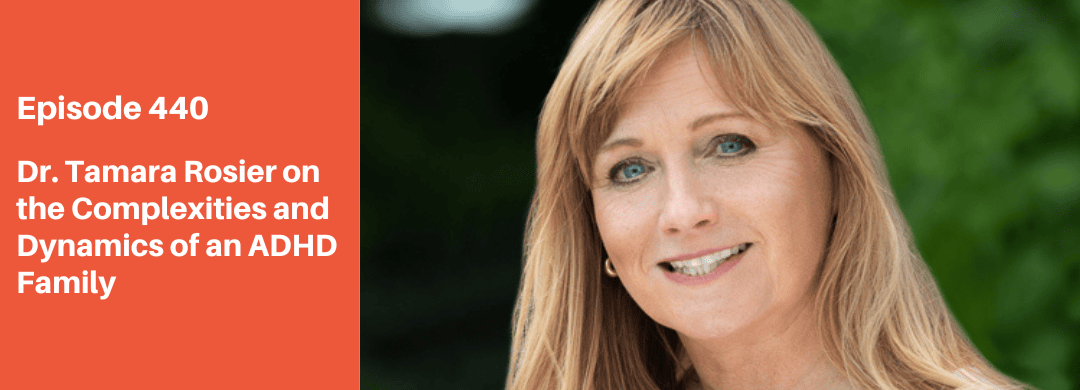
Would you define your family as an ADHD family? Today’s guest, Dr. Tamara Rosier, and the author of the book You, Me, and Our ADHD Family: Practical Steps to Cultivate Healthy Relationships, says that ADHD isn’t an individual experience – it’s a relational one. And the ADHD dynamic affects the entire family system. I know many listeners would identify as members of an ADHD family and so I’m excited to share this conversation and Tamara’s work with you.
In our conversation, Tamara shared her personal and professional insights on what it really means to live in an ADHD family, from the emotional rollercoasters to the quirky dynamics that might feel familiar to you. We talked about how ADHD deeply affects relationships, communication, and emotional regulation across the whole family system. Tamara offered creative, relatable metaphors that help make sense of ADHD behaviors, and she emphasized the importance of self-awareness and revisiting our own childhoods to parent with more clarity and empathy.
About Dr. Tamara Rosier
 Dr. Tamara Rosier has been a college administrator, a professor, a leadership consultant, a high school teacher, a business owner, and an ADHD coach. Through these varied experiences, she has gained invaluable insights into ADHD and its impact on individuals’ lives. As the founder of the ADHD Center of West Michigan, Dr. Rosier guides a dedicated team of coaches, therapists, and speech pathologists in assisting individuals, parents, and families as they develop a deep understanding of themselves and acquire practical skills to navigate life with ADHD. Her books, Your Brain’s Not Broken and You, Me, and Our ADHD Family, offer practical strategies for addressing the potent emotional dimensions of living with ADHD.
Things you’ll learn from this episode
- The ways in which ADHD affects entire families and how recognizing its inheritable nature can foster deeper understanding across generations
- How emotional processing and dysregulation present unique challenges in ADHD households, making self-reflection and revisiting childhood experiences key to breaking cycles
- Why cultivating self-awareness and compassion is essential for growth and healthier family relationships
- How externalizing ADHD symptoms and using metaphors can help children better understand their experiences
- How strategies like managing one’s “monkeys,” recognizing quirks as non-personal, and understanding proximity to emotional triggers can improve family dynamics
- Why helping kids take responsibility for their emotions is a critical piece of helping ADHD families thrive
Resources mentioned
- You, Me, and Our ADHD Family: Practical Steps to Cultivate Healthy Relationships by Dr. Tamara Rosier
- Your Brain’s Not Broken: Strategies for Navigating Your Emotions and Life with ADHD (A Playbook for Neurodivergent Men and Women with Tools for Coping with ADHD) by Dr. Tamara Rosier
- The ADHD Center of Western Michigan (Tamara’s organization)
Want to go deeper?

There’s something here for everyone, whether you’re a sit back and absorb learner, a hands-on, connect and engage learner, and everything in between. Join the Differently Wired Club and get unstuck, ditch the overwhelm, and find confidence, connection, and JOY in parenting your differently wired child.
Learn more about the Differently Wired Club
Episode Transcript
Debbie:
Hey Tamara, welcome to the podcast.
Dr. Tamara Rosier:
Hi, it’s great to be here. Thanks for having me.
Debbie:
It is, of course. I’m really looking forward to getting into your work. You are such a strong voice out there in the ADHD space and supporting families and ADHD adults. And your new book came across my radar and I just thought I had to bring you onto the show. So I’m going to mention the name of the book now because often I like to dive in and 40 minutes later I’m like, I forgot to mention it. So let me do that. And then I’d love if you could introduce yourself as well in your own words. But the book we’re talking about today came out last fall. It’s called You, Me, and Our ADHD Family, Practical Steps to Cultivate Healthy Relationships. And yeah, I would love it if you could kind of talk to us a little bit about your personal why in this space and how you got into being this leader in the ADHD conversation.
Dr. Tamara Rosier:
Yeah, well, let’s start. So you, me and our ADHD family is my second book. And my first book is Your Brain’s Not Broken. And I had been an ADHD coach for a little bit. And I wrote the first book, Your Brain’s Not Broken, to all those people who are just so tired and frustrated. They didn’t know they had ADHD and they’re just like sludging through life. And I just wanted to give them hope. Your brain’s not broken. You’re OK. You’re OK. And sure, having ADHD. Yeah, that’s a handful. It’s not great. I’m just going to be really honest. I’m not one of the people who says it’s my superpower. I think you have to be very privileged to be able to say those words. But for the rest of us mere mortals, it does cause us to walk with a limp. But I wanted people to know it’s OK. You can have hope. So I wrote that book and then I started working a lot with families and I’m realizing that families are limping along because we don’t do ADHD in isolation. There’s a whole environment there. And so I wrote the second book to try to give hope to families. And so you mean our ADHD family isn’t a parenting book? So I want your listeners just to be, it’s people who happen to have family and are affected by ADHD. How do you live in a healthy way yourself and have healthy relationships? And so that’s how I positioned the book. Yeah, I care deeply about the clients I’ll never meet. And so I write to them.
Debbie:
Yeah, that’s great. Well, thank you for that. And so much in your book too, even though it is focused on ADHD specifically, I think just for listeners, as we set the tone for this conversation, there’s a lot in there that’s applicable to just kind of neurospicy families, just navigating all the different dynamics that might be going on. But would you take a few minutes to describe in more detail or define perhaps an ADHD family because you talk about how it affects entire families and not just individuals. Say more about that.
Dr. Tamara Rosier:
Yeah. Well, first of all, whenever there’s one ADHD person, look for more because ADHD is highly inheritable. Highly. So, you know, I work with parents who are like, yeah, we don’t know where this ADHD came up. You know, we’re doing fine in life. But if I probe a little bit, can see and hear that the parents actually had different life circumstances, for whatever reasons, they were able to manage differently than their son or daughter. But they do have ADHD. In my case, I can trace my ADHD back at least to my great grandfather. But I can kind of see the thought. And I had two grandfathers with ADHD. And I had two parents with ADHD. And think of the drunken goat rodeo that can be. So here’s why. When you have ADHD in the family, it’s so hard. First of all, those of us with ADHD, we have challenges managing our emotions. And the reason why, I know this isn’t news to you, but the reason why we have difficulty challenging emotions is because our brains work differently. So when I take in information, I first take in information, not through my prefrontal cortex, I tend to take it in a different place and then go, Well, what does this mean? Emotionally, what is this saying about me? And so I’m processing information emotionally first. Now I can think logically, but I’m going to process it emotionally. So this means that let’s say we are in the same house together and you’re like, Tamara, will you take out the trash? And I might go, for crying out loud, I was going to do it until you asked. And now I’m just tired of you asking. I have this emotional response, right?
And I write about this in the book, you know, I manage my ADHD really well during the day with my clients. I’m like, yeah, I’m kind of nailing life. And I come home, hang up my coat, and my husband says something and it might slip out of my mouth like, well, that’s a really dumb idea, right? Because I’ve been a grownup all day and I forgot to use my grownup skills. And I’m just responding in my ADHD fashion of, yeah, that’s stupid, right? Now he also has ADHD. And so now we have two emotional responses. Okay. So another problem in neuro-spicy families is a short attention span. I didn’t say that correctly. Short term memory issue. And short term memory issues, you know, I was just explaining this to a new client today. I have difficulty thinking three minutes ahead. I didn’t understand how neurotypical people can think three hours ahead, if not further. I still think it’s a source of witchcraft or something. Like how can you think this far ahead? And it used to mystify me. And finally, I just realized it’s because of my short-term memory limitations. So those of us with ADHD, we truly do have short-term memory limitations. But guess what? Those people in my family who don’t have ADHD find it exhausting. Let me give you a quick example.
And my daughter was very gracious about this, but my daughter’s living with us for her first year in grad school. And I was with a client in my office. She was in her bedroom slash office. And I realized, no, I forgot my cord downstairs. I’m with a client. The batteries say, hey, you’re going to die soon unless you plug me in. So I just text her, say, hey, can you bring up my battery pack or my plug? And so she runs downstairs. And you know, I imagine her thinking, what are you going to do when I move out? Why are you always leaning on me? Now, she’s an incredibly wonderful, gracious person. And when I say things like that, she’s like, no, I don’t really think that. But that’s just because she’s super nice. Right. What if you’re not living with someone who’s super nice? They’re like, for crying out loud, will you please stop doing this? It is because I did not anticipate my battery dying. Now, for those of you who are neurotypical, you’re like, well, that’s an easy thing to anticipate. Sure, but not if you have a three minute, if you can see three minutes. So for me, it’s like driving in fog, right? I don’t have a clear view. And I’m saying this because that’s very irritating to live with if you’re neurotypical. You’re like, why couldn’t you predict that? And the research shows we really can’t predict it. Research is kind of depressing on this one. So that’s something that also makes it difficult. Some of us with ADHD are legitimately time blind. Meaning, yeah, I have a PhD, I can do statistics, but me trying to figure out what time to leave the house, that’s another kind of witchcraft area where I’m like, I need to cast a spell, how do people know this? Right? And I literally don’t feel the passing of time. Well, that’s hard to live with if you don’t have ADHD, or it’s hard to live with when you do have ADHD, right? So let’s say we’re all ADHD. We’re all showing up at church really late, hoping everyone’s shoes are on, right?
Debbie:
And, raising kids who may or may not be ADHD or, know, in this audience are neurodivergent in some way. it is, you know, you can just imagine how challenging it could be to get through just kind of your typical day, getting out the door to go to school, you know, all, all of those things. And I actually want to go back a little bit. You said that you can trace it back to your great, great grandfather. I mean, that’s pretty amazing. And, you know, we know that this does run in families. There’s also so many listeners who’ve discovered their ADHD as an adult because of who their kids are, and they’re really starting to connect all the dots. I’m sure that you work with a lot of those clients. And so can you talk a little bit about the importance of parents doing their own work? You know, maybe it’s reparenting themselves in order to be able to kind of break cycles or really show up for their kids in a way that would be more affirming and supportive.
Dr. Tamara Rosier:
I love this question. Thank you. Thank you for asking this. Because here’s what I work with. And this is, I work with parents a lot. They get so angry at their kids. And I said, why are you so angry? Yesterday I had this conversation. Why are you so angry? Well, I just, I see this and this is going to lead to this behavior and this and this and this. And I said, do you have those behaviors? And the dad started crying. He’s like, I do, and I don’t want my son to have these behaviors. I see the worst in my son. And all of a sudden his anger melted away and we were talking about fear. And so, by the way, this tends to follow gender lines. So moms tend to have more fear about their daughters raising daughters, ADHD daughters. Dads tend to have more fear around raising their sons. like dads are like, a lot of dads have said to me, I have no idea how he’s going to turn out to be a man. Like, I have no idea how I’m going to make this lump who won’t leave the basement into a man.
And so there’s a lot of fear there. And so when I work with parents, I really want them to be honest. You’re afraid, especially if this is your first kid. I talk about the first pancake. Like if you ever make pancakes, you don’t know how the first one’s gonna turn out. Is it too hot? Is it too cold? Do I have enough butter in there? Like you don’t know how your first pancake’s gonna turn out. And so we just have to admit we’re afraid. We don’t know how this is going to turn out. And first pancake means first child, right? So I didn’t know if I was that clear. I didn’t want to listen to her going, OK, wait, why is she talking about pancakes all of a sudden? Why am I hungry? So when we first want to really work through, know, let’s work, be honest with the fear. And when we’re honest with the fear, then it melts away our anger and frustration. And then I really say, let’s partner with a kid. So if ADHD is highly heritable, inheritable, then let’s treat it like, hey, buddy, you and I, we’ve got monkey brains. So let’s figure out how to work together. And hey, you know what? I have kind of the same thing going on here. Or you could say, you know what? My brain works slightly differently. Can you tell me more about that? And so instead of working against your child, you’re joining arms going, you’re not alone. Let’s work together. Let’s problem solve together. Well, it doesn’t mean tiptoeing around your child’s triggers. I do not condone that ever. It means helping the child problem solve and be a fellow problem solver. And well, you read the book, so you know that’s a big thing I talk about.
Debbie:
So just before we move into some of the other content that you share in the book, can you just spend a moment talking about any work you think it’s important for parents to do as well in terms of maybe revisiting the childhood that they had and maybe how their ADHD symptoms and the way they showed up may not have been met with understanding. Maybe they grew up feeling like they were a massive screw up, the bad kid, all those things. And of course, we want to show up differently for our kids. What do you recommend parents do?
Dr. Tamara Rosier:
Yeah, really, so before the break we talked about, admit that you’re afraid. Admit that you’ve never done this before, that you’re afraid. Admit that it really takes you off to see your worst character, what you believe are your worst characteristics in your progeny. That’s just something special that just really irks you. Just admit those things. But then the next step is to go back. What is it that you’re really hating about yourself? And I don’t call it re-parenting. just, I want people to go back. And a lot of times people think parent coaching is about fixing their kid. It’s really about exposing the shame in the parent. So now remember shame is just insidious. Shames like, you know, my parents never asked me, so I’m not asking my kid. You know, my parents just sent me off to college, especially like Gen Xers love saying that kind of stuff. Right. And so, you know, no one did this for me. And I say, well, what if they would have? How would that have felt? Would that have been good for you? And so what can you do differently to see yourself differently?
So I’m going to get real vulnerable and then regret it later, okay? I see myself as a screw up and people don’t understand how hard I am on myself. Well, if you think about my story, I was, I am a Gen Xer. So that’s before ADHD was prevalent in girls, right? Even though it was there. I had two ADHD parents who fought, who were emotionally unwell, right? Because they didn’t have ADHD managed. And I grew up in chaos. They eventually divorced. So I just had this chaos and I grew to believe that it was all up to me. If I was going to do anything, it was all up to me. But that means all the pressure I had no one to work with. It was only me. I had to unlearn that belief as an adult. So when I coach parents, I asked them, what belief do we need to unravel? Now, people can’t answer that question because you can’t go, hey, I believe that everything’s on my shoulders. I had to do work to get there. But through coaching, I had to unravel that belief. So a lot of times when people say, reparenting themselves, they’re really talking about finding those hidden false beliefs about yourself. And how do we grow out of it? You can change beliefs. And I’m in the business of changing beliefs, right?
So anytime I want to go back to, wow, Tamara’s a screw up, I’m like, no, let’s trace this back. I’m a screw up because I thought it was all on me. And so I take responsibility for everything. Right? There was a point in my life you could convince me the problems of the Middle East were my fault. Right? And I’m positive there’s a parent out there with a similar experience. But yeah, that checks out. Not about me causing Middle Eastern problems, but about them being blamed for everything. Do you see how I built this all up? So I had to learn to parent myself differently and I treat myself very differently. The other thing I want parents to do is I want them to go back and high five their younger selves. And I do this a lot with my clients. I’m like, all right, so let’s imagine, and I’ll use myself as an example, 10 year old Tamara. She’s a tomboy, she’s throwing dolls up in the trees so that she could go rescue them. I wanted to be a paramedic and or a stunt woman because you know, duh. And so you know, what would you say to 12 year or 10 year old Tamara? And I’d say you know what we turned out OK kiddo. We turned out OK. We did it. It was a hard journey, but we did it. And then it flashed forward. I usually find out when the hardest time was in this person’s life. For me it was 12. I had to make some very grown up decisions I wasn’t old enough to make. What would you tell your 12 year old self? Well, you know what I’d tell her? I’m walking with you. It’s okay. You’re not alone anymore. You see, we go back through and talk to ourselves at different times. Parents can experience deep healing that way.
Debbie:
Yeah, absolutely. Thank you so much, first of all, for sharing and being vulnerable in that way. I think that to me is where the most powerful transformations can happen when we’re, when we’re willing to do that work. And I think that is how we really do kind of break those cycles and be part of the bigger paradigm shift. And I just wanted to see if I can connect the dots here because you were talking about going back and you know, having a conversation with that younger part of you. That’s something I do, that my therapist has been working with me in doing through the Internal Family Systems modality. so as you were just explaining that, I’m thinking about internal family systems. And then that also came up for me as I was reading your chapter on monkeys, which I love. And I would like you to talk a little bit about it, but just this idea that there are lots of different aspects to who we are. with that really awkward segue, could you tell us about monkeys in the work that you do?
Dr. Tamara Rosier:
That wasn’t awkward at all because I’m a huge fan of IFS. Now I’m a coach, I don’t do therapy, but you can apply the theory differently, right? So the monkey chapter is called Monkey Malarkey. And something I was noticing, I started this first with my younger clients and I was noticing my clients would talk about my ADHD, my ADHD. And it was just this big bunch of we don’t know what. And parents would go, you’re ADHD, you’re ADHD. I’m like, well, that’s not fair because we don’t know what to work on. And so I took the symptoms of monkeys and divided it, divided, gave each symptom a monkey and then named that monkey. And so I started to work with kiddos and I had a big basket of monkeys with name tags. And so we’d talk, we’d pull it out of the basket. I’m like, here’s disorganized Derek. Do you think disorganized Derek lives in your head? And we have to only choose five of the monkeys that show up the most. And, you know, we talk about, well, no, I’m not that disorganized. Meanwhile, mom’s like, but where’s your homework? Is that disorganization? Yeah, I am disorganized. And so it’s helping the client understand, yeah, I have that monkey, right? So we go through them. Others are like emotional Emma, avoiding Andrew, a timeline Timmy, whoops, there’s mine, critical Kelvin. Critical Kelvin’s a little jerk. He pops up on my shoulder a lot to talk to me.
Now we talk about it, so we break it down and we talk about them. And then I say to the kiddos, hey, here’s a rule. These are your monkeys, man. You can’t shoot them. You can’t poison them. One kid said, maybe I can poison them. I’m like, no, we’re not going to poison them. They’re yours to care for. So how are we going to care for it? Because all these monkeys in their weird way, and there’s anxious Amy, right? She’ll pop up and go, oh no, oh no, right? All these monkeys in a way think they’re trying to help you. So we go through and ask, how do you think the monkeys are helping you? Well, disorganized Derek, he thinks he’s saving me time. He’s like, we don’t need to do that. Let’s just shove it in the bottom of our backpack, right? You know, avoiding Andy, like he’s like, hey, listen, there’s a lot better things we can be doing right now. And so the monkeys think they’re helping. So let’s thank them for helping. But because you’re not the monkey, let’s redirect that. So let’s help them.
And by the way, we would line up the monkeys with our name tags and take a picture so that parents can be inquisitive. Like, hey, which monkey do you think is talking right now? Right? So one day I was working with this wonderful priest and he said, what’s that basket of monkeys for? And I brought out the monkeys and I lined them up and I went through the exercise with him. He loved the exercise. And he’s like, well, this makes more sense to me than just trying to manage my ADHD, because what is that? And so he would work on, you know, of course he’s ADHD. He’s like, I found 50 more monkeys. I’m like, okay, cool. They are not legion. We are not trying to cast them out. We can only work with a few at a time. And so we worked on monkey management with him. And after that, I thought, hey, I wonder if adults would get anything out of this.
And then I started using it with adults. It meant a lot to adults. So it’s my way of helping people manage their ADHD to kind of focus on one symptom at a time and not focus on all of them all the time. And to hear the voice, right? And the other last little bit about the monkeys is the monkeys talk to each other and they gang up on you. An example of my life is. I think I even wrote about this in the second book. After my first book came out, I regretted being vulnerable, right? I’m like, Tamara, too much has been said. And H.S.A.B. pops up like, we agree, and this is too scary. Maybe you could call the publisher and have her just like not sell the book. I mean, this is when they’re already printed, delivered to stores. And H.S.A.B. wasn’t real, but you know, she’s really like trying to help me any way she can. And I’m like, that doesn’t work, that doesn’t work. And I’m like, and I took a breath of my anxious Amy. I know you’re trying to help me, but I don’t think there’s a way out of this. And she’s like, there’s gotta be. So out pops, you know, my little friend, critical Calvin, he’s just like, tis, tis, tis, you have done a bad thing here. And I hope you learn from this. I hope you learn, stop being vulnerable. And I’m like, I know, Calvin. And you see how like, Overwhelmed Oscar shows up and he’s like, yeah, mistakes have been made. Let’s just go take a nap. Like you hear all the voices. And so then something we do with clients is help them to manage the voices.
Debbie:
I love that. Thanks for those examples. And I think it is so powerful to externalize that and in a non-judgmental way. And again, recognizing that you’re trying to help. get it. So you’re not banishing me, because you can’t. You can’t banish the monkeys. So I think having that kind of uneasy alliance with them or relationship with them is part of the deal. There were two things that I wanted to just make sure that we mentioned because I think they play a big role in the family dynamic of an ADHD family. And maybe in talking about them, we could share a strategy or two or a reframe that parents can think about. The two things are in their huge buckets. So you don’t have to go into detail with them. But you mentioned earlier, emotional dysregulation. And I just want to say that that is something I think that, same with executive function challenges, like people forget about that when really it’s the biggest thing, right? It is, I think it’s the biggest thing. And then you also talk about rejection sensitive dysphoria, and you know, which is something our family absolutely, you know, deals with. And we’ve talked a lot about on the show. And, but the way you wrote about that in the context of a family dynamic was really interesting to me, something I hadn’t considered. I’ve always thought about it and like, from an outsiders perception or that kind of thing. So maybe kind of pick one of those and talk about the challenges that that presents in a family and how do we begin to navigate it in a way so it can feel better.
Dr. Tamara Rosier:
So before I start, I’m just, this is the disclaimer. I was a former English teacher. So no one can beat metaphors to death like a former English teacher. So I know we just did a monkey metaphor, but now I’m going to give you a different metaphor. Okay? And you know where I’m going. I’m going to the pool. I teach families about the pool. And what happens is, let’s say we have a child, the child freaks out in the middle of Michael’s, right? True story that happened. And the pair’s like, my goodness, how did we get here? And it’s just, everyone’s overwhelmed. Well, instead of interacting at that moment, we have to interact at different moments. And so that’s why the metaphor is helpful. So if you imagine the pool, the pool is full of your biggest emotions. And they could be big happy emotions or big angry emotions. Big sad emotions, whatever, they’re the biggest of the big and they swim in the pool. Okay, they don’t swim in the pool, it is the pool.
So what we don’t know when we have ADHD all the time is the proximity we have to the pool. And so unlike people who are neurotypical, we can accidentally fall into the pool. Neurotypical people tend to have a fence around the pool. tend to even have a lifeguard on duty. Like I don’t know how much they pay that guy, but I would, but I don’t have a lifeguard on duty. And so there’s some times I accidentally fall into my own pool and I’m like, how does this even happen? Right? And so what we want to do is work on proximity, understanding proximity to the pool. Now, when I work with families, we either use Legos, we use Barbies, we use whatever toys they have, they bring it. I talk with the parents ahead of time. And we talk about the proximity to the pool.
So what happens is we don’t want the child to fall into the pool, but when the child is in the pool, and by the way, parents fall into the pool too, right? Sometimes the child’s in the pool, we’re like, cannonball, we just jump in right in there too. That’s not great. We’ll deal with that later. But we don’t wanna deal with it when a child’s in the pool. When the child is in the pool, that child is not able to reason or respond accordingly. So your goal is if your child is in the pool to get them to a safe place where they won’t harm themselves or other people, right? And then afterwards, we can talk with them. So if they do land in the pool, that’s not the time to reason. All reasoning is gone, right? And we know that they’re emotionally flooded. So I help families and kids understand when they’re getting close to the pool. I help kids and I have worked with a lot of genius parents who just kind of pick up what we’ve done and run with it who helped their kids have ways of getting out of their pool. Right once you’re in the pool you’re responsible to get yourself out of the pool. One genius mom made a whole basket full of life preservers. And the daughter could choose one of the life preservers to look at and go, I do, I want to crawl under the piano right now. That’s what I’m going to do. And she would crawl under the piano and she could come out when she’s out of the pool. So we talk with kids ahead of time. How can you get yourself out of the pool? And we create things that they can do and reminders because they’re going to forget.
Well, after they get out of the pool, that’s when the pool stories come in. That’s when we talk about, hey, let’s go over the pool story. So what happened? How did you get in the pool? Huh. Was there a way to avoid the pool? Did you have to fall in? No shame. Just what were your options? How did you get yourself out of the pool? Did that work for you? Notice I’m only asking questions. I’m not lecturing. Parents love to lecture and tell their kids what they should be thinking. I can tell you 100 % of the time, it never works. At least not the way you think it works, right? Only ask questions. Now some parents are like, well, he still deserves a punishment. I like to frame it as, right, so this all happened, but you splashed a lot of people, dragged people in the pool. So how do we make this right? So instead of me giving the punishment, I’m saying, how are you going to make this right? Because you did things. Now some parents still want to punish, and I say, go ahead and punish them. The ADHD brain’s not gonna learn from that, but it might make you feel better.
Debbie:
Thank you for walking us through that metaphor. I loved it so much. I’ve written quite a bit about my own personal challenges of not jumping into the metaphorical pool when my child is emotionally dysregulated. And that’s something I worked so hard on. And so I just love the way you kind of played this out. love all the little tools that you can use for getting the life wraps or to get out of the pool. I think that’s so powerful. So this whole metaphor is totally working for me. And one of the things that you said that kids have to be responsible for getting themselves out of the pool and you do write, I think it was in your common emotional missteps chapter, you say that parents sometimes inadvertently encourage their child’s emotional errors. Is that what you’re talking about here?
Dr. Tamara Rosier:
Sort of, yeah. So sometimes very loving parents, they’re doing all of this out of love. But when we don’t allow other people to take responsibility for what they’re feeling, we’re really doing them a disservice. And that’s for everyone in the whole family, right? I used to take responsibility for how my husband felt. That worked for him. It didn’t work for me. It took me years to figure that out, right? And that wasn’t his fault, that was mine. So we need to be careful to let people own their emotions and behaviors. So something we want to teach our kids is we name emotions, but it’s like, one child I worked with, it’s like if a butterfly lands on your hand and you’re like, you’re a butterfly. What do you want to tell me before you fly off? Again, beating up metaphors since 1968. So that’s a way to do this. So imagine the emotional butterfly landing on your head. You’re like, oh, hi, oh, I’m sad. Butterfly, what do you want to tell me before you fly away? So we’re not going to hold onto the butterfly. We’re not going to try to keep it in a cage. We’re not going to feed it we’re just going to let it flutter away because that’s what butterflies could do. And that’s how emotions can be very transient, right? That’s why we want to encourage our kids. We name it, but then we can also release it. Sometimes the butterfly sits on your hand for a while. Doesn’t mean it’s bad. It just means sometimes it’s there.
Debbie:
Yeah, that’s great. One more question, and then we’re gonna wrap up. I did wanna just touch upon the quirks. You shared the 10 quirks you most commonly see in families that you work with with ADHD. I was like recognizing so many of these, and one of them being starting a conversation without context is just like, you know, that’s just how we roll. Could you share one of those quirks that’s maybe, I don’t know, the most common that you see and how you recommend families kind of reconcile or be with that quirk?
Dr. Tamara Rosier:
Oh, I didn’t even know I was going to write that chapter. I have one daughter who’s neurotypical. OK, she’s taught she’s taught me so much because I’m like, oh, is that how people think who don’t have ADHD? Intriguing. I was writing at the dining room table and she was doing some work at the dining room table, too. And my husband came over and I said, and I’m starting to talk to him about an issue. He looks at me and he starts to talk to me and then shuts his mouth and just turns and walks away. And I look at my daughter, like, well, that was weird. What’s happening there? And she looked at me and this shocked me. She goes, mom, both of you guys do that. I’m like. No, no, no, I’m an ADHD professional. I’m sure that I’m more aware of myself than this. And she’s like, you did it yesterday. I’m like, holy cow. And she’s saying this in a generous way, not criticizing me, but it was shocking. So in the past, I didn’t realize this, but in the past I would be kind of low key irritated. Okay, I have ADHD, my husband’s irritated, of irritated me, but he has ADHD. So instead of being irritated, instead of nursing that thought, I said, hey, we were talking earlier about this and you walked away. Can you tell me what that’s about? And he literally had to think for a while. I’m like, you were standing here, I was standing here, I’m reconstructing it all. And he’s like, huh. Oh, the pool filter was on and I had to go turn it off before I forgot.
That was such an eye-opening experience to me, because I could have made that about me. And so when we have these quirks, and we have quirks, a great rule is this isn’t about me. That his quirk is not about me. He wasn’t saying, I reject you, Tamara, and I reject everything you stand for. And even though we’ve been married for a long time, nothing’s about me. He forgot the pool filter and just walked away. I’m still shocked that I do it though. I’m not gonna lie. Yes, yeah, am a professional.
Just one last quick thing. I have a psychologist friend who is an ADHD expert and she read my new book. She’s like, Tamara, I didn’t realize I should be asking my husband questions about what he’s interested in. And his her husband was standing right next to her and he said, is that why you were asking me about football? I said yes I’m just trying to be interested in you. He’s another quirk that we just sit and talk about ourselves. So we’re quirky, we’re really quirky.
Debbie:
That’s awesome. I think we should wrap up, but I just wanna, I’m gonna mention the name of the book again because really, I found it a really enjoyable read with lots of metaphors, lots of anecdotes. It just felt very relatable. So if you are listening to this and you, consider yourself an ADHD family. You will absolutely get a lot out of this book. It’s called You, Me, and Our ADHD Family, Practical Steps to Cultivate Healthy Relationships. And Tamara, is there anywhere in particular that you want people to connect with you?
Dr. Tamara Rosier:
I can be reached. My author’s website is tamararosier.com. The center that I founded is miadhd.com.
Debbie:
Okay. And listeners, as always, I will have links to those resources and everything else we talked about as well as Tamara’s book in the show notes page. So definitely check that out. Share this episode if you got a lot out of it with other ADHD family friends. And Tamara, thank you so much. This was such a pleasure to connect.
Dr. Tamara Rosier:
I love your questions, you are so thoughtful. So thank you for having me.
Do you have an idea for an upcoming episode? Please share your idea in my Suggestion Box.